


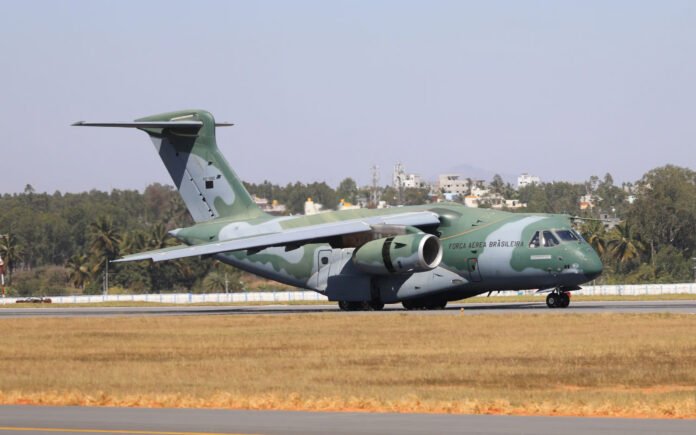
The Brazilian aerospace company Embraer in partnership with Mahindra Group is competing for an Indian Air Force programme to acquire 60 medium transport aircraft, a potential contract valued at about ₹1 lakh crore. Embraer’s proposal pairs the C-390 Millennium with plans for local assembly and a broader Indian supply chain, positioning the bid as both an aircraft sale and an industrial partnership. The estimate of 500 aircraft across Asia over 20 years is Embraer’s projection, not a confirmed regional order pipeline.
Embraer Defense & Security chief executive Bosco da Costa Junior told media that the company did not view India simply as a market for the initial order. He said Asia accounts for 40-45% of the addressable market for aircraft in this class, which Embraer translates into demand for roughly 500 planes over the next 20 years. The company hopes production in India could serve customers beyond the Indian military.

The immediate contest is the IAF’s Medium Transport Aircraft programme. India has invited bids through five domestic companies, which are expected to partner with international aircraft makers. Under the programme’s reported terms, the selected supplier would deliver the first 12 aircraft in fly-away condition and manufacture the remaining 48 in India. Locally built aircraft must have at least 40% indigenous content, while the contract is to be completed within 11 years. The bid deadline is January 13.
Embraer and Mahindra have identified Nagpur as the potential site for a final assembly line, subject to the C-390 being selected and an Indian order being placed. Their announcement describes preparations for aircraft assembly, systems integration, manufacturing engineering and development of local suppliers. The companies have also discussed maintenance, repair and overhaul capabilities in India. No production line is yet assured: the plans depend on the outcome of the procurement.
The C-390 is a twin-engine jet transport designed for cargo and troop carriage, airdrops, medical evacuation, search and rescue, firefighting and humanitarian operations. Embraer lists a maximum payload of 26 tonnes and says the aircraft can use temporary or unpaved runways. Those features are central to the company’s pitch for a modern, multi-mission platform, though the IAF’s evaluation will also turn on operational suitability, cost, delivery terms and performance against its requirements.
The aircraft has gained international customers, providing Embraer with a growing export profile. Sweden ordered four in 2025, with options included in the procurement framework, while the Netherlands and Austria have placed a joint order for nine. The platform has entered service with Brazil, Portugal and Hungary, according to Embraer. Such selections offer potential customers evidence of an expanding operator base, but do not guarantee that India or other Asian countries will choose the aircraft.

The principal rival in India is Lockheed Martin’s C-130J Super Hercules, offered in collaboration with Tata Advanced Systems, which already builds components for the aircraft in India. The IAF operates 12 C-130Js, a fleet used for missions including support to forward deployments in Ladakh. Existing experience and local industrial links give the rival bid a strong foothold, while Embraer is emphasising production scale and exports.
For India, the contest tests whether a major military aircraft procurement can deliver both new capability and substantial domestic manufacturing. For Embraer and Mahindra, an Indian contract would provide a launch customer for the proposed Nagpur facility and a platform from which to pursue regional sales. The wider 500-aircraft figure gives the proposal an ambitious commercial rationale, but remains a market forecast; the first decisive milestone is winning the IAF competition.








