


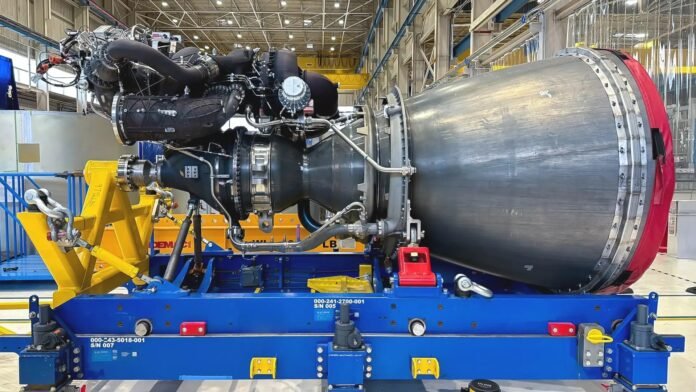
Northstar burns liquid oxygen and liquefied natural gas, the same propellant combination used by Blue Origin’s BE-4 engine. The company says the new engine produces 715,000 pounds-force of thrust, compared with 640,000 pounds-force for the BE-4, while reducing mass by 30% and parts count by 50%. The announcement was made on November 5.
The company says more than 65% of Northstar is produced using additive manufacturing, a method that builds components layer by layer. Blue Origin says this approach allows parts to be combined or eliminated, helping to simplify the engine and reduce its mass. It also says assembly can be completed in less than a day, although it did not provide a direct comparison with BE-4 assembly time.

Northstar is designed as a reusable, oxygen-rich staged-combustion booster engine. Blue Origin says it retains the single-shaft turbopump architecture and combustion cycle used in its propulsion development. The company reports that it moved the programme from approval to development testing in 11 months. It has not announced a first flight date or said which New Glenn configuration will use the engine.
That qualification matters because Northstar is an announcement about development, not a report of an engine already flying. The company has not published test results in its announcement that would show how Northstar performs in operation, how often it can be reused or how its production pace compares with the existing engine under routine conditions. The headline specifications are therefore manufacturer-reported targets and characteristics, not a record of service performance.
The engine’s predecessor, BE-4, is already central to Blue Origin’s launch business. Seven BE-4s power the first stage of the standard New Glenn rocket, and two more power the first stage of United Launch Alliance’s Vulcan launch vehicle. Blue Origin lists BE-4’s thrust at 640,000 pounds-force and identifies liquid oxygen and liquefied natural gas as its propellants.
New Glenn’s standard configuration pairs its seven-engine booster with a second stage powered by two BE-3U engines. The rocket is designed to recover and reuse its first stage. Blue Origin says the booster is designed for a minimum of 25 flights, a goal that makes engine durability and turnaround time particularly important to the vehicle’s operating model.

Northstar’s higher stated thrust could provide more power for future booster operations, while fewer parts and faster assembly could help simplify manufacturing. But those advantages will need to be demonstrated through testing and, eventually, flight. Blue Origin has not said whether Northstar will replace BE-4, supplement it, or be allocated to a specific version of New Glenn. Its announcement describes Northstar as the company’s second booster engine, alongside BE-4.
The announcement also arrived alongside Blue Origin’s unveiling of GS3, a proposed third stage for New Glenn. The company says GS3 is intended to expand the rocket’s ability to deliver payloads to high-energy destinations, including geostationary orbit and lunar or deep-space trajectories. The two announcements point to a broader effort to develop propulsion and vehicle options for missions beyond conventional lower-Earth-orbit launches.

For now, Northstar’s practical impact will depend on information the company has yet to release: its development-test results, planned integration schedule and first-flight timing. The public specifications set out Blue Origin’s case for the engine-more thrust, less mass and fewer parts-but the next milestones will determine how those design claims translate into operational capability.







