


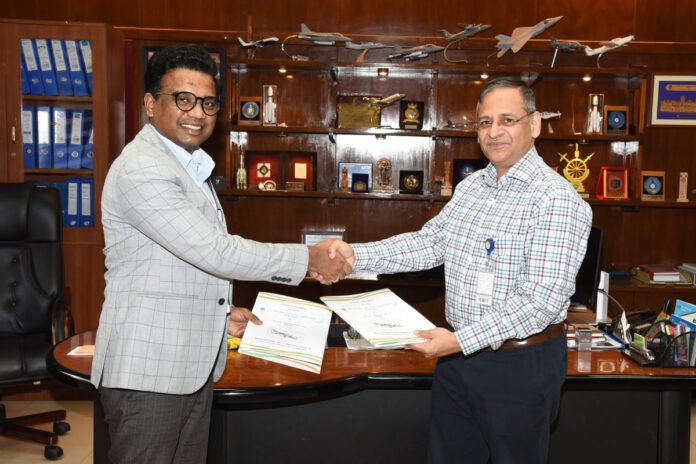
New Delhi: CSIR-National Aerospace Laboratories (CSIR-NAL) has signed a pivotal technology transfer agreement with Chennai-based KRR Aerospace Pvt. Ltd. to enable the mass production of the QPlane, India’s indigenous all-electric Vertical Take-off and Landing (eVTOL) unmanned aerial vehicle.
This collaboration marks a significant stride towards self-reliance in UAV technology, aligning seamlessly with the nation’s “Make in India” initiative.

The QPlane, developed by CSIR-NAL, stands out for its lightweight composite structure, which delivers exceptional strength-to-weight efficiency. Designed for rapid, autonomous operations, it boasts a 20 km operational range, making it ideal for diverse applications including defence surveillance, agricultural monitoring, and logistics delivery.
Under the agreement, KRR Aerospace gains full rights to manufacture and commercialise the QPlane. This Chennai firm, already a frontrunner in specialised aerospace manufacturing, will scale up production to meet growing domestic and potential export demands, thereby curtailing India’s dependence on imported drone components.
KRR Aerospace’s expertise complements CSIR-NAL’s innovations perfectly. The company has prior experience collaborating with CSIR-NAL on indigenous aerospace-grade autoclave technology, which has bolstered its capabilities in composite material processing for high-performance UAVs.
This partnership extends KRR Aerospace’s UAV portfolio significantly. Previously focused on advanced manufacturing solutions, the firm now positions itself as a key player in eVTOL systems, leveraging the QPlane’s electric propulsion for eco-friendly, low-noise operations suited to urban and remote environments.

In the defence sector, the QPlane promises versatile roles such as border patrol, reconnaissance, and tactical logistics support. Its vertical take-off and landing capability allows deployment in constrained spaces, enhancing the Indian armed forces’ operational flexibility amid rising regional security challenges.
Agriculture stands to benefit immensely too. Farmers can deploy the QPlane for precision tasks like crop health assessment, pesticide spraying, and soil mapping, promoting efficient resource use and higher yields in India’s vast farmlands.

Logistics applications further underscore the drone’s commercial potential. With its autonomous navigation and extended range, the QPlane can facilitate last-mile deliveries in hard-to-reach areas, supporting e-commerce growth and disaster relief efforts.
The agrement resonates deeply with India’s push for Aatmanirbhar Bharat in defence and aerospace. By indigenising eVTOL production, it fosters job creation, skill development, and technological sovereignty, reducing vulnerabilities tied to foreign supply chains.
CSIR-NAL’s role as a knowledge hub remains central. As a premier research body under the Council of Scientific and Industrial Research, it continues to bridge laboratory breakthroughs with industry-scale manufacturing, exemplified by this transfer.
KRR Aerospace, headquartered in Chennai, brings robust infrastructure to the table. Its facilities, equipped for composite fabrication and assembly, will accelerate QPlane production while adhering to stringent aerospace standards.
Market projections for India’s UAV sector are optimistic. With government incentives and rising demand, this collaboration could capture a substantial share, propelling exports and positioning India as a global UAV manufacturing hub.
Challenges persist, however, including regulatory approvals for beyond-visual-line-of-sight operations and battery technology enhancements for longer endurance. Yet, the partners’ track record suggests these hurdles are surmountable.
This deal also highlights the growing synergy between public research institutions and private enterprises. It sets a precedent for future tech transfers, accelerating innovation in electric aviation and sustainable drone ecosystems.
Ultimately, the CSIR-NAL and KRR Aerospace partnership heralds a new era for Indian UAVs. The QPlane’s rollout promises to transform key sectors, reinforcing national security and economic resilience through homegrown ingenuity.






