


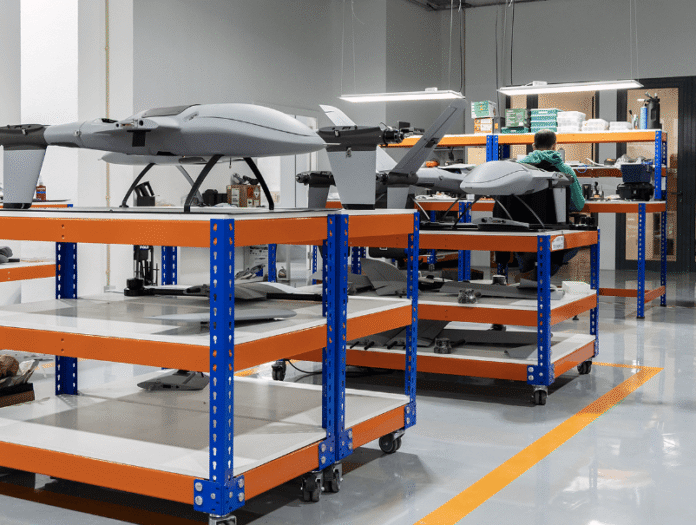
Over the past few years, India has emerged as one of the world’s fastest-growing drone ecosystems. From surveillance missions along sensitive borders to precision agriculture, disaster response, logistics and military reconnaissance, unmanned aerial vehicles (UAVs) are becoming indispensable to both national security and economic development.
Government initiatives such as the Drone Rules 2021, the Production-Linked Incentive (PLI) Scheme, Innovations for Defence Excellence (iDEX) and a rapidly expanding startup ecosystem have accelerated domestic drone manufacturing at an unprecedented pace.

Today, hundreds of Indian companies are designing and assembling UAV platforms for both civilian and defence applications.
Yet beneath this impressive growth lies a structural challenge that receives far less attention.
While India has achieved remarkable success in designing airframes, developing mission software and integrating complete drone platforms, many of the technologies that determine a UAV’s operational performance continue to originate overseas.
High-efficiency propulsion systems, advanced flight-control hardware, semiconductor chips, electro-optical and infrared payloads, specialised sensors and battery cells remain heavily dependent on foreign supply chains.

Consequently, many drones labelled “Made in India” continue to rely on imported components for their most critical functions. This distinction is strategically significant. Manufacturing a drone platform is not synonymous with mastering the technologies that power it.
In an era when geopolitical competition increasingly shapes technology access and global supply chains, dependence on imported subsystems could become a serious vulnerability during future conflicts or major geopolitical crises.

True self-reliance in unmanned systems will therefore require India to move beyond platform assembly and develop a comprehensive domestic ecosystem capable of designing, producing, testing and continuously improving the critical technologies concealed within every UAV.
India’s Drone Revolution: Strong Platforms, Growing Capability
India’s drone industry has undergone a remarkable transformation within a relatively short period.
What was once a niche sector dominated by imports has evolved into a vibrant ecosystem comprising hundreds of startups, established defence manufacturers, research institutions and government-supported innovation programmes.
Companies such as ideaForge have demonstrated India’s ability to produce reliable surveillance drones for defence and homeland security, while Garuda Aerospace has expanded drone applications across agriculture, infrastructure inspection and commercial services.
At the same time, larger defence companies have begun manufacturing advanced UAV platforms through indigenous development and technology partnerships, reflecting the sector’s growing maturity.
Government policy has played a decisive role in enabling this transformation.
Procurement reforms, targeted financial incentives, simplified regulations and initiatives such as iDEX have encouraged startups to move beyond experimentation towards operationally relevant technologies.
Collectively, these measures have significantly expanded India’s manufacturing capacity while creating a competitive domestic market.
As the industry matures, however, the next phase of growth will depend less on increasing the number of assembled drones and more on strengthening the indigenous technological foundation that supports them.
The Hidden Technology Gap
India’s achievements in drone manufacturing are undeniable, but they also conceal a deeper technological reality.
A modern UAV is far more than its airframe or software. Its operational effectiveness depends upon an intricate combination of propulsion systems, flight-control hardware, semiconductor chips, electro-optical payloads, navigation modules and power systems.
While Indian companies have become increasingly proficient at designing aerodynamic structures and integrating complete platforms, many of these critical subsystems continue to be sourced from overseas suppliers.
This dependence creates vulnerabilities that extend well beyond manufacturing costs. Propulsion provides an excellent illustration.
The true measure of self-reliance lies not in assembling drones, but in mastering the technologies within them
High-efficiency brushless direct current (BLDC) motors for tactical drones and specialised heavy-fuel UAV engines remain largely imported, even though propulsion systems account for a substantial proportion of a drone’s overall value.
Similarly, the hardware underpinning many flight controllers—including widely used microcontroller boards—continues to be manufactured abroad, even where Indian engineers have developed customised firmware and mission software.
Advanced semiconductor components, inertial measurement units (IMUs), electro-optical and infrared payloads, thermal-imaging cores and high-performance battery cells also remain heavily dependent on international supply chains.
Why These Dependencies Matter
The strategic implications of these dependencies extend far beyond manufacturing economics.
During peacetime, globally integrated supply chains may appear efficient and cost-effective. However, geopolitical tensions, export controls, sanctions or disruptions to international logistics can rapidly interrupt access to essential components.
In such circumstances, India’s ability to expand drone production during a military emergency could be constrained not by a shortage of engineers or manufacturing capacity, but by the unavailability of imported subsystems.
A drone assembled domestically but dependent upon imported “brains”, “eyes” and “muscles” cannot realistically be regarded as fully strategically autonomous.
From Assembly to Technological Sovereignty
This challenge is not unique to India. Several countries that today lead the global UAV industry initially depended upon imported technologies before systematically investing in domestic research, component manufacturing and specialised industrial ecosystems.
For India, therefore, the next phase of drone development will depend not merely on increasing production volumes, but on progressively replacing critical imported subsystems with indigenous alternatives that can be designed, manufactured, upgraded and sustained within the country.
Building a Complete UAV Ecosystem
Recognising these challenges, the Government of India has already introduced several policy measures to strengthen the domestic drone ecosystem.
The Production-Linked Incentive (PLI) Scheme encourages manufacturers to increase local value addition, while initiatives such as Innovations for Defence Excellence (iDEX) have provided financial support to startups developing advanced defence technologies.
Imported propulsion systems, sensors and semiconductors remain India’s most significant vulnerabilities in unmanned warfare
Restrictions on the import of fully built drones, simplified regulatory procedures through the eGCA platform and tax reforms have further accelerated the industry’s growth.
Collectively, these initiatives have helped transform India into one of the world’s fastest-growing drone markets.
The next phase of self-reliance, however, demands a shift in emphasis. Building additional drone assembly lines alone will not eliminate strategic vulnerabilities if the most critical technologies continue to be sourced from overseas.
The priority must now shift towards developing India’s indigenous component manufacturing ecosystem.
High-efficiency BLDC motors, heavy-fuel UAV engines, secure flight-controller hardware, advanced electro-optical payloads, precision sensors and domestic semiconductor capabilities should become long-term national priorities.
Achieving these objectives will require close collaboration among defence laboratories, private industry, startups, academic institutions and the armed forces to bridge existing technological gaps.
Redefining Indigenous Capability
Equally important is redefining how indigenous capability is measured. A drone should not be regarded as fully indigenous simply because it is assembled within the country.
Greater emphasis must instead be placed on the domestic development of strategically important subsystems that directly influence operational performance, technological resilience and long-term national security.
At the same time, India should invest in specialised testing laboratories, precision manufacturing facilities and component-certification infrastructure capable of supporting a robust domestic supplier base.
Strategic autonomy requires technological sovereignty—not merely manufacturing capacity
Such investments would not only reduce dependence on imports but also improve product reliability, stimulate innovation and enhance the global competitiveness of Indian manufacturers.
Ultimately, technological sovereignty is achieved through sustained ecosystem development rather than isolated manufacturing successes. India’s progress in drone production has created a strong foundation. The next challenge is to ensure that future generations of Indian UAVs are not only designed and assembled domestically but are also powered by indigenous technologies at their core.
Achieving that transformation will demand patient investment, sustained policy support and long-term institutional commitment, but it will substantially strengthen India’s defence preparedness and strategic autonomy.
Beyond the Airframe
India’s drone industry has reached a defining moment in its evolution. The country has successfully built a vibrant ecosystem of innovators, startups and defence manufacturers capable of designing and assembling a wide variety of UAV platforms.
The true measure of self-reliance, however, will not be the number of drones produced, but the extent to which their critical technologies are conceived, developed and sustained within India.
The nations that master critical UAV technologies, rather than simply producing drones, will shape the future of military innovation
As modern warfare increasingly revolves around autonomous systems, resilient supply chains and technological superiority, dependence on imported subsystems could emerge as a significant strategic constraint during future conflicts.
Moving beyond drone assembly therefore requires a broader national vision—one that prioritises indigenous component manufacturing, advanced research and development, secure semiconductor capabilities and stronger collaboration among government, industry, academia and the armed forces.
India has already laid a strong foundation through progressive policy reforms and a rapidly expanding innovation ecosystem. The next phase must focus on mastering the technologies that lie beneath the airframe.
Only then will India evolve from being a successful assembler of drones to becoming a globally competitive developer of sovereign unmanned systems, strengthening both its defence preparedness and long-term technological independence.
In the coming decade, the countries that master critical drone technologies—not merely drone production—will shape the future of military innovation. India has the opportunity to be among them, provided it invests as seriously in the technologies within the platform as in the platform itself.

The writer is an engineering student pursuing a B.E. in Artificial Intelligence and Machine Learning from Pune. His areas of focus include autonomous warfare systems, aerospace innovation, artificial intelligence in defence, and India's evolving national security landscape.





