


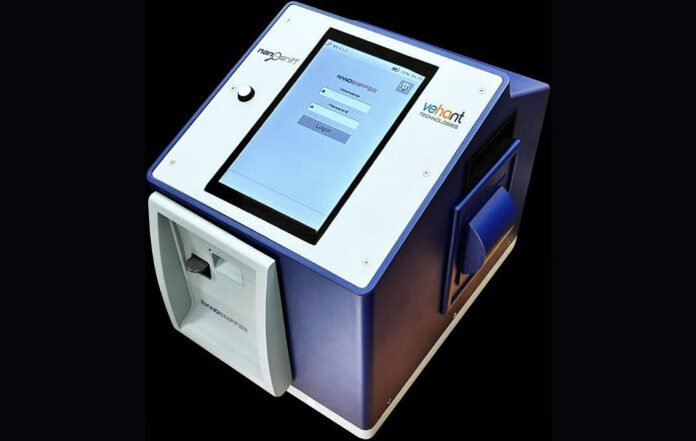
New Delhi: The Airport Authority of India (AAI) will install 232 explosive trace detectors (ETDs) at more than 60 airports across the country. To this effect, AAI has signed a ₹40-crore contract with Vehant Technologies for the supply and maintenance of ETDs.
Marking a crucial upgrade to India’s airport security infrastructure, the deployment list includes key airports Chennai, Kolkata, Pune, Varanasi, Srinagar, Jammu, Amritsar, Port Blair and Coimbatore.

Capable of detecting explosives in under 10 seconds, the microsensor-based ETD significantly strengthens India’s aviation security framework. Earlier, the ETD NanoSniffer had received a trial order for 20 units under the AAI Make-in-India programme in 2023. These units are successfully functioning at seven airports for more than two years.
The NanoSniffer ETD is the world’s first microsensor-based explosive trace detector, capable of identifying trace levels of explosives in under 10 seconds, according to public documentation.
In 2008-2009, the technology originated at the Indian Institute of Technology Bombay (IIT Bombay), backed by funding from the Principal Scientific Adviser’s Office and support from the Ministry of Electronics and Information Technology (MeitY) to establish a dedicated nanoelectronics laboratory.
NanoSniffer was conceived and developed by NanoSniff Technologies, co-founded by Dr Nitin S. Kale and Kapil Bardeja, along with Prof Ramgopal Rao and Prof Soumyo Mukherji. Now operating from the IIT Bombay Research Park, the company entered a technology transfer agreement with Vehant Technologies, which was incubated at IIT Delhi in 2005.

The current AAI order involves deployment across major hubs and regional airports, covering checkpoints, baggage handling systems, cargo and transit areas.
As per Vehant Technologies, the initiative will significantly strengthen India’s explosive detection capabilities while reducing reliance on imported ETD systems.

“NanoSniff has not only developed the ETD system but also its key constituents the MEMS sensor, the underlying science and the detection algorithms. We have worked on this technology with invaluable support from IIT Bombay, IISc Bangalore, DRDO-HEMRL Pune, PSA and MeitY,” said Dr Nitin S. Kale, co-founder of NanoSniff Technologies.
Co-founder and CEO of Vehant Technologies and co-founder of NanoSniff Technologies, Kapil Bardeja, said, “By providing this indigenous deep-tech solution along with lifecycle support, we reaffirm our commitment to enhancing aviation security and advancing the Make-in-India agenda. This innovation was achieved much before the launch of India’s Semiconductor Mission.”






