


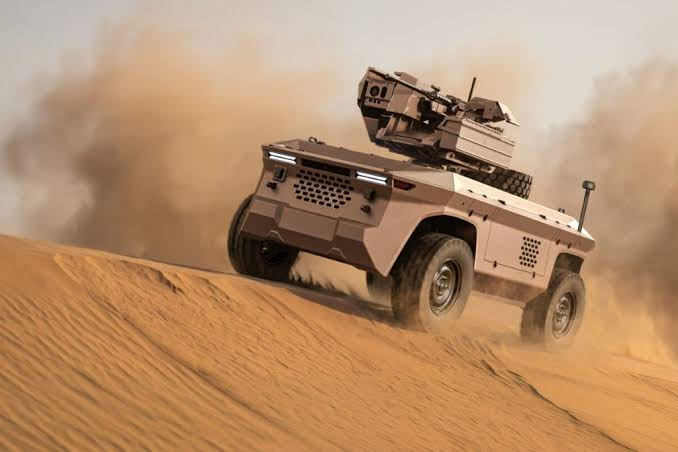
Seraing, Belgium. Renault Group and Belgian defence company John Cockerill have presented Forefront Concept, a modular, remotely operated ground platform designed to carry out missions in high-risk or difficult-to-reach environments. The companies say it combines Renault’s vehicle engineering and manufacturing capabilities with John Cockerill’s defence expertise.
Forefront is an electric vehicle with four-wheel drive, four-wheel steering and two electric motors. Its target range is approximately 400 kilometres, with a range extender available to increase operating distance. The platform is designed to carry a payload of up to one metric ton. The companies describe it as quiet-running and capable of operating off-road across varied terrain.

The proposed military roles include logistics support, intelligence, surveillance and reconnaissance, counter-drone operations, fire support and evacuation. The partners also point to possible civilian applications, including civil protection, logistics and work in hazardous or constrained environments. These are intended uses; the companies have not announced an operational deployment or a customer order.
A central feature of the programme is its planned progression from remote operation toward greater autonomy. John Cockerill is responsible for the teleoperation and autonomy functions, alongside vehicle militarisation, mission-system integration and operational support. The company says its modular systems are intended to enable eventual fully autonomous operation, with safety and security requirements built into development.
Renault designed the vehicle platform, drawing on automotive components and a modular architecture. The automaker says applying design-to-cost and design-for-manufacturing principles from the outset could help reduce development time and support production at scale. It also brings more than 15 years of experience in electrification, including battery and powertrain expertise. The partners’ stated ambition is to develop a platform that can be industrialised rapidly at controlled cost; no production schedule, price or manufacturing volume has been disclosed.
The companies say the concept was developed with input from the French armed forces. It is due to take part in exercises and trials in the coming weeks, where military feedback will be used to refine the vehicle and assess its relevance to operational requirements. The announcement does not specify which units will participate, where the trials will take place, or what performance criteria will be used.

The unveiling comes amid growing European interest in unmanned ground vehicles for support and other dangerous tasks. A European Defence Agency operational experimentation campaign in 2025 tested unmanned systems for military logistics, including resupply and casualty evacuation, under field conditions. The campaign brought together industry, military users and representatives from EU member states to assess how systems performed in practical scenarios – not just on paper.
That experience underscores the distance between a concept’s specifications and its usefulness in service. A vehicle intended for military operations must be assessed for mobility, reliability, communications, mission-system integration and ease of use under realistic conditions. Remote operation also depends on dependable links between vehicle and operator; expanding autonomy raises additional questions about safeguards and the level of human oversight. Forefront’s upcoming trials may help answer some of these questions, but the companies have not yet released trial results.

The project pairs two different industrial strengths: Renault’s experience in designing and producing vehicles, and John Cockerill’s defence and robotics expertise. Whether that combination can deliver an affordable, rugged platform at scale will depend on the test programme, operational feedback and eventual procurement interest. For now, Forefront remains a concept entering evaluation – not a fielded military vehicle.







