


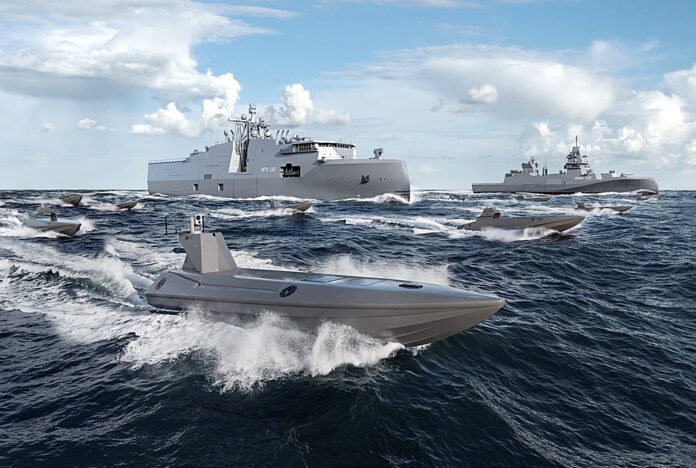
Paris. The 30th edition of Euronaval runs from November 3 to 6, at Paris’s Nord Villepinte, as the maritime defence industry gathers to display equipment and ideas for future naval operations. Organisers say the show has 40% more exhibitors than in 2024; Naval Group describes this year’s edition as bringing together 700 exhibitors, compared with 500 two years ago. The event’s stated theme, “Towards high intensity”, frames an agenda that ranges from autonomous systems and artificial intelligence to electronic warfare, cyber defence and seabed operations.
The exhibition is designed as more than a product showcase. Its programme includes conferences, business-to-business meetings, an awards programme and SEAnnovation, a space dedicated to emerging technology. In 2024, the event welcomed 150 foreign official delegations and held 1,250 business meetings, according to the organiser-figures that underline its role as a venue for procurement discussions as well as public demonstrations.

Thale’s M-Cube, a lightweight dipping sonar and a modular CAPTAS-4 system are designed to help crewed and uncrewed platforms share anti-submarine missions and sensor information
Thales Connects Sensors and Platforms
Thales is foregrounding a “Hybrid Fleet” approach to anti-submarine warfare: connecting crewed ships, helicopters, unmanned vessels and sensors so they can operate as a coordinated network. Its Euronaval announcements centre on three technologies: M-Cube, a mission-management system; a new Lightweight Dipping Sonar; and the CAPTAS-4 Mission Module, which packages variable-depth sonar capability in a deployable format.
M-Cube provides a shared command-and-control environment for planning, tasking and supervising distributed assets. Thales says the system, initially developed for mine warfare, is being extended to anti-submarine warfare, intelligence, surveillance and reconnaissance and above-water warfare. The proposition is to combine information and actions from multiple platforms rather than rely on the capabilities of a single ship.
Naval Group is showing frigates, submarines and mine-countermeasure vessels alongside Rampart anti-drone technology and the SCX 26 concept ship
The Lightweight Dipping Sonar is intended to bring acoustic detection to lightweight and autonomous platforms. Thales presents it as a way to extend sensing farther forward and sustain surveillance while reducing the exposure of personnel and high-value vessels. The CAPTAS-4 Mission Module complements that distributed approach: its modular, transferable design is intended to let navies equip different vessels with advanced sonar without dedicating a specialist frigate to every mission. The company also points to BlueSentry, a towed sonar payload for uncrewed maritime platforms.
Separately, Thales has introduced a containerised Maritime Modular Capability: a 20-foot module integrating sensors, electronic-warfare systems, fire control, navigation and communications, with the TACTICOS combat-management system. The company says it can be deployed on ships, uncrewed or low-profile platforms, and on land, with the system configured to suit different operational requirements. It is designed to be ready for field testing.

Naval Group Displays Platforms and Integration
Naval Group’s stand, inspired by the design of its Defence and Intervention Frigate, is intended to present the company as both shipbuilder and systems integrator. Its range includes the FDI and Gowind frigates, mine-countermeasure vessels, and the Blacksword Barracuda and Scorpène submarine families. The company emphasises modular designs and platforms developed around operational requirements, including the ability to adapt combat systems.
MBDA is highlighting the Exocet SM40, Naval Cruise Missile and Stratus family, reflecting the continued focus on ship- and submarine-launched weapons
The group is also addressing the pressure to detect threats sooner and respond to multiple dangers. Its showcase includes Rampart, an anti-drone system, and a broader portfolio of drones and autonomous systems for collaborative combat operations. Naval Group says it is working with Thales to incorporate artificial intelligence into critical systems through cortAIx, while its through-life-support offering focuses on fleet availability, maintenance and support for crews.

A more forward-looking exhibit is the SCX 26 concept ship, which Naval Group describes as a demonstrator combining hybrid propulsion, modularity, a digital architecture and space for multiple drones. The concept includes Rampart launchers and a rail gun. It is presented as a way to explore possible future configurations, rather than as a production vessel.
Missiles, Autonomy and Digital Shipbuilding
MBDA’s presence brings the weapons dimension into view. The company lists the Exocet SM40, Naval Cruise Missile and the Stratus missile family among the systems it is highlighting. MBDA says the SM40 incorporates a new seeker technology, while its Naval Cruise Missile provides a long-range strike capability from surface ships and submarines.
Forcys and Exail are showcasing capabilities that include underwater systems, sonar, mine warfare, navigation and unmanned maritime surveillance
Forcys, a maritime systems group whose portfolio spans underwater vehicles, sonar and mine warfare, is among the exhibitors focused on undersea capabilities. The company’s listed areas include submarine and anti-submarine warfare, mine warfare, underwater asset protection and surface-vessel systems. Exail, meanwhile, is showcasing navigation equipment designed to operate when satellite signals are jammed or unavailable, along with unmanned maritime surveillance systems and seabed-security capabilities.
The show also highlights the growing role of software and digital engineering in naval programmes. Dassault Systèmes is demonstrating how its 3DEXPERIENCE platform can support model-based systems engineering, simulation and virtual-twin technologies for ship design, shipyard production and fleet sustainment. The company says a connected model can help stakeholders test configurations and scenarios virtually before committing to changes in production or operations.
DNV, is positioning its maritime services around naval defence, safety and cybersecurity. Its event information points to themes including digital transformation, European defence cooperation and unmanned systems. Taken together, these displays show how suppliers increasingly compete not only on individual hardware, but on the services, data and integration that help fleets work across domains.
Other exhibitors span the unmanned-systems supply chain, from navigation and engines to communications and counter-drone technologies. The range reflects the show’s emphasis on surface, subsurface and aerial systems, and on the links between them. Euronaval’s wider programme includes the SEAnnovation area, where emerging technologies and innovation projects receive dedicated attention.
Dassault Systèmes and DNV are drawing attention to digital engineering, simulation, cybersecurity and other services supporting ship design and fleet operations
The companies’ announcements point to shared priorities: extending surveillance, linking crewed and uncrewed platforms, strengthening anti-submarine and mine-warfare capabilities, and adapting equipment more quickly to changing missions. Those priorities respond to a common operational problem – navies need to cover large maritime areas while facing threats from below the surface, above it and in the digital domain.
The emphasis on modularity is especially visible. Thales’ containerised systems and sonar modules, Naval Group’s configurable platform families, and Exail’s integrated autonomous-surveillance offering all promise ways to distribute or adapt capabilities across fleets. Digital models and mission-management systems add another layer, helping operators and manufacturers coordinate complex equipment and make changes across a vessel’s service life.
Euronaval’s exhibitor mix makes clear that the modern naval offer is an ecosystem: shipbuilders, weapons makers, sensor specialists, autonomy developers and software firms presenting interdependent technologies. With the show continuing through 6 November, the Paris gathering provides a high-profile setting for companies to pitch those technologies to naval authorities and potential customers – and for visitors to assess how industry’s competing visions translate into operational capability.







