


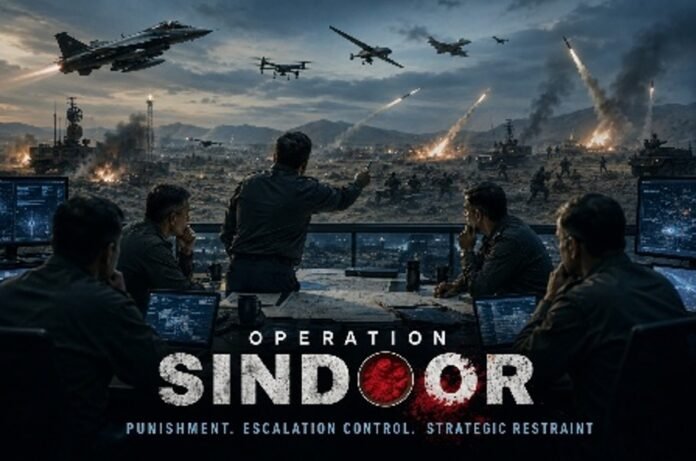
In an age of instant commentary, strategic concepts are increasingly packaged around personalities. A successful operation is followed by a podcast, a paper or a television debate, and soon a complex national-security approach acquires a convenient human label. The temptation is understandable. Names simplify complicated ideas. But in matters of national security, simplification can become distortion.
The contemporary discussion around a so-called “Doval–Ghai Doctrine” therefore deserves greater intellectual scrutiny. Ajit Doval may well have been an important strategic articulator of India’s security thinking, while Lt Gen Rajiv Ghai, as DGMO, represented the military leadership responsible for translating national objectives into operational action. But to convert their respective contributions into ownership of a doctrine is to confuse personalities with institutions.

History gives us another perspective. The Truman Doctrine, Monroe Doctrine, Brezhnev Doctrine and Nixon Doctrine acquired their names because political leaders articulated broad propositions of state policy. Military doctrines, on the other hand, emerge through institutional study, debate, experimentation and acceptance.
Operation Sindoor makes the question even more interesting because the sequence appears, at first sight, to have been reversed. Doctrine normally shapes operations. Sindoor may be an example of an operation helping crystallise doctrine.
That distinction matters because the words we use to describe national power eventually shape the way national power itself is understood.
A doctrine may have an architect, an articulator and an executor – but it cannot become the property of any one of them.
First, Get the Vocabulary Right
Before debating doctrine, we must first understand what doctrine is.

- Doctrine is the accepted body of principles that explains how a state or military institution intends to employ power. At the state level, it can express a broad strategic posture. At the military level, it provides an intellectual framework for preparing for and conducting war.
- Strategy is different. Strategy connects political objectives with the instruments available to achieve them. It answers the larger question: what are we trying to achieve, against whom, under what constraints and at what acceptable cost?
- The Operational Plan is narrower still. It translates strategic intent into executable military action: who will act, against what objective, where, when, with what resources and under what constraints.
Associating military strategy with individual surnames distorts statecraft. Strategic intent may be articulated or executed by specific leaders, but true doctrine derives its longevity and legitimacy strictly from institutional consensus and state authority
The relationship can therefore be broadly visualised as:
Political objective(s) → Doctrine → Strategy → Operational concept → Operational plan → Tactical action.

But the arrows do not run only in one direction.
A battlefield experience can challenge an existing doctrine. An operation can reveal a capability previously underestimated. A campaign can expose a strategic assumption as false. Lessons can then travel upwards – from tactics to operations, from operations to strategy and eventually from strategy into doctrine.
Doctrine is therefore not a static book sitting on a shelf. It is institutionalised learning.
Doctrine provides the grammar, Strategy writes the sentence, and the Operational Plan decides how that sentence will be spoken on the battlefield.
Whose Doctrine is it Anyway?
The first question about any doctrine should be: who owns it?
This is where the distinction between state doctrine and military doctrine becomes critical.
A State Doctrine can indeed become associated with an individual political leader because that leader articulates a defining proposition of national policy. The Truman Doctrine did not become less American because Truman’s name was attached to it. But its authority ultimately came from the United States as a state, not merely from Harry Truman as an individual.
Military Doctrine is even more clearly institutional. It is developed through intelligence assessments, operational research, professional military education, exercises, war-gaming, inter-Service consultations, technological evaluation and experience. It must survive the departure of the personalities who helped shape it.
That is why attaching the name of two individuals to an emerging national-security doctrine requires caution. Doval and Ghai may have contributed at different levels. One may have helped articulate strategic intent; the other may have helped translate that intent into military action. But neither individual can, by himself, constitute the institutional authority of the Indian State.
There is also a larger danger. Personalising a doctrine can create the illusion that national security is the product of individual brilliance rather than institutional capability.
Individuals may illuminate doctrine; institutions give it legitimacy, continuity and life.
Normally Doctrine Comes First
Professional militaries do not normally discover their doctrine in the middle of a war.
Doctrine is generally developed before the crisis. It begins with an assessment of the security environment: the adversary, the threat, geography, technology, political constraints and available capabilities. It is tested through exercises and simulations, challenged by professional debate and refined through experience.
This is why doctrine matters. It provides commanders with a conceptual framework before the fog of war descends.
Strategy then chooses the appropriate objectives and methods for a particular situation. The commander converts those choices into an operational concept, and the operational staff develops the detailed plan. The soldier eventually encounters only the final expression of this intellectual chain.
But there is an important caveat. Doctrine is not scripture. It evolves because war evolves.
Kargil challenged assumptions. The post-9/11 environment changed counter-terrorism thinking. Precision weapons transformed the relationship between distance and force. Information warfare altered the meaning of the battlefield. Unmanned systems have changed surveillance, targeting and the economics of attrition.
Strategy translates political goals into action, while doctrine provides the underlying intellectual framework. However, this process is non-linear – operational outcomes and battlefield realities frequently flow upward to reshape state doctrine
Thus, the normal sequence is:
Doctrine shapes strategy; strategy shapes operations; operations generate lessons; lessons eventually reshape doctrine.
The last arrow is often forgotten.
The best doctrine is not the doctrine that never changes; it is the doctrine that learns faster than the threat.
Op Sindoor Presents an Interesting Reversal
Operation Sindoor may represent the moment when operational experience began crystallising an already evolving strategic idea into something more explicit.
India did not suddenly discover cross-border counter-terrorism on May 7, 2025. The strategic evolution had been visible through successive responses over more than three decades. Surgical strikes and the Balakot air strike had already demonstrated a willingness to cross earlier thresholds.
What Sindoor added was a broader and more clearly articulated combination of punishment, precision, reach and escalation management.
From its first official description, India characterised the operation as focused, measured and non-escalatory, while exercising restraint in target selection and initially avoiding Pakistani military facilities.
That is important. The operation was not simply an act of retaliation. It was a calibrated politico-military proposition: force could be used against terrorist infrastructure across the border without automatically making the objective a general war with Pakistan.
Subsequently, the political leadership explicitly articulated broader principles arising from Sindoor: India would respond to terrorism on its own terms and timing; nuclear blackmail would not be tolerated; and the distinction between terrorist masterminds and their sponsors would no longer provide immunity.
The “new doctrine” was explicitly articulated/formally declared by the Prime Minister in Parliament on July 29, 2025.
This creates an unusual but fascinating relationship between action and doctrine. Sindoor was not born without strategic thinking. But Sindoor appears to have provided the empirical experience from which a more explicit strategic doctrine could be articulated.
Sometimes doctrine precedes the battle; sometimes the battle reveals the doctrine waiting to be born.
Punishment Without Uncontrolled Escalation
The strategic genius of punishment lies not in how much force is used, but in how deliberately it is used.
For decades, India’s terrorism dilemma contained a cruel asymmetry. Terrorist groups could attack India while operating from sanctuaries across the border, while India’s response was constrained by the danger that conventional retaliation might escalate into a larger India-Pakistan conflict. Sindoor challenged that equation.
The message was no longer simply that terrorism would be condemned or that its perpetrators would eventually be pursued. The emerging proposition was more consequential: terrorism can invite direct and precise punishment at its source.
But punishment without escalation control is merely escalation.
The sophistication of the approach lies in the second half of the proposition. India demonstrated that it could impose costs while attempting to retain control over the ladder of escalation. The initial operation was officially described as focused, measured and non-escalatory; subsequent Pakistani military actions elicited responses calibrated to the evolving situation.
Effective deterrence hinges on imposing direct costs at the source of aggression without surrendering control of the escalation ladder, striking a balance between perpetual restraint and unchecked conflict
This is the essence of strategic calibration.
The objective is neither perpetual restraint nor unlimited retaliation. It is to impose sufficient cost to alter the adversary’s calculation while denying the adversary the ability to dictate the level and direction of escalation.
The measure of power is not the ability to escalate; it is the ability to punish without surrendering control of escalation.
The Nuclear Paradox
Nuclear weapons deter nuclear war; they cannot automatically provide immunity to every form of aggression below it.
This is perhaps the most consequential strategic proposition emerging from Sindoor.
Pakistan’s nuclear capability has always complicated India’s conventional options. The fear of escalation has traditionally created space between sub-conventional aggression and conventional retaliation. But if nuclear weapons become a shield behind which terrorism can be conducted with impunity, deterrence itself becomes distorted. Sindoor tested whether India could reject that proposition.
The political message after the operation was explicit: nuclear blackmail would not be tolerated.
This does not mean that nuclear deterrence has become irrelevant. Quite the contrary. It makes escalation management even more important. The challenge is to create credible conventional options below the nuclear threshold while retaining sufficient political and military control to prevent inadvertent escalation.
That requires extraordinary precision – not merely in weapons, but in political signalling, target selection, intelligence, timing and termination.
The emerging principle is therefore not “nuclear weapons do not matter”.
It is far more nuanced:
Nuclear weapons may deter certain forms of war, but they cannot be presumed to confer immunity from calibrated conventional punishment.
The nuclear threshold should deter war – not become a sanctuary for terrorism.
From Operation to Doctrine: What Happens Next?
An operation becomes a lesson immediately; it becomes doctrine only after an institution has learned from it.
This is where we must resist premature declarations.
The success of Sindoor does not, by itself, establish a doctrine. A successful operation demonstrates that a particular combination of political intent, intelligence, technology, command, force employment and execution worked under particular circumstances.
Doctrine requires something more.
The lessons must be captured, debated, tested, challenged and validated. They must find their way into professional military education, war-gaming, exercises, contingency planning, force structures, technology priorities and operational procedures.
The doctrine must also survive scrutiny under circumstances different from those in which it was born.
What worked in Sindoor must be examined against a smaller terrorist attack, a larger attack, ambiguous attribution, a rapidly escalating conventional confrontation, a two-front contingency or direct involvement of another major power. Only then can the State know whether it has created a doctrine – or merely experienced a successful operation.
Strategic operations demonstrate that nuclear capabilities cannot serve as an absolute shield for proxy aggression; conventional, highly target-specific options can operate effectively beneath the nuclear threshold
This is why I would prefer the term “emerging Sindoor doctrine” to an already settled “Sindoor Doctrine.”
Victory creates confidence; only institutional learning creates doctrine.
The Real Test: Can it be Repeated?
A doctrine is not tested by the war that creates it; it is tested by the crisis that follows.
This is perhaps the hardest test facing any emerging doctrine. Suppose another terrorist attack occurs. Will the response automatically be identical? It should not be.
A doctrine is not a menu of pre-decided targets. It is a framework for decision-making.
The next crisis may involve fewer casualties but stronger evidence of state involvement. Or greater casualties but weaker attribution. The adversary may respond conventionally. International opinion may be less sympathetic. The geography may be different. The political objective may be different.
A mature doctrine must accommodate these variations without losing its core logic.
That is why punishment, escalation control and strategic restraint should not be treated as three slogans. They are three interacting variables.
Punishment without restraint can become escalation. Restraint without punishment can become deterrence failure. Punishment with escalation control can become deterrence.
A successful single operation demonstrates tactical execution, but it does not instantly equal a doctrine. Ideas must endure testing across varied scenarios and be integrated into military education to mature into doctrine
That is the strategic equation India must continue to refine.
And it is also why the doctrine cannot belong to one operation, one commander or one political personality.
A doctrine earns its name not when it explains yesterday, but when it helps a nation decide tomorrow.
When War Writes Doctrine
Perhaps the important lesson of Sindoor is not what India did, but what India may now learn from what it did.
The conventional military sequence is straightforward: political objectives shape strategy; strategy is translated into doctrine and operational concepts; commanders develop plans; soldiers execute them.
But history is rarely so linear.
Sometimes a nation confronts a crisis for which its existing strategic vocabulary is inadequate. It acts within an evolving framework, discovers what is possible, observes the adversary’s reaction, manages escalation and then looks back at the experience.
That is when an operation becomes more than an operation. It becomes a laboratory. Operation Sindoor may eventually prove to be such a laboratory for India.
It has already been politically articulated as establishing a new doctrine, with principles centred on India’s freedom to respond on its own terms, rejection of nuclear blackmail and a refusal to separate terrorist masterminds from their sponsors.
But the final judgment belongs to time and institutions.
A mature framework does not offer fixed, rigid responses. It provides an adaptable decision-making apparatus designed to guide a nation through unpredictable future crises rather than simply explaining past actions
If these principles are incorporated into national strategy, tested through military planning, institutionalised across the Armed Forces and successfully applied across different contingencies, history may indeed look back on Sindoor as a doctrinal turning point. Until then, we should resist the easy temptation to attach two names to something that belongs to a much larger national enterprise.
Doval may articulate. Ghai may operationalise. Commanders may plan. Soldiers may execute. Political leadership may decide. Institutions may learn.
But doctrine, when it finally becomes doctrine, belongs to the State and the institution that carries it forward.
And perhaps that is the most important distinction of all.
Doctrine shapes the battle. Strategy gives the battle its purpose. The operational plan gives it form. But sometimes, the battle itself teaches a nation what its next doctrine must be.

Lt Gen Rajeev Chaudhry (Retd) writes on contemporary national and international issues, strategic implications of infrastructure development towards national power, geo-moral dimension of international relations, and leadership nuances in a changing social construct. The views expressed are of the author and do not necessarily reflect the views of Raksha Anirveda





