


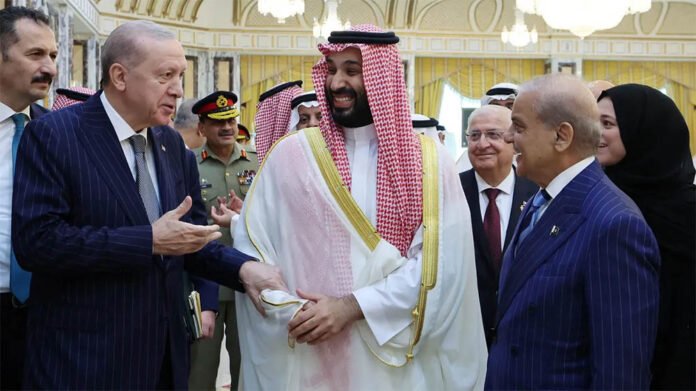
The Mecca Pact among Pakistan, Turkey and Saudi Arabia has been in the limelight since it was inked. It was announced as a pact akin to Article 5 of NATO, wherein an attack on one member was considered an attack on all. Even NATO has not invoked Article 5 in the Iran war and the US invasion of Iraq, wherein the US claimed to be seeking so-called ‘weapons of mass destruction’. The only time it was invoked was on September 12, 2001, after the 9/11 strike on the US. Turkey, entering the pact, is outside its NATO commitments and hence any attack on it, as a result of this pact, will not draw NATO support. This implies that chances of an Article 5-type commitment by members of this pact are unlikely, as Turkey would never risk being sidelined and ignored by NATO.
Each nation involved in the Mecca Pact has its own interests and security concerns. Saudi Arabia is concerned about attacks on its soil from Iran and its proxies, largely Houthis and militias in Iraq. It also desires no hindrance to its oil exports. Turkey is impacted by happenings in northern Syria, Kurdish rebels, and continuing tensions with Israel. Netanyahu recently called Erdogan, the Turkish President, ‘an antisemitic dictator’. Turkey is also concerned about the Cyprus-Greece-Israel axis.

“We’ve received numerous messages from neighbouring countries about shaping new security arrangements and economic cooperation… The United States put the security of every single one of its allies at such risk through bullying and pure disregard for their interests for the sake of Israel,” says Iran’s parliamentary speaker Mohammad Bagher Ghalibaf
Pakistan is battling insurgencies in its western provinces; it is involved in a conflict with Afghanistan and has continued tensions with India. It cannot instigate a conflict with Iran as it shares a 900 km border with it in restive Baluchistan. For all three nations, Israel is a common concern, which can strike at will, as it did in Qatar in November 2025, and the US, the traditional security provider, failed to prevent it. However, Saudi Arabia and Israel have no direct enmity, while Turkey has an embassy there. It is only Pakistan that refuses to recognise it.
There are also reports that Middle East nations, including Saudi Arabia, the UAE, and Qatar, have privately reached out to Iran, sending messages regarding regional security. Iran’s parliamentary speaker, Mohammad Bagher Ghalibaf, mentioned, “We’ve received numerous messages from neighbouring countries about shaping new security arrangements and economic cooperation in the region.” He added, “The United States put the security of every single one of its allies at such risk through bullying and pure disregard for their interests for the sake of Israel that they briefly saw their entire existence on the line.” Iran welcomed the Mecca Pact as it kept the US out.
Media inputs also mention that Pakistan’s foreign minister Ishaq Dar kept Iran in the loop on discussions over the Mecca Pact, assuaging its concerns that the pact is aimed against it. Other media reports also mention that Iran has been invited to join the Mecca Pact, though it has not been confirmed by signatories to the pact, nor by Iran officially. Even attacks by the Houthis on Saudi shipping and its oil facilities have not been responded to by members of the pact.
Saudi Arabia has working relations with Israel, while with India it has a joint security working group, which last met in January this year, as well as deep trade and diplomatic ties
Simultaneously, Pakistan’s Asim Munir visited Tehran, seeking to re-broker talks with the US. It was also revealed that Trump spoke to Asim Munir a few days ago. The Iranian President conveyed that ‘coercion and bullying’ will only complicate the implementation process of the Islamabad accord. It is unknown whether the offer to join the Mecca Pact was discussed.

The efforts made by Pakistan and other members of the pact to win over Tehran, despite its ongoing conflict with the US, suggest that Iran is not the main reason for forming the pact. Further, Iran possesses the military might to challenge Israel’s unilateral actions. This then leaves two others, Israel and India. Saudi Arabia has working relations with Israel, while with India it has a joint security working group, which last met in January this year, as well as deep trade and diplomatic ties.
India and Turkey are working to re-establish their relations after a few years of freeze. Though Turkey will continue to support Pakistan militarily by providing it with arms and other support, alongside China, it is unlikely to deploy its troops in a confrontation. This support was evident when several aircraft, with supposed military equipment, possibly drones and their control stations, landed in Pakistan recently.

For nations in the Middle East, Iran joining the pact would be a win-win. The fact remains that Iran was forced to hit back at its neighbourhood as that was the only way to push them to apply pressure on the US to stop its attacks. Most of Iran’s objectives in neighbouring countries were US bases and radar sites, though some economic targets were also struck.
For India, which has good economic and diplomatic ties with nations in the Middle East as well as Israel, the major benefit is that any attempt by Pakistan to invoke the Mecca Pact against India’s counter to a terrorist act would find little support
The main concern of nations in the region is Israel’s military, its ability to target at will and support from the US. It would now be a common foe with Iran possessing the capability to counter. Nations forming part of the pact could be the negotiators in future talks between Washington and Tehran. They could assuage fears of Tehran by blocking use of their bases for the US military to target Iran. No nation in the region seeks a nuclear-armed Iran, and that could be ensured.
There are other benefits which would accrue. The Red Sea and the Straits of Hormuz, blocked for Saudi oil-exporting vessels, would open. In addition, the Houthis and Iranian proxies in Iraq would be controlled. They would have freedom to act against Israel but not the Saudis. The economic isolation of Iran would end. In return, Gulf states could fund reconstruction of Iran.
The move would also lay to rest the belief that the Mecca Pact is a Sunni NATO. It would unite the region, drawing in more nations, reducing threats, while enhancing economies. The US would then have a limited role, which it would dislike.
The move would be beneficial to China as it is currently hampered due to its proximity to Iran, which remains a concern. The reduction in US involvement and lifting of economic restrictions on Iran would open doors for China to expand its outreach.
For India, which has good economic and diplomatic ties with nations in the Middle East as well as Israel, the major benefit is that any attempt by Pakistan to invoke the Mecca Pact against India’s counter to a terrorist act would find little support. Overall, Iran’s inclusion in the Mecca Pact would benefit the Middle East.

The writer is a strategic analyst and a motivator. He can be reached at @kakar_harsha. The views expressed are of the writer and do not necessarily reflect the views of Raksha Anirveda





