



Indian Air Force’s 29 fighter squadrons, reflect a deepening shortage as ageing fleets retire and replacements lag. Yet, restoring numbers alone is insufficient. Recent wars in Ukraine, Gaza, Iran and Operation Sindoor reveal that massed precision, resilient bases, deep magazines and networked kill chains now define combat power.
Transformation of War: What the Recent Wars Reveal
Ukraine-Russia War: Russia, with an air force many times Ukraine’s, has failed to win air superiority in over four years of war. Dense, layered, mobile ground-based air defences have denied both sides contested airspace, pushing manned aviation into stand-off roles, with glide bombs and cruise missiles released beyond SAM reach. The defining innovation is the drone: produced in millions, attritable and woven into reconnaissance-strike complexes that compress the kill chain from hours to minutes. On June 1, 2025, Operation Spider’s Web used truck-launched FPV drones to destroy Russian strategic bombers on airfields thousands of kilometres from the front. The airbase, not the aircraft in flight, proved the most vulnerable node. The 117 drones reportedly inflicted up to $7 billion in damage at a fraction of the cost. In this future of warfare, anything, anywhere can become a target.

Operation Sindoor: Between May 7 and 10, 2025, two nuclear-armed states fought the first sustained air campaign almost entirely with stand-off weapons. The IAF struck terror infrastructure and then 11 Pakistani air bases with BrahMos, SCALP and loitering munitions were launched from the Indian airspace, while the IACCS, S-400 and Akashteer network blunted Pakistan’s drone and missile waves. Hard lessons followed. Restrictive initial rules of engagement and incomplete intelligence on the PL-15 may have cost the IAF aircraft on the first night. The J-10C/PL-15 combination and the PAF’s integration of China’s Link-17 extended Pakistan’s reach, aided by live Chinese operational inputs and ISR data. The two-front threat is no longer sequential or hypothetical; it is collusive and present.
Gaza: An air force with uncontested air superiority and AI-enabled targeting, generating targets at industrial rates, still could not convert precision into political resolution. Gaza also exposed missile defence’s brutal cost-exchange: interceptors costing tens of thousands of dollars meet rockets worth a few hundred, making saturation a strategy in itself.
Air superiority is now contested, local and temporary. The goal is to deny the adversary the air while exploiting it for short windows
Iran versus the United States and Israel: The twelve-day war of June 2025 and the far larger campaign launched on February 28, 2026 showed what first-rate air forces can achieve, and their limits against a determined, resource-innovative adversary. American and Israeli airpower struck over a thousand targets in the first 24 hours and established air supremacy within days. Five months later, the Strait of Hormuz remains contested and political objectives unmet. Iran adapted by dispersing mines, small craft, shore-launched missiles and drones. Interceptor and precision-munition inventories, even American ones, became a binding constraint, and parallel strikes gave way to sequential ones. Air supremacy did not deliver strategic victory. Iran’s asymmetric strategy, built on hypersonic missiles and cheap drones with Chinese and Russian intelligence support, has imposed exorbitant costs on the world’s most powerful military.

Five Lessons for the IAF
Ukraine and Iran have shown how low-cost weapons, used as massed precision, can impose severe costs on stronger adversaries. The IAF can draw five lessons.
First, air superiority is contested, local and temporary. The struggle is to deny the adversary the air while exploiting it for short windows, placing a premium on SEAD/DEAD, long-range stand-off weapons and electronic warfare over the classic fighter sweep.

Second, mass has returned now, as affordable, attritable massed precision. The side fielding thousands of cheap drones and hundreds of cruise missiles imposes costs that a few hundred exquisite fighters cannot absorb.
Third, air bases are prime targets and frontlines. Spider’s Web, Sindoor and the Gulf strikes all targeted airfields. Hardened shelters, dispersal, rapid runway repair and counter-drone point defence are now combat capabilities, not infrastructure.
Fourth, magazine depth determines endurance. These wars consumed munitions and interceptors faster than industry could replenish them. An air force with aircraft but empty magazines is a force in being, not a fighting force.
Fifth, the kill chain is a network. Space-based ISR, AEW&C, secure data links and resilient command and control determine effectiveness more than platform numbers. The PL-15’s reach during Sindoor reflected a Chinese-built networked targeting system, not the missile alone.
Mass has returned as massed precision: thousands of cheap drones and hundreds of cruise missiles impose costs that a few hundred exquisite fighters cannot absorb
Numbers and the Force Structure
Even if Mk 1A deliveries, most optimistically, stabilise at 16 to 24 aircraft a year from 2027, Jaguar, Mirage 2000 and MiG-29 retirements will absorb most gains. The 114-aircraft MRFA, if signed this year, will not yield squadrons before 2030. The Tejas Mk 2 has slipped, and the AMCA is a mid-to-late 2030s proposition. On current trajectories, the IAF will struggle to exceed 32 or 33 squadrons before 2035, while China fields over 1,200 combat aircraft, including more than 200 J-20s, and Pakistan eyes fifth-generation J-35s.
The Way Forward
Fix the Production Problem. HAL’s supply-chain vulnerability and single-source Tejas monopoly cause delays and quality-control problems; a second private-sector production agency would accelerate output and address them.
Technology Access and Control. Netcentric integration of diverse fleets is problematic without source code and ICDs. A Rafale fleet unable to integrate Astra, Rudram or BrahMos without French approval perpetuates dependency at $40 billion; ICD access must be non-negotiable.
Modernise the Backbone. Upgrading the Su-30 MKI fleet on a war footing is the fastest way to add combat value without adding airframes.
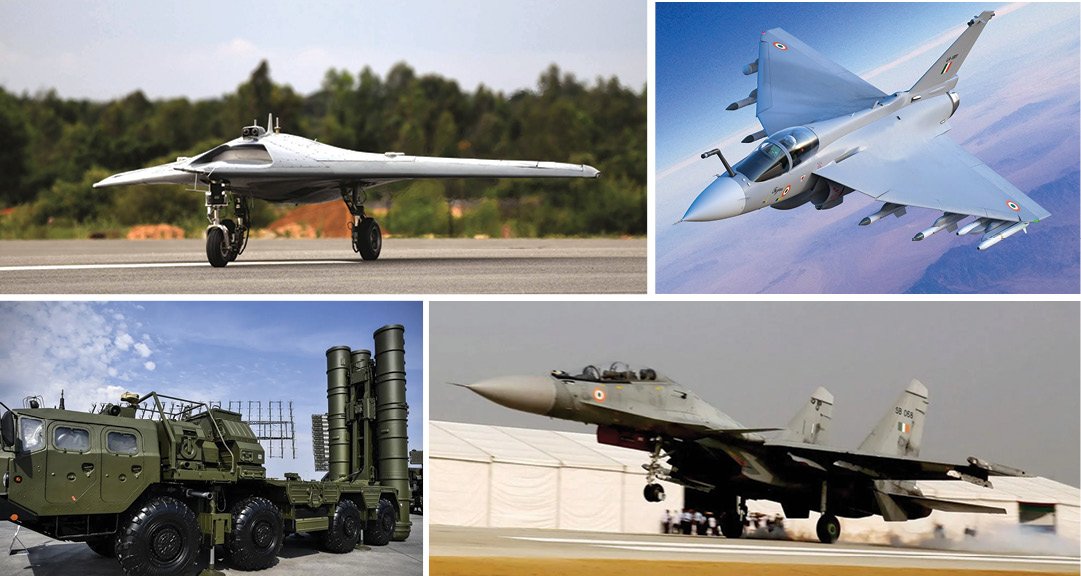
Factor Massed Precision. Force-structure calculations must count drones and autonomous systems as squadron equivalents: CATS Warrior, Ghatak UCAV, loitering munitions and Pralay missiles, assessed alongside manned squadrons. Manned-unmanned teaming outperforms manned fighters alone.
Build Magazine Depth. Create large-scale production lines for cheap drones and autonomous weapons, and fund surge-capable lines for Astra Mk2 and Mk3, Rudram, cruise missiles and interceptors as strategic reserves, not consumables.
Harden and Networked. Mission Sudarshan Chakra should integrate S-400, Kusha, Akash and counter-drone systems into one sensor grid anchored in hardened, dispersed air bases. SBS-3 satellites, additional AEW&C and tankers each deliver more than a fighter squadron.
Keep Airpower Indivisible. Multi-front threats demand rapid repositioning of air assets; fragmenting a 29-squadron air force across theatres would leave every theatre weak.
Overall, the 45-squadron force structure remains a necessary floor for a nation facing a collusive two-front threat across 6,000 kilometres of contested frontier, but it is not a sufficient measure of readiness. The future belongs to the air force combining capable manned fighters with attritable mass, deep magazines, resilient bases and a sovereign kill chain. The IAF’s challenge is twofold: urgently restore numbers and redefine what they mean. Failing the first leaves India exposed today; failing the second leaves it prepared for a war that no longer exists.

The writer, AVSM VM PhD (V) is a former Deputy Chief of Integrated Defence Staff at HQ IDS, and is currently Founder-President of The Peninsula Foundation. The views expressed are of the writer and do not necessarily reflect the views of Raksha Anirveda






