


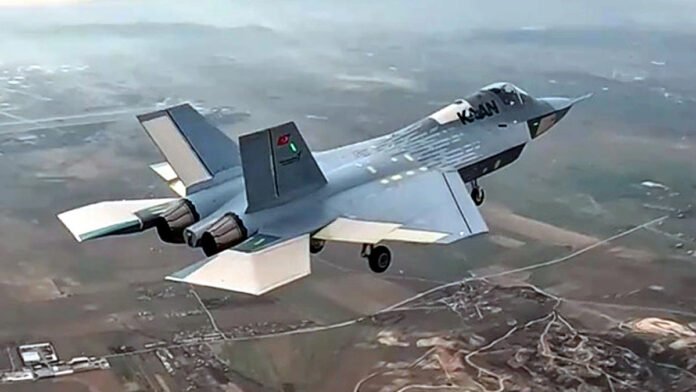
Tel Aviv: Countries that cannot buy American made fighter aircraft mainly for political reasons – may find the solution in the Turkish KAAN – fifth generation fighter aircraft.
According to Israeli sources, this development further complicates the relations between Ankara and Washington mainly in the context of NATO. In 2019, the United States withdrew Turkey from the F-35 fighter jet programme because of its purchase of the Russian S-400 air defence system, mostly on the basis of security concerns.
Although Turkey has made a concerted effort to return to the programme or receive compensation since then, its readmission has been thwarted by legislative limitations, mistrust of technology security, and Turkey’s regional interests.
Recently, Turkey has reached a major preliminary agreement to purchase 40 Eurofighter Typhoon jets from a consortium led by the UK and Germany, in a deal valued around $5.6 billion, aimed at modernising its air force and strengthening regional military power.
Israeli sources see the KAAN programme and the Eurofighter agreement as two pressure tools aimed at getting the F-35.
The KAAN is scheduled to be operational in 2030. Prospects for the Turkish KAAN fighter aircraft’s export success and international sales appear strong, with several key positive indicators:
Turkey secured its first major export deal for KAAN jets with Indonesia, agreeing to sell 48 units in a landmark contract valued around $15 billion. Deliveries to Indonesia are expected to start in the early 2030s and continue over a decade. This deal is a historic milestone, making Turkey one of the few nations capable of designing and exporting fifth-generation fighter jets.
The Indonesia deal includes strategic cooperation with local production involvement, boosting Indonesia’s aerospace capabilities while supporting Turkish defence exports.
Beyond Indonesia, there is growing interest from other countries, particularly in the ASEAN region and the GCC (Gulf Cooperation Council) nations. Malaysia has been formally offered a partnership on the KAAN project, with potential interest also from the Philippines and Vietnam. However, adoption depends on political relations, cost, and integration with existing military systems.
The KAAN, being a non-US platform, may avoid geopolitical export restrictions associated with American fighter jets, providing an advantage in certain markets seeking alternatives to the F-16, F-35, or Western aircraft.

-The writer is an Israel-based freelance journalist. The views expressed are of the writer and do not necessarily reflect the views of Raksha Anirveda





