


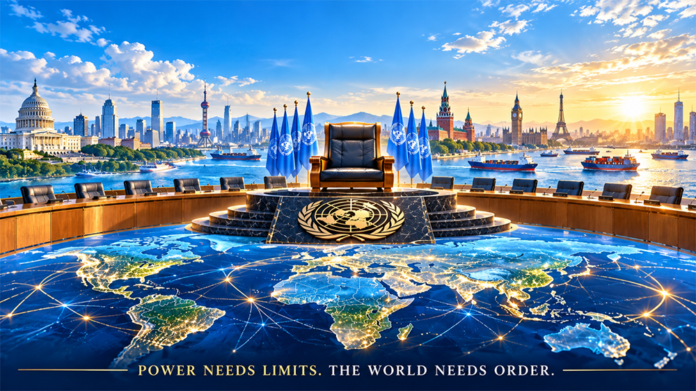
The Whistle that No Longer Stops the Game: The most dangerous moment in any contest is not when the rules are broken, but when those responsible for enforcing them can no longer make the players stop. International politics is approaching such a moment. The United Nations remains indispensable, but its authority is constrained by the interests of its most powerful members; international law remains relevant, but its enforcement is uneven.
This is not to say that the world has descended into anarchy or that every conflict is alike. Institutions still mediate, treaties still matter, and cooperation continues across borders. The deeper concern is the widening gap between the rules states proclaim and the restraint they are willing to accept. The central question, therefore, is not whether global order exists, but whether it can command obedience when power and principle collide.

The Architecture of the Old Order
Every international order carries the imprint of the war, fear and balance of power that produced it. The system established after 1945 sought to prevent another world war through collective security, international institutions and a framework for economic cooperation. The United Nations Security Council placed special responsibility in the hands of five permanent members, each with a veto. That arrangement reflected the realities of the time, but also embedded inequality within an organisation founded on the sovereign equality of states.
Yet the system was never as universal or impartial as its language suggested. Decolonised states often found their voices constrained; interventions and humanitarian claims were applied inconsistently; and institutions created in a different era struggled to accommodate rising powers. Today’s friction is therefore not simply a revolt against rules. It also reflects demands that representation and authority better match contemporary realities.
When power becomes the final interpreter of the rules, international law risks becoming an argument rather than a restraint. The Security Council’s veto can block collective action even when a crisis demands urgency
Still, nostalgia offers no solution. Its limitations do not erase its achievements. The challenge is to reform institutions without destroying the habits of cooperation that make them valuable. The system is strained because its distribution of authority no longer commands universal acceptance, yet no agreed alternative has emerged.
When Power Becomes its Own Permission
When power becomes the final interpreter of the rules, international law risks becoming an argument rather than a restraint. The Security Council’s veto can block collective action even when a crisis demands urgency. The result is not that law has vanished; it is that legal argument increasingly competes with strategic calculation.

Consistency matters because legitimacy depends on more than the wording of a resolution. If states invoke territorial integrity in one theatre and minimise it in another, or demand accountability from adversaries while resisting scrutiny themselves, they weaken the credibility of the principles they claim to defend. Yet false equivalence must also be avoided: conflicts differ in their facts, legal context, responsibility and scale.
The danger is cumulative. Selective enforcement encourages smaller states to doubt whether rules will protect them, while powerful states may conclude that costs can be managed through vetoes, alliances or economic leverage. This uncertainty can fuel arms acquisition, harden threat perceptions and narrow diplomatic space.

India’s influence will depend not only on the weight it accumulates, but on the confidence other countries place in how it uses that weight
The question is not whether international law can eliminate power politics; it never could. It is whether law can raise the political and material costs of coercion enough to influence decisions before a crisis becomes a war. This erosion is especially dangerous for states that lack the leverage to retaliate: their security depends not only on their own capabilities, but on whether collective commitments survive a test of convenience.
The New Contest for Global Influence
The struggle for world order now runs through the arteries of trade, technology, finance and energy as much as across territorial frontiers. Tariffs, sanctions, export controls, semiconductor supply chains, critical minerals, undersea cables and maritime chokepoints have become instruments of strategic leverage. Interdependence once appeared to make conflict prohibitively expensive; today, governments increasingly examine the same connections as potential vulnerabilities. Networks that create prosperity can also transmit coercion.
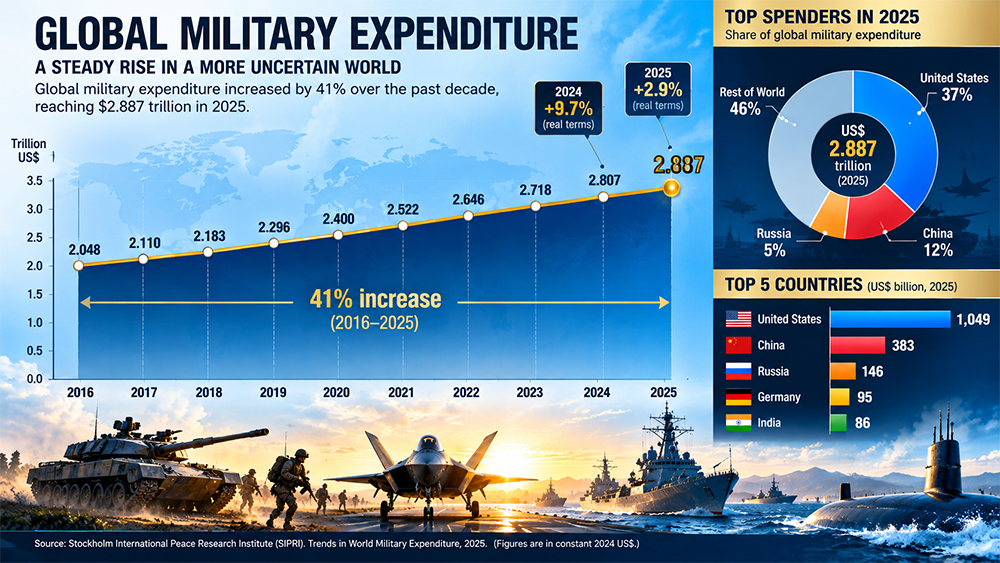
The scale of military spending reveals the mood. The Stockholm International Peace Research Institute estimates that global military expenditure reached $2.887 trillion in 2025, rising for an eleventh consecutive year and equalling about 2.5 per cent of world gross domestic product. The United States, China and Russia together accounted for 51 per cent of the total. These figures do not prove war is inevitable, but indicate that states are devoting immense resources to preparing for insecurity rather than assuming that institutions will prevent it.
Economic rivalry carries its own warning. In October 2026, the World Trade Organisation raised its forecast for global merchandise trade growth to 3.9 per cent, helped by strong demand for artificial-intelligence-related goods, including a reported 67 per cent year-on-year increase in trade in semiconductors and data-centre products. Yet the same outlook identified conflict-related disruption, energy costs and uncertainty as significant risks. Technology intensifies the dilemma. Artificial intelligence depends on chips, computing capacity, data, electricity and specialised minerals, linking civilian prosperity to strategic competition. Control over standards and supply can shape future dependence long before a crisis becomes visible. The new contest is not simply who produces more, but who can withstand disruption — and who can impose it.
The Middle Powers and the Indian Test
When major powers begin rewriting the rules, middle powers must decide whether to remain spectators, become instruments, or help shape the settlement. India’s position illustrates the difficulty. Its relationships with the United States, Russia, Europe, China and the Global South cannot be reduced to a permanent choice between rival camps. Strategic autonomy is therefore neither isolation nor equidistance; it is the capacity to make decisions in the national interest without surrendering the ability to choose.
Reform must begin with representation. Global institutions must reflect the economic and political realities of the 21st century, while preserving the principle that smaller states are not merely objects of great-power bargains
That capacity cannot rest on diplomatic skill alone. It requires credible military strength, resilient infrastructure, reliable energy supplies, technological competence, economic depth and diversified supply chains. Partnerships can broaden India’s options, but excessive dependence can narrow them. A country that cannot absorb economic pressure or secure essential inputs may possess formal sovereignty while losing practical freedom of action. Strategic autonomy must be built at home before it can be exercised abroad. For India, this is also a test of judgement: partnerships should expand choices, not substitute one dependency for another. The measure of success is durable room for manoeuvre.
India also has a stake in shaping the rules it seeks to navigate. It can advocate more representative global institutions, uphold peaceful settlement of disputes, strengthen regional cooperation and build practical coalitions with countries that differ in ideology but share specific interests. A rules-based order cannot credibly be defended only when its principles favour one’s own position; nor can reform succeed if emerging powers merely demand a larger seat without accepting greater responsibility.
No single state can replace the authority of a universal institution, but coordinated diplomacy, economic cooperation and crisis mediation can raise the costs of unilateral coercion. India’s influence will depend not only on the weight it accumulates, but on the confidence other countries place in how it uses that weight.
A World that Must Learn to Referee Itself
The answer to a world without an effective referee cannot be a world without rules. Nor is a new hegemon a dependable remedy: concentrated power may impose order, but it can also produce resentment and resistance. The objective is a system in which institutions are more representative, obligations are more fairly, transparently and consistently applied, and violations carry genuinely credible consequences.
A referee cannot guarantee a fair contest, but without credible enforcement, the contest becomes a test of force. The future will be decided not by who holds the greatest power, but by whether the world’s powers can agree that power itself must have limits
Reform must begin with representation. Global institutions need to reflect the economic and political realities of the twenty-first century, while preserving the principle that smaller states are not merely objects of great-power bargains. Regional organisations and coalitions of middle powers can supplement global institutions by supporting mediation, humanitarian access and negotiated crisis management.
Rules also require practical foundations. States should strengthen communication channels between rivals, clarify crisis procedures and protect essential infrastructure against disruption. Supply-chain diversification can reduce coercive dependence, but indiscriminate economic separation would damage prosperity and increase mistrust. Resilience must mean reducing dangerous vulnerabilities while preserving the benefits of exchange. Above all, international law needs consistent defence — not rhetorical perfection, but a willingness to apply common standards even when doing so is inconvenient.
India can contribute by combining national capability with institutional credibility. It can support a world where strength creates responsibility as well as freedom, and where strategic competition does not erase the value of restraint. The old order will not return unchanged, and a new one will not emerge by declaration. It will be built through repeated choices: whether states negotiate before coercing, accept limits when powerful, and defend principles when the immediate advantage lies elsewhere.
A referee cannot guarantee a fair contest, but without credible enforcement, the contest eventually becomes a test of force alone. The future will not be decided simply by who holds the greatest power, but by whether the world’s powers can agree that power itself must have limits.

Lt Gen Rajeev Chaudhry (Retd) writes on contemporary national and international issues, strategic implications of infrastructure development towards national power, geo-moral dimension of international relations, and leadership nuances in a changing social construct. The views expressed are of the author and do not necessarily reflect the views of Raksha Anirveda





