


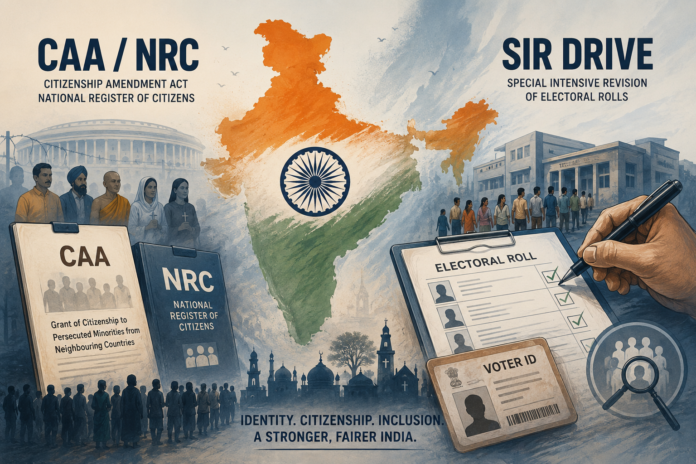
India has spent seven decades explaining itself to the world using borrowed terms such as ‘secularism’, ‘minority rights’, ‘communal harmony’, which were created for European nations dealing with post-Reformation religious turmoil. They were not meant for a civilisation where the starting point is not the separation of religion from state, where dozens of faiths, languages and legal traditions co-existed inside one continuous cultural stream stretching back for millennia. At this stage, it is time for India to craft its own theoretical vocabulary, for its own civilisational reality. Call it the Vedic-Quantum Counterpoint, meaning the recognition that India’s identities are not merely diverse but entangled, bound together in a coherent whole, such that pressure on one part of the system generates a defensive response across the whole.
The Security Logic
The central insight is simple. India’s greatest vulnerability isn’t really some border skirmish, or a terrorist cell operating in the dark; it’s the careful manufacture of polarisation that deliberate efforts by hostile actors, both domestic and foreign, to push a pluralistic population into this rigid binary, i.e., ‘us’ versus ‘them’. And, a civilisation that is built on overlapping identities, where a citizen is at the same time part of a language community, a caste network, a regional culture, a faith tradition and also the nation… tends to resist that kind of framing.

A civilisational container that lets plural identities flourish must be defended, as the alternative is just chaos. You end up with undocumented populations, parallel legal systems, plus porous borders where hostile actors can slip in exactly because ambiguity is easier to weaponise than clarity. This is the whole pivot on which CAA, NRC, NPR, and UCC turn
You can’t easily radicalise someone whose loyalties are stitched into ten different fabrics at once; it doesn’t take the simple route. This isn’t sentimental nationalism either; it has real grounding in the scholarship around communal resilience, shared economic interdependence and cross-cutting identity. Scholars like Ashutosh Varshney and Amartya Sen have documented these patterns in Indian settings for decades; it’s not just an opinion.
But the resilience of this kind doesn’t really keep going. A civilisational container that lets plural identities actually flourish has to be secured, documented, and defended too, because the alternative to a managed plural container isn’t some shiny utopian plurality; it’s just chaos. You end up with undocumented populations, parallel and unaccountable legal systems, plus porous borders where hostile actors can slip in exactly because ambiguity is easier to weaponise than clarity. This is the whole pivot on which CAA, NRC, NPR, and UCC turn. They are not, on this reading, instruments that force India’s plural identities into a single mold. They are instruments that secure the civilisational boundary, the container, inside which pluralism is allowed to keep operating without being hijacked by fragmentation, illegal migration, or competing legal sovereignties that erode the state’s capacity to protect its own citizens.
The National Register of Citizens performs the state’s most basic sovereign function, i.e., knowing who its citizens are. A state that cannot answer that question cannot protect anyone, majority or minority, from the demographic and security pressures that accompany unregulated cross-border movement
Four Instruments, One Doctrine
The National Register of Citizens performs the state’s most basic sovereign function, i.e., knowing who its citizens are. A state that cannot answer that question cannot protect anyone, majority or minority, from the demographic and security pressures that accompany unregulated cross-border movement. The National Population Register extends this into ordinary demographic observation, the same kind of administrative visibility that most functioning states take for granted. The Citizenship Amendment Act is supposed to tackle a kind of smaller, humanitarian issue, like refuge for specific persecuted groups from nearby states, and its supporters say this is a civilisational duty, not a civilisational threat. Meanwhile, the Uniform Civil Code is meant to touch the final, and more delicate layer: it reduces internal legal patchwork, the sort where citizens end up living under different rules regarding marriage, inheritance, and family depending on faith. That kind of division, even if it once had historical reasons, feels a bit off with the notion of one, steady national community.
Taken separately, each one can read like a technical policy. But together, supporters claim, they add up to a wider doctrine: you consolidate the civilisational core, so the pluralism inside it can keep working as a security advantage, rather than turning into an opening for risk or trouble.

Critics say that the boundary-protection framing flips cause and effect, like it suggests India’s plural resilience somehow comes after a centralised ‘civilisational core’ but actually it predates it, and doesn’t depend on it at all
What the Ballot Box Says
Sceptics will ask if any of this really reflects genuine public will, or is it just elite theorising dressed up nicely. Here, the electoral record is still worth taking seriously, even if it may not be overstated too much. In Assam, West Bengal, Kerala, and Tamil Nadu, states where CAA and NRC were most fiercely contested, where opposition parties built entire campaigns around warning voters these policies were existential threats, the electorate did not deliver the wholesale repudiation that the loudest critics predicted. This is not proof of policy endorsement in any narrow sense either; voters tend to weigh welfare delivery, leadership, and local dynamics far more than any single statute. But it is at minimum evidence that the apocalyptic framing of these policies did not match the lived calculus of millions of the voters supposedly most threatened by them, which should complicate, rather than resolve, the debate.

The Honest Tension
None of this erases a real philosophical tension, and it is worth naming rather than hiding. If India’s strength is really grounded in identities that keep on not quite clearing up, plural, overlapping, unsettled, then any machine whose job is to sort identity into cleanly separated binary stuff (citizen or no citizen, included or excluded) is working in tension with that whole idea. The most solid version of the civilisational consolidation claim does not pretend this friction away; it just reframes it, like, differently. Pluralism, on this account, was never the foundation; it is the output of a stable civilisational structure, and structures require boundaries to remain stable. Protecting the boundary is not opposed to protecting the plurality; it is the precondition for it.
Others dispute the electoral evidence right on its face, pointing out that state elections are rarely clean referenda on any one piece of law, and that West Bengal, Assam, and Tamil Nadu results were driven a lot more by local welfare politics and coalition arithmetic, rather than CAA/NRC sentiment, only
Whether that reframing is persuasive, or merely a permission structure for a policy conclusion decided in advance, is precisely where the debate should now be joined.
Worth weighing on the other side: critics say that the boundary-protection framing flips cause and effect, like it suggests India’s plural resilience somehow comes after a centralised ‘civilisational core’ but actually it predates it, and doesn’t depend on it at all. They also argue that citizenship verification regimes have historically generated statelessness, plus anxiety, that lands more concentrated among specific minority communities instead of acting as broad, uniform civilisational protection. Others dispute the electoral evidence right on its face, pointing out that state elections are rarely clean referenda on any one piece of law, and that West Bengal, Assam, and Tamil Nadu results were driven a lot more by local welfare politics and coalition arithmetic, rather than CAA/NRC sentiment, only. At the same time, empirical work directly tying these four policies to reduced radicalisation is still kind of thin. So, the causal story, well, it mostly runs in theory, not in measured outcomes.
The writer is an expert on geopolitics, national security, and counter-terrorism; and he regularly contributes his subject thought-leadership and academic commentary with several publications in newspapers, journals, and periodicals. He works with investigative agencies, regulatory bodies, financial institutions and enterprises, providing strategic and regulatory advisory. The views expressed are personal and do not necessarily carry the views of Raksha Anirveda





