


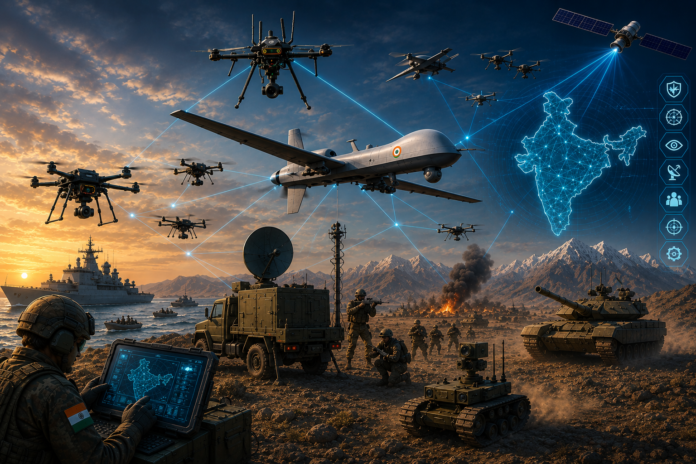
The evolution of the Unmanned Aerial Vehicle (UAV), commonly known as a drone, is set to transform the way modern militaries think about surveillance, intelligence, and battlefield operations. What was once primarily a tool for aerial observation has become a versatile technology capable of supporting reconnaissance, logistics, electronic warfare, precision operations and counter-drone missions. The strategic importance for India lies not in adopting a new military system but in developing an agile, technologically empowered military force.
Recent happenings have seen the use of drones and their impact on such conflicts. UAVs, with their low costs and versatility, provide significant advantages and reduce the risks of the personnel using them. The UAV developments are likely to trigger the global strategic balance, with drone swarms and advanced autonomy leading to UAVs being used not only for spying but also for fighting. UAVs and their associated technologies, therefore, need to be prioritised by India, not only strategically but also because the Indian defence ministry has also mandated the need to develop a UAV manufacturing ecosystem for self-reliance.

Recent happenings have seen the use of drones and their impact on such conflicts. UAVs, with their low costs and versatility, provide significant advantages and reduce the risks of the personnel using them. The UAV developments are likely to trigger the global strategic balance, with drone swarms and advanced autonomy leading to UAVs being used not only for spying but also for fighting
From Surveillance to a Multi-role Defence Capability
The use of Unmanned Aerial Vehicles (UAVs) has changed dramatically over the years. Drones can provide situational awareness, intelligence, surveillance, and reconnaissance (ISR) to gather real-time information without exposing personnel to unnecessary risk. UAVs can also carry supplies to facilitate logistics and make the transport of equipment easier in otherwise inaccessible terrain. The versatility of drones is their most significant advantage, as the same underlying framework can be modified to utilise different aircraft, ranging from small tactical units to large aircraft. As a result, drones are becoming complementary to traditional defence assets rather than simply replacing them.
The Rise of AI and Autonomous Systems
The next major shift is likely the convergence of drones with artificial intelligence, advanced sensors and autonomous systems. AI can enable UAVs to process information, identify patterns and navigate complex environments with greater efficiency. Autonomous capabilities can also make drone operations less reliant on human inputs and more network-centric, allowing for swarming capabilities.
The development of UAVs requires a confluence of aerospace, electronics, software, artificial intelligence, robotics and other cutting-edge technologies. This has the potential to foster collaborations involving start-ups, defence industries, R&D organisations and skilled manpower working in tandem to indigenously evolve solutions for rapid development and deployment
This is especially important in the context of drone swarms wherein the loss of one or more elements would not compromise the mission since the swarm as a whole retains its combat capability, thanks to distributed cognition and decision-making. India’s defence innovation programmes are already encouraging development in areas including AI, autonomous and unmanned solutions, secure communications and domain awareness.
Advancing Defence Strategies to the Rise of UAVs
A future-ready drone ecosystem cannot focus only on deploying UAVs. It must also be prepared to detect and respond to hostile drones. As the use of unmanned systems grows, counter-drone technology is becoming an equally important part of modern air defence. The swarm can include drones with different capabilities, such as anti-aircraft or missile capabilities, electronic warfare and other sensor-based payloads. India’s indigenously developed capabilities in this sphere are likely to grow in the years to come as it becomes increasingly aware of the need to counter aerial threats. This could range from kinetic and non-kinetic means to counter hostile UAVs as well as to protect friendly platforms.

Building an Indigenous System
Perhaps the most important opportunity for India lies in moving from drone adoption to drone manufacturing and innovation at scale. A truly future-ready ecosystem requires more than assembling finished platforms. It needs domestic capabilities across critical components, software, sensors, propulsion, communications, navigation and artificial intelligence.
Drones are not just about machines in the sky. They represent a shift towards a defence model built around speed, intelligence, adaptability and innovation. Their true potential lies in connecting engineering with human creativity; using technology not merely to build better platforms, but to solve real operational challenges
The next step is to make this ecosystem more agile to keep up with the rapid advances in drone technology, as procurement and development cycles need to be shortened to meet the changing battlefield needs. As drone technology evolves rapidly, defence systems must be designed to adapt just as quickly. Continuous upgrades, close collaboration between users and manufacturers, and sustained innovation will be essential to ensure that drone capabilities remain relevant to changing operational requirements.

Strengthening India’s Defence-Industrial Base
Beyond the battlefield, drones present a significant opportunity to strengthen India’s wider defence-industrial base. The development of UAVs requires a confluence of aerospace, electronics, software, artificial intelligence, robotics and other cutting-edge technologies. This has the potential to foster collaborations involving start-ups, defence industries, R&D organisations and skilled manpower working in tandem to indigenously evolve solutions for rapid development and deployment. For India, it will be important to develop this capability to reduce dependence on foreign technology, while also catering to India’s varied terrain from high-altitude regions and deserts to maritime borders.
From Technology to Strategic Capability
Ultimately, drones are not just about machines in the sky. They represent a shift towards a defence model built around speed, intelligence, adaptability and innovation. Their true potential lies in connecting engineering with human creativity; using technology not merely to build better platforms, but to solve real operational challenges.
For India, the pursuit of drones is therefore a pursuit of self-sufficiency, as it seeks to develop its own research and development, manufacturing base, skilled manpower, AI models, unhackable communication networks, and counter-unmanned aerial vehicle capabilities, which will enable it to meet the demands of the battlefield of the future and stay ahead of the curve in military technology advancements.

The writer is Founder and CEO, Garuda Aerospace





