


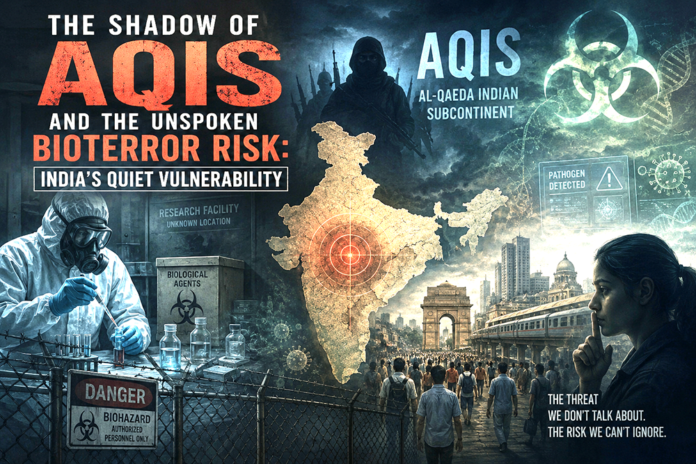
The 38th report of the Analytical Support and Sanctions Monitoring Team, submitted pursuant to UN Security Council resolution 2734 (2024), has delivered an uncomfortable reminder. Al-Qaida in the Indian Subcontinent (AQIS) is no longer a fringe or fragmented entity; it has grown into a regional terrorist organisation, with logistics and financial networks in place. It operates through decentralised small cells rather than big, clearly visible units, and somehow that difference matters more than before. The report attributes the November 2025 attack near the Red Fort in Delhi to AQIS. That attribution, if grounded in the National Investigation Agency’s exhaustive investigation, should force a harder national debate about both conventional and unconventional threats.
The NIA’s 7,500-page chargesheet against the accused in the Faridabad ‘white-collar’ terror cell links them to Ansar Ghazwat-ul-Hind, a known AQIS offshoot. The picture that emerges is of educated, professionally placed individuals rather than the stereotypical foot soldiers of earlier decades. This shift towards small, dispersed, professionalised cells is precisely what makes detection harder and the potential for surprise greater. AQIS’s reported capacity to sustain itself through local networks, rather than relying solely on external direction, marks a qualitative change in the threat landscape of the Indian Subcontinent.

Yet the report’s more unsettling passage concerns chemical and biological weapons. Al-Qaida and ISIL (Da’esh) have shown sustained interest over many years in developing such capabilities. They have not yet overcome the technical challenges. Instructions on producing botulinum toxin and cyanide appeared in ISIL’s English-language magazine ‘Invade’ earlier this year. ISIL-Khorasan has circulated guidance on ricin production over the past 12 months. Three individuals, including a doctor, were arrested after being tasked by an overseas ISIL cell to develop ricin. The Indian authorities have not confirmed that any such programme has taken root on Indian soil, but the absence of confirmation is not the same as the absence of risk.
Instructions on producing botulinum toxin and cyanide appeared in ISIL’s English-language magazine ‘Invade’ earlier this year. ISIL-Khorasan has circulated guidance on ricin production over the past 12 months. Three individuals, including a doctor, were arrested after being tasked by an overseas ISIL cell to develop ricin
India has never recorded a documented case of bioterrorism. That fact is reassuring, but also misleading. Studies of natural disease outbreaks show how hard it is for investigators to determine whether bioterror is involved. There are multiple plausible agents, different incubation periods, and even when some illnesses lead to high mortality, the picture can still stay murky. Plus, it is easier for a carrier to travel and spread the pathogen before symptoms show up, so the early trail can get messy. Figuring out whether it was a bioterror attack or a natural outbreak is not always clear-cut, particularly in those first critical days. Also, 17 countries are known to have maintained biological weapons programmes at some point. The knowledge base is therefore not confined to state laboratories; technical instructions circulate freely in online extremist communities.
Official responses in Parliament have outlined India’s existing architecture for biological emergencies. The Ministry of Health and Family Welfare is the nodal ministry. The National Disaster Management Guidelines on Management of Biological Disasters (2008) and the National Disaster Management Plan (2019) give an overall framework for prevention, preparedness, early detection, containment, and a coordinated response. The Integrated Disease Surveillance Programme operates in a decentralised way through a system of Rapid Response Teams, which is the point. The Indian Council of Medical Research has built a network of more than 150 Viral Research and Diagnostic Laboratories, also with two mobile BSL-3 laboratories. Meanwhile, the Pradhan Mantri Ayushman Bharat Health Infrastructure Mission is meant to bolster primary, secondary, and tertiary capacity against emerging diseases. Battalions of the National Disaster Response Force receive basic CBRN training and are equipped for detection, monitoring, and decontamination. Regular multi-agency mock drills are conducted.
India has never recorded a documented case of bioterrorism. That fact is reassuring, but also misleading. Studies of natural disease outbreaks show how hard it is for investigators to determine whether bioterror is involved. There are multiple plausible agents, different incubation periods, and even when some illnesses lead to high mortality, the picture can still stay murky
These measures are real and necessary. They are also mainly crafted for natural outbreaks and public-health emergencies, pandemics, epidemics, or accidental releases. The official documents and parliamentary replies seldom highlight intentional bioterrorism as a separate contingency. NDRF teams are trained for CBRN response, but whether that training actually folds in the investigative, forensic, and attribution difficulties that are particular to a deliberate attack isn’t really obvious from what the public record shows. Health is a state matter, and even if the central technical and financial support is very generous, it still cannot automatically secure consistent readiness across all districts.

The distinction matters. A natural outbreak sets off public health protocols built around containment, care, and vaccination. But a bioterror incident adds more layers, like a criminal inquiry, attribution work, the possible presence of secondary devices or even simultaneous conventional attacks, plus all the extra effort to keep responders safe from the pathogen and also from hostile action that might happen at the same time. Small cells of the AQIS could, in theory, exploit this gap, using the chaos of an unexplained disease cluster to amplify psychological impact while remaining below the threshold of military response.
None of this is to claim that a bioterror attack is imminent or that AQIS possesses such capability today. The UN monitoring team itself notes the persistent technical barriers. The point is more modest and more urgent: the combination of a decentralised, professionalising regional network with the open circulation of crude biological weapon recipes creates a residual risk that existing public-health and disaster-management frameworks only partially address. Treating bioterror solely as a subset of biological disaster management risks under-preparing the specialised interfaces between health agencies, intelligence services, forensic laboratories and specialised response forces.

The Red Fort attack of November 2025, whatever its precise operational details, has already demonstrated that AQIS or its affiliates can project violence into the national capital using domestic cells. The white-collar profile of the Faridabad network suggests recruitment of individuals with technical education and professional cover. That profile is not limited to explosives or firearms
The Red Fort attack of November 2025, whatever its precise operational details, has already demonstrated that AQIS or its affiliates can project violence into the national capital using domestic cells. The white-collar profile of the Faridabad network suggests an ability to recruit individuals with technical education and professional cover. That profile is not limited to explosives or firearms. Educational and professional networks could, in a worst-case scenario, be leveraged for more complex projects.
India’s disaster-management architecture has matured considerably since 2008. The expansion of laboratory networks, the creation of mobile BSL-3 capacity, the institutionalisation of Rapid Response Teams and the CBRN training of NDRF units are tangible achievements. What remains is to close the conceptual and operational gap between ‘biological emergency’ and ‘bioterrorism’. Continuous technical assessment by the Ministry of Health, the National Centre for Disease Control, the ICMR and security agencies is already underway. Explicitly incorporating intentional biological threats into planning assumptions, exercise scenarios, and inter-agency protocols would be a logical next step.
The UN report does not claim that AQIS has solved the technical problems of biological weapons. It does record sustained interest, open dissemination of instructions, and at least one attempt involving a medical professional. In an environment where terrorist groups operate in small, scattered cells and recruit from educated urban cohorts, the residual risk cannot be dismissed as purely theoretical. Preparedness that is framed only around natural outbreaks leaves an unnecessary seam in national resilience. Closing that seam is not alarmism; it is prudent recognition of how the threat has evolved.

The writer is an expert on geopolitics, national security, and counter-terrorism; and he regularly contributes his subject thought-leadership and academic commentary with several publications in newspapers, journals, and periodicals. He works with investigative agencies, regulatory bodies, financial institutions and enterprises, providing strategic and regulatory advisory. The views expressed are personal and do not necessarily carry the views of Raksha Anirveda





