


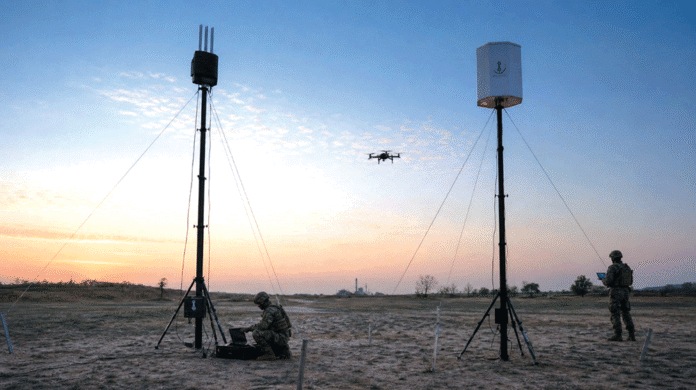
A tired sentry, after a night-long vigil, hears a faint buzzing sound. At first, he dismisses it as an insect. Seconds later, the sound grows louder. A small object appears over the tree line, flying low and steadily towards the perimeter. It is too small to identify with the naked eye. Is it a hobby drone? A surveillance platform? Or the beginning of an attack?
Modern battlefields rarely provide enough time to find the perfect answer. Decisions often must be made within minutes. Sometimes, within seconds. That brief window—between the first indication of a threat and the moment it reaches its target—is where modern Counter-Unmanned Aircraft Systems (CUAS) earn their place.

The New Face of the Battlefield
For decades, air threats were associated with fighter aircraft, helicopters, and missiles. These platforms were expensive, highly visible, and usually operated by state actors.
Modern day drones have changed that equation.
Today, a commercially available drone costing less than a smartphone can gather intelligence, track the ground movement, map sensitive installations, and it can even deliver a small payload. Most importantly, such drones are widely available and easy to operate.
This has transformed the nature of battlefield surveillance and security. A small quadcopter hovering over a defence / restricted zone may appear harmless. Yet the same platform can be used to collect images, relay coordinates, or assist a larger attack.

The uncertainty surrounding these threats is what makes them difficult to counter.
From Alert to Assessment
Many people assume that once a drone is detected, the problem is solved. In reality, detection is often the easiest part of the process, but it is only the beginning. Determining its intent is often the harder task.

Modern CUAS use a combination of sensors to monitor the airspace. Radars search for airborne objects, radio-frequency sensors listen for communication links and signals, electro-optical cameras provide visual confirmation and thermal sensors assist during low-light conditions. Each sensor contributes another piece to the puzzle.
However, detecting a drone-sized object is not always straightforward. Birds, environmental clutter, buildings, moving vehicles, and weather conditions can all generate confusing signals. Operators must continuously assess incoming information and determine whether an alert represents a genuine threat. The battlefield rarely offers perfect data. Instead, decisions must be made using the available information and limited time.
The Operator in Loop
Technology often receives the spotlight, but every successful counter-drone engagement ultimately depends on people.
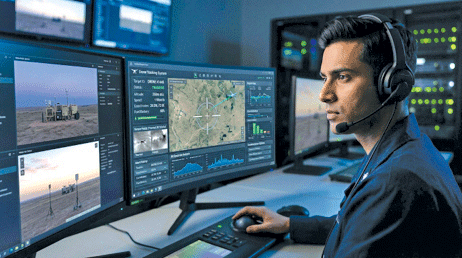
Behind every command-and-control display, is an operator responsible for interpreting the data, assessing threats, and communicating with decision-makers. The operator’s task is not simply to identify a drone.
They must determine whether the object poses a threat, understand its behaviour, evaluate possible responses, and coordinate with multiple stakeholders.
Modern Counter-Unmanned Aircraft Systems (CUAS) use a combination of sensors to monitor the airspace. Radars search for airborne objects, radio-frequency sensors listen for communication links and signals, electro-optical cameras provide visual confirmation and thermal sensors assist during low-light conditions. Each sensor contributes another piece to the puzzle
This responsibility becomes even more demanding during periods of high activity.
Imagine receiving several alerts within a short span of time. One may be a bird. Another may be a friendly drone. A third could be an unknown platform approaching a sensitive area. The operator must make sense of these situations without the luxury of lengthy analysis. Training, experience, and judgement become just as important as technology. In many cases, the difference between success and failure lies not in the equipment but in the quality of human decision-making.
What Comes Next?
Once a drone has been detected and identified, the next question is deceptively simple: “What should we do about it?” This is often the most critical stage of the engagement. Responding too slowly may allow the drone to complete its mission. Responding too aggressively may create unnecessary risks. A drone flying near an ammunition depot may require immediate action. A drone operating near a civilian area may demand a more measured response. Decision makers must balance operational necessity, safety considerations, and rules of engagement. There is no universal solution. Every situation must be assessed based on its own circumstance.
Training, experience, and judgement become just as important as technology. In many cases, the difference between success and failure lies not in the equipment but in the quality of human decision-making
Soft Kill Before Hard Kill
Modern counter-drone systems generally rely on a layered approach. Whenever possible, the preferred option is to disrupt the drone without physically destroying it. This is often achieved through different electronic warfare techniques. By interrupting the communication links or interfering with satellite navigation signals, operators may force a drone to land, return to its launch point, or lose its ability to continue the mission. Such measures can be effective while minimising collateral damage. However, electronic measures are not always sufficient on their own. Autonomous drones, pre-programmed flight paths, and evolving technologies are reducing the effectiveness of traditional countermeasures.
When soft-kill options fail, hard-kill solutions become mandatory. These may include kinetic interceptors, specialised projectiles, directed-energy weapon, net catchers or other defeat mechanisms. The objective remains the same: neutralise the threat before it achieves its purpose.
When Every Second Counts
Counter-drone operations are often measured in minutes. Sometimes even in seconds. A drone travelling at modest speeds can cover significant distances in a very short period. Every delay reduces the available response window. This creates what many operators describe as a race against time. Detection must occur early. Classification and Identification must be accurate. Communication must be clear. The entire process must work in tandem.
Lessons From Recent Conflicts
In many theatres, they have become one of the most visible examples of how innovation can rapidly alter the balance between attackers and defenders. They are a battlefield standard. What has changed is not just frequency of use but the nature of the threat. Small, low-cost drones are now being used in coordinated swarms, flying pre-programmed routes that defeat traditional jammers, strikes with precision at the targets that once required far greater resources to reach. The cost asymmetry is significant, and the adversary can field dozens of systems for what it costs a defender to intercept one. This has forced a fundamental rethink of air defence doctrine. The question is no longer how to defeat a small number of high-value aerial threats. It is how to build a defence that is effective, scalable, and economically sustainable against a large and growing volume of low-cost airborne systems.
For India, this challenge carries additional significance. Securing a vast geographic area and a wide range of critical infrastructure requires solutions that are not only operationally effective but also scalable, sustainable, and most importantly indigenous. Counter-drone capability therefore sits at the intersection of national security and India’s Aatmanirbhar Bharat initiative, which seeks to strengthen technological self-reliance in defence. Today, India roughly has around 10 credible CUAS integrators in the country who can supply a complete system (Detect, Track and Neutralise).
The Future of Counter-Drone Innovation
The counter-drone challenge is not merely an operational problem. It is increasingly an innovation challenge. The challenge is no longer developing individual technologies in isolation but integrating them into operationally effective systems that can respond at the speed of the threat. Modern Counter-Unmanned Aircraft Systems sit at the intersection of RF detection, radar, electro-optical sensors, interceptors, artificial intelligence, data fusion, embedded systems, and advanced software. Success in this domain requires expertise across multiple disciplines working together within a single operational framework.
Across industry, startups, and research institutions, efforts are underway to develop indigenous capabilities for electronic countermeasures. Counter-drone technology is not an abstract capability. It is a practical test whether India can innovate at the pace of a real and evolving threat combining software agility and hardware depth in a single deployable system.
Across industry, startups, and research institutions, efforts are underway to develop indigenous capabilities for electronic countermeasures. Counter-drone technology is not an abstract capability. It is a practical test whether India can innovate at the pace of a real and evolving threat combining software agility and hardware depth in a single deployable system
Looking Ahead
The drone threat will continue to evolve.
Artificial intelligence, autonomous navigation, swarm technologies, and improved communications will make future systems more capable and more difficult to counter. At the same time, counter-drone technologies will continue to advance. Better sensors, improved data fusion, faster decision-making tools, and enhanced electronic warfare capabilities are already shaping the next generation of CUAS solutions. Yet one reality is unlikely to change. The success of any counter-drone operation will depend on the ability to detect threats early, understand them quickly, and respond effectively.
Sometimes, the battle is won in the last 300 seconds!

–The writer is Vice President – Operations at Big Bang Boom Solutions Pvt Ltd. The views expressed are personal and do not necessarily reflect the views of Raksha Anirveda





