


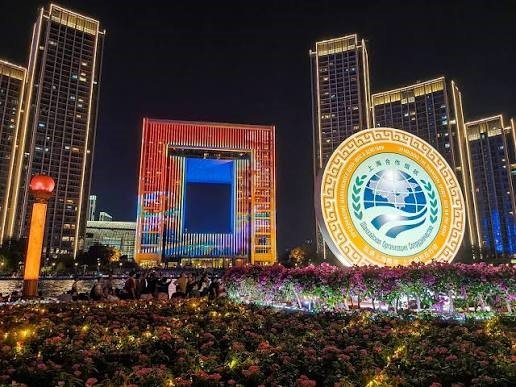
The Shanghai Cooperation Organisation (SCO) was built to fight terrorism, yet its consensus structure gives Pakistan and China a permanent veto over naming cross-border threats. India remains in the bloc not to seek institutional solutions, but to prosecute its case on a global stage while safeguarding its Eurasian strategic interests.
When PM Narendra Modi told the Shanghai Cooperation Organisation in Bishkek that “there can be no place for double standards on terrorism,” he was stating a principle that is both unarguable and, within that particular room, unachievable.

The SCO turned twenty-five this year having built its very identity around counter-terrorism. Its founding logic, the “three evils” of terrorism, separatism and extremism, predates almost everything else it does. And yet for South Asia, the region where terrorism is least abstract, the organisation is constitutionally incapable of naming the problem.
That is not rhetoric. It is arithmetic.
New Delhi’s refusal to sign the joint communiqué after the Pahalgam attack exposed the bloc’s bias, choosing complete silence over endorsing a inverted narrative
The SCO decides by consensus; every member holds a veto. India sits at the table alongside Pakistan, the state it accuses of masterminding, financing and sheltering the cross-border attacks that have shaped a generation of Indian security policy, and alongside China, Pakistan’s closest strategic partner and, until this year, the SCO’s chair.
In an organisation where a single objection sinks a document, the effect is straightforward: the body designed to fight terrorism cannot name the terrorism that most concerns one of its most important members.

The mechanism was on open display last June. At the SCO defence ministers’ meeting in Qingdao, Defence Minister Rajnath Singh refused to sign the joint communiqué. The draft made no mention of the Pahalgam attack of 22 April 2025, in which 26 people, most of them tourists, were murdered in Kashmir’s Baisaran Valley.
It did, however, find room for “disturbances in Balochistan”, Islamabad’s preferred grievance, and an implicit charge against New Delhi. Because the SCO issues statements only by agreement, India’s objection meant no statement at all. New Delhi preferred silence to a document that inverted victim and perpetrator.

India continues attending SCO summits to indict Pakistan and challenge China on a shared stage, leveraging the adversary’s own forum for global messaging
Read carefully, Qingdao is the whole story of the SCO’s counter-terrorism pretensions in miniature. The forum was not merely failing to help India; it was being steered, by Pakistan with Chinese acquiescence, into a vehicle for the opposite narrative.
India’s walkout preserved its position but also revealed the ceiling: the most India can extract from the SCO on terrorism is the power to deny others a clean propaganda victory. Accountability, the naming of sponsors, the freezing of networks, lies permanently out of reach.
This is what the analysts’ phrase “coexistence without convergence” actually means when applied to security. The SCO gives India something real: a standing channel to its rivals, insulated from the theatrics of bilateral rupture. But it converts that proximity into paralysis on precisely the issue where India seeks movement.
The Regional Anti-Terrorist Structure, the SCO’s dedicated counter-terror arm, illustrates the same limit. RATS runs databases, shares watch-lists and coordinates the occasional exercise. What it cannot do, will never do, is act against a member state. Its architecture assumes the terrorists are external to the club. In South Asia, India argues, they are not.
Which raises the harder question: why does India keep showing up?
Beyond security, the SCO serves as India’s primary gateway to Central Asia, Iran and Russia, protecting key energy and transport corridors like Chabahar
Part of the answer is that the SCO is a megaphone. When Modi says in Bishkek that “terrorism cannot be a strategic asset for anyone,” or that the “entire ecosystem” of financing, recruitment, radicalisation and safe havens must be dismantled, the words are aimed less at the leaders in the hall than at the global audience beyond it.
The forum India cannot use to punish Pakistan, it can use to indict Pakistan, repeatedly, on a shared stage, in front of Beijing and Moscow. There is a certain logic to prosecuting your case in the courtroom your adversary helped build.
The other part of the answer has nothing to do with Pakistan. The SCO is India’s most efficient point of contact with Central Asia, Iran and Russia, the connectivity partners behind the International North-South Transport Corridor and Chabahar, the energy suppliers, the swing states India courts to dilute Chinese dominance of its northern neighbourhood.
PM Modi’s pointed insistence in Bishkek that connectivity “must respect sovereignty and territorial integrity”, an unmistakable reference to the China-Pakistan Economic Corridor cutting through Pakistan-occupied Kashmir, was a reminder that for India, the contest for Eurasia and the fight against terrorism are the same contest, waged with different instruments.
But the most consequential shift in South Asian security is not visible in any SCO document. It is in what India now does when the forums fail. Operation Sindoor, India’s military response to Pahalgam, came with a doctrine attached: in Singh’s words at Qingdao, “epicentres of terrorism are no longer safe.”
The SCO amplifies India’s counter-terrorism argument, but true regional deterrence relies entirely on unilateral strength and external diplomatic pressure
That sentence is the real Indian position, and it is addressed to the same audience as the summit speeches. New Delhi is signalling that it no longer waits for multilateral consensus to sanction what it regards as self-defence. The measured cadences of Bishkek and the strikes of last May are two dialects of a single message: India will manufacture its own accountability where the institutions refuse to.
None of this means India should abandon the SCO, and it would be a mistake to read the summit as an Indian triumph. Repeatedly blocking communiqués carries a cost; it lets rivals cast India as the spoiler in a room that prizes the appearance of unity.
India’s simultaneous insistence that there is “no solution on the battlefield”, a line meant for Ukraine, sits uneasily beside a doctrine that reserves the right to strike across a border. And Pakistan’s own claim to victimhood, whatever its merits, will keep finding a sympathetic drafter for as long as China holds the pen. New Delhi should expect the drafting battles to intensify, not ease.
The sober conclusion is that the SCO is a stage, not a shield. It amplifies India’s counter-terrorism argument while structurally refusing to enforce it. For the region, the lesson is that South Asia’s security will not be underwritten in Bishkek or Tianjin.
It will be built where it has always been built, in India’s deterrence posture, its bilateral intelligence links, and the financial and diplomatic pressure it can mobilise outside a consensus that Pakistan and China can always veto. India goes to the SCO to be heard. For everything else, it has learned to look elsewhere.
The writer is an expert on geopolitics, national security, and counter-terrorism; and he regularly contributes his subject thought-leadership and academic commentary with several publications in newspapers, journals, and periodicals. He works with investigative agencies, regulatory bodies, financial institutions and enterprises, providing strategic and regulatory advisory. The views expressed are personal and do not necessarily carry the views of Raksha Anirveda





