


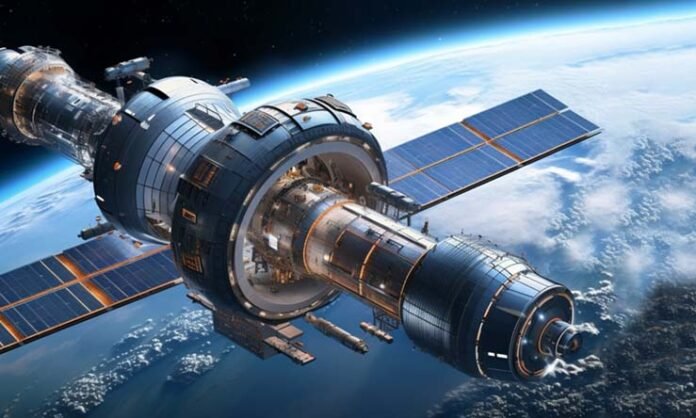
New Delhi: In a major step towards autonomous space technology, the country’s leading space organisation ISRO is developing Space Docking Experiment SPADEX (Space Docking Experiment).
It is one of ISRO’s most significant steps towards developing autonomous docking technology, crucial for India’s growing space ambitions. Docking systems allow two spacecraft to connect in orbit, enabling critical operations like assembling space stations, refuelling, or transferring astronauts and cargo.

SPADEX is key to achieving India’s long-term space exploration goals, including manned spaceflight, satellite maintenance, and future space station construction.
The mission involves two vehicles—‘Chaser’ and the ‘Target’—coming together and connecting in space. It will also test how well the combined spacecraft maintains stability and control after docking, ensuring smooth operations for future missions.
Once docked, the two spacecraft will later separate to perform additional tasks. This experiment is crucial for ISRO to develop the skills needed for advanced missions, such as human spaceflight and lunar sample returns. Mastering these docking and rendezvous techniques is essential for the success of such ambitious operations.
Hyderabad-headquartered Ananth Technologies, an aerospace and defence company, successfully completed the satellite integration project for ISRO. This also marks a private player joining the SPADEX Mission.

Ananth Technologies Private Limited (ATL) successfully assembled two 400 kg satellites for ISRO and delivered them to the UR Rao Satellite Centre (URSC) in Bengaluru. This centre is responsible for designing and developing satellites for various space missions.
“We have been manufacturing electronic subsystems for ISRO since 2000 and have been an integral part of every Indian space programme over the last two decades,” Subba Rao Pavuluri, chairman of ATL, said.

ISRO has acquired two satellites, each weighing 400 kg, for a SPADEX mission. In this mission, a single rocket will launch both satellites into space, placing them in slightly different orbits. This setup is essential to test how well the satellites can approach, align and dock with each other in orbit, demonstrating key technologies for future missions.
The two satellites, travelling at about 28,000 km/h (or around 8 km per second), will carefully align with each other to perform a ‘space handshake’, where they will connect and attach mechanically, becoming a single unit in orbit. This experiment is important because mastering docking is essential for future missions, such as Chandrayaan-4 and India’s proposed Bharatiya Antariksha Space Station.

Raksha Anirveda's editorial desk team brings in the collective experience of creative professionals - a fine mix of senior copy editors, writers, proofreaders and designers. Working as a team, they continuously create, manage, and curate content to sustain the magazine's profile and reputation in line with market trends and achieve magazine's goal.





