


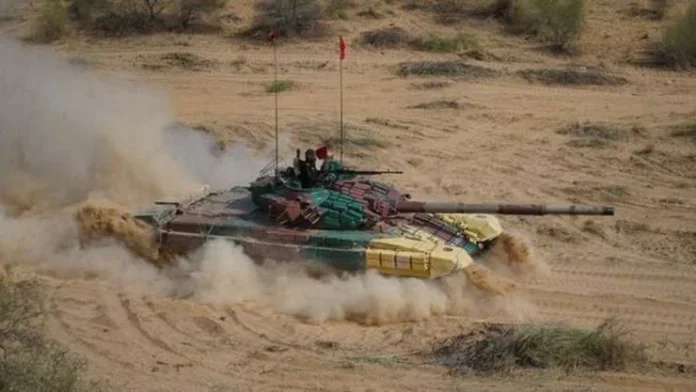
Every tank crew carries the same quiet challenge into the final minutes before contact. It is not the enemy it can see; it is the one it cannot: the missile team buried in the ground, the minefield nobody mapped, the drone that has been watching for ten minutes. For a century, the answer was more armour, and more armour meant a heavier, dearer and slower tank. The Indian Army is now testing a different answer. Send something else in first.
The idea is a ground loyal wingman, an unmanned vehicle that moves with or ahead of manned tanks to scout, breach, draw fire, carry extra weapons, and sometimes act as a mobile command point. It has moved from a seminar slide to a written requirement. In the ADITI 4.0 round of iDEX, open from March 17 to May 4, 2026, the Army asked industry to digitise the T-72, make it remotely operable while retaining its mechanical reliability, and connect it to higher control systems via an IP-based interface, so that legacy tanks can augment manned ones in a manned-unmanned teaming framework. Smaller efforts run alongside. In 2022, DRDO’s Combat Vehicles Research and Development Establishment proposed an unmanned vehicle based on the Arjun Mk 1A, and a Corps of Engineers officer showcased a multi-utility UGV, Sapperscout 2.0, at the Army’s Innoyodha event in late 2025. Private industry is also collaborating with foreign partners and making efforts. Yet none are on the ground and truly indigenous.

The Army has asked industry to digitise the T-72, make it remotely operable while retaining its mechanical reliability, and connect it to higher control systems via an IP-based interface, so that legacy tanks can augment manned ones in a manned-unmanned teaming framework
Precision matters here. A challenge statement is not a fielded system, and the government listing shows the T-72 round as closed, with the outcome awaited. The debate is therefore about direction, and the hardest question in it is who will build the machine.
The direction is sound. A crew is the costliest and slowest thing a regiment can replace, so spending a machine to protect it is good arithmetic. India has a large legacy tank fleet that is losing its place on the modern battlefield, and conversion turns that liability into mass without waiting for a new design. A robot that goes first also changes what the enemy must do. Every contact costs him ammunition, position, and time before he learns whether he has hit anything that matters, and a decoy that fights like a tank buys the commander seconds.
The indigenous question starts with an uncomfortable fact. India has never produced a truly indigenous tank. The Arjun took decades and still relies on imported technologies and major assemblies. The 118 Mk-1A tanks ordered in 2021 have been held up by the powerpack, and public reporting through July 2026 did not confirm that serial deliveries had begun. One imported component has controlled the delivery of a finished weapon. BEML test-fired an indigenous 1,500 horsepower tank engine in March 2024, a real milestone, but one that arrived decades after the programme began. Even the Zorawar light tank, built by L&T, uses a US-built Cummins engine and a RENK transmission after a German engine deal fell through on export restrictions. Indigenous content remains a poor 40 to 45% approx.
Resilient radios and anti-jam navigation determine whether a wingman stays loyal under electronic attack. Beneath the software lie the chips, most of which India still imports. A wingman can carry Indian code and still stall on a foreign part
A wingman built on a converted T-72 inherits that pattern: a Soviet-designed hull and powerpack, and a supply chain India does not control. The advantage is the availability, as the T-90 and later FRCV replace the T-72. The conversion itself is a different matter. It calls for actuators on steering, throttle, and brakes; sensors; onboard computing; secure data links; and autonomy software. That is electronics and software work, where Indian start-ups and MSMEs are better placed than in heavy powertrains. Small ground robots such as DRDO’s Daksh and Sapperscout 2.0 show that Indian teams can field working machines. The step from there to a tank of more than forty tonnes that must keep pace with armour is large, but it is a step from a base that exists.

The gaps deserve plain names. Powertrain and transmission come first, and the Arjun story is the warning. India has long imported gun control and precision sighting. Resilient radios and anti-jam navigation determine whether a wingman stays loyal under electronic attack. Beneath the software lie the chips, most of which India still imports. A wingman can carry Indian code and still stall on a foreign part.
The answer is not to demand a fully indigenous machine on day one. That instinct produced the Arjun’s long wait. A better test is sovereignty over the parts that decide the fight: the autonomy software and its source code, the data link, the command interface, and the right to modify all three. Commodity and legacy components can be sourced abroad, provided each has a second source and an indigenous replacement under development in parallel. Indigenous content then grows with orders instead of being demanded before the first one.

Industry capability is uneven. Public sector bodies such as the Heavy Vehicles Factory, BEML and CVRDE hold the heavy engineering and the T-72 and Arjun experience. Large private firms such as L&T bring programme discipline. Start-ups and MSMEs bring speed in autonomy and sensing. What has often failed is the stretch between a working prototype and a production order, where small firms run out of money. iDEX is good at starting work. It is not, by itself, a route to a fielded fleet, so the Army must state the numbers it will buy if conversion kits pass trials.
The answer is not to demand a fully indigenous machine on day one. A better test is sovereignty over the parts that decide the fight: the autonomy software and its source code, the data link, the command interface, and the right to modify all three
Others offer cautions. The United States began its Robotic Combat Vehicle effort in 2019 with light, medium, and heavy variants in mind, narrowed it to one vehicle, and halted it in 2025 under the Army Transformation Initiative. By October 2025, General Dynamics Land Systems was answering a fresh Army call for a robotic vehicle, so cost and relevance, not lack of interest, appear to have driven the halt. Britain has announced work to explore the Ajax as a command hub for ARX Robotics’ Hector wheeled robot, which is a concept and not yet a capability. ARX says its Gereon was refined on Ukraine’s front line.
Six steps follow. Write the requirement by role, not by platform, so a start-up with a sound 400-kilogram robot can compete with a converted tank. Build a tiered family: converted heavies for breaching and decoy work, light robots for reconnaissance, small ones for ammunition and casualties. Keep sovereign control of autonomy, data link, and command interface, with an open architecture so kits from different Indian firms can be swapped. Trial in the Rajasthan sands and Eastern Ladakh with jamming switched on, across a full season, with soldiers and not vendors at the controls. Build the people, with an operator trade, simulators at the Armoured Corps Centre and School at Ahmednagar, and EME trained to repair what returns damaged. And write the doctrine, including the rule that is not negotiable: a human decides when a machine fires. Plan for attrition throughout, because a wingman nobody will lose gets handled like a tank.
A wingman India cannot build, repair, and update on its own terms is a borrowed one. The robot’s job is to be lost so that the regiment is not, and industry’s job is to make sure that losing it never depends on someone else’s export licence.
The writer, a PVSM, AVSM, VSM has had an illustrious career spanning nearly four decades. A distinguished Armoured Corps officer, he has served in various prestigious staff and command appointments including Commander Independent Armoured Brigade, ADG PP, GOC Armoured Division and GOC Strike 1. The officer retired as DG Mechanised Forces in December 2017 during which he was the architect to initiate process for reintroduction of Light Tank and Chairman on the study on C5ISR for Indian Army. Subsequently he was Consultant MoD/OFB from 2018 to 2020. He is also a reputed defence analyst, a motivational speaker and prolific writer on matters of military, defence technology and national security. The views expressed are personal and do not necessarily carry the views of Raksha Anirveda





