


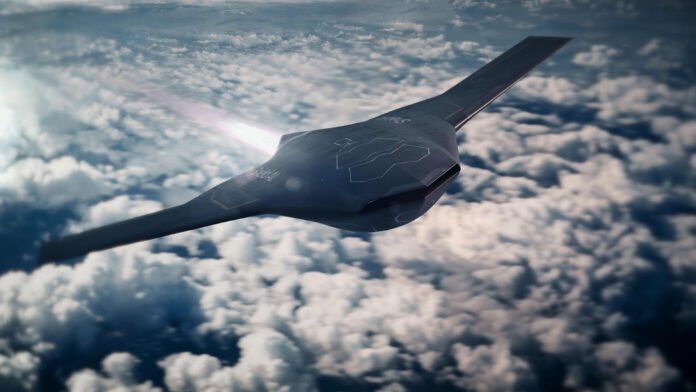
The US defence technology company, Shield AI presented the X-BAT concept as a runway-independent combat aircraft: it would rise vertically from a tail-sitting position, transition to conventional flight and return to land vertically. The proposed design is intended to operate from locations and vessels that lack the runways or carrier equipment used by conventional fighter aircraft.
Shield AI says the aircraft could perform air-to-air and air-to-surface missions, as well as electronic warfare. Its website describes a 39-foot wingspan, a range exceeding 2,000 nautical miles and an operating ceiling above 50,000 feet. Those are company-published specifications for a system still in development, not independently demonstrated performance.

The concept’s central feature is its vertical take-off and landing profile. X-BAT is designed to stand on its tail and use a jet engine with a thrust-vectoring nozzle to control its flight during the vertical phases. The aircraft would then transition to forward flight for its mission. The unusual approach could reduce dependence on prepared runways, but it also places demanding requirements on propulsion, flight controls and autonomous operation.
Shield AI has partnered with GE Aerospace on the propulsion system. The companies have described adapting an F110 engine for the aircraft and using a thrust-vectoring nozzle, with testing and development underway. In April 2026, the companies displayed a revised design with an arrowhead-shaped profile, replacing an earlier configuration. Shield AI said the changes followed an iterative development process informed by test data.
Autonomy is another core part of the pitch. Shield AI says its Hivemind software will control the aircraft and enable it to operate in GPS- or communications-denied environments. The company also presents X-BAT as capable of working in teams, with one human commander directing multiple aircraft. These are intended functions; their effectiveness in operational conditions will depend on testing, integration and future military evaluation.
A key appeal for military planners would be the possibility of dispersing aircraft across more sites. Runways and major air bases are expensive infrastructure and can be vulnerable in a conflict. An aircraft able to launch from a ship or austere forward location could, in principle, give forces additional basing options. Shield AI describes this as runway-independent airpower, while analysts note that the actual benefits will hinge on the aircraft’s performance, support requirements and ability to recover reliably.

The programme has drawn US Navy funding. In August 2026, the Navy and the Defence Innovation Unit committed $50 million toward development, matched by Shield AI. In October, the Navy added a $150 million agreement modification, also to be matched by the company. The combined public and private commitments announced for the programme amount to $400 million. Funding is tied to development milestones, and the aircraft has not yet flown.
Shield AI has said it expects to begin flight testing before the end of 2026, starting with vertical take-off and landing trials. In October, the company said it was building two full-scale prototypes, with the first nearing completion. It has described a goal of achieving an early operational capability around 2029. The schedule is ambitious, and the project must still demonstrate that the aircraft can safely transition between vertical and forward flight, as well as complete recoveries in realistic conditions.

The proposed platform joins a broader effort by militaries and defence firms to develop autonomous aircraft that complement crewed fighters. Such systems could extend surveillance, electronic-warfare or strike capacity, but they also raise questions about command authority, reliability, maintenance and how autonomous aircraft would be integrated into existing forces. X-BAT’s developers argue that the aircraft is designed around autonomy from the outset, rather than adapting a conventional crewed aircraft.
For now, X-BAT remains a development programme, not an operational fighter. The company’s announcement sets out an ambitious combination of vertical take-off, long-range flight and autonomous control. Prototype testing will determine whether those features can be combined in a practical aircraft-and whether the runway-free concept can move from a striking design to a capability military customers are willing to field.







