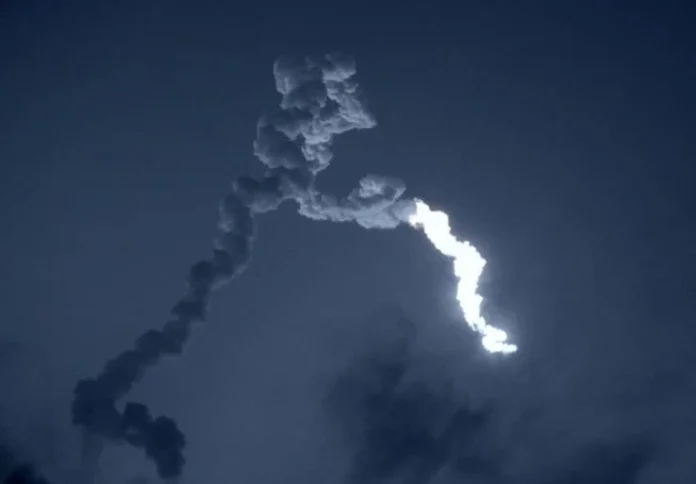
New Delhi: Indian Space Research Organisation’s second mission of the year to place an earth observation satellite by a GSLV rocket faced a setback as the mission could not be accomplished fully due to performance anomaly in the cryogenic stage of the rocket, the space agency said on August 12.

The 51.70-metre tall rocket GSLV-F10/EOS-03 successfully lifted off from the second launch pad at the spaceport as planned at 05.43 hours soon after the 26-hour countdown concluded.
Ahead of the lift-off, the Launch Authorisation Board cleared the decks for a normal lift-off as planned. The performance of the rocket in the first and second stages of the rocket was normal, scientists at the Mission Control Centre said.
However, minutes later the scientists were seen in discussion and it was announced in the Mission Control Centre by the Range Operations Director “mission could not be accomplished fully due to performance anomaly”.
The Geosynchronous Satellite Launch Vehicle-F10 (GSLV-F10) took off at 5.43am as scheduled and the core stage burn out happened as planned, propelling the rocket in its intended path. Second stage ignition happened as planned some two minutes into the launch and payload fairing was confirmed by the mission control a little after nearly four minutes after take-off, as planned.

And then there were a few tense moments that followed soon after the second stage shut off. The cryogenic stage did not ignite, rendering the mission a failure.
“Due to a technical anomaly in the cryogenic stage, the mission could not be fully accomplished,” ISRO chairman K Sivan said addressing the team of scientists and engineers at Sriharikota after the mission. ISRO will now form a failure analysis committee (FAC) that will analyse the reasons for the anomaly.

This was the space agency’s third attempt at launching the satellite. It was first scheduled for March 5, 2020, but was scrubbed minutes before the 26-hour countdown was to begin on March 4, 2020. While ISRO again appeared confident of launching it earlier this year (2021), the launch didn’t happen owing to a voltage issue that scientists described as a “minor power problem”.
Designed to provide near real-time images of large “areas of region of interest” at frequent intervals, the satellite was to be a kind of advanced ‘eye in the sky’ and also held the potential of aiding the country’s armed forces to plan operations.
The satellite was expected to boost India’s abilities by providing near real-time observation of the sub-continent, under cloud-free conditions, at frequent intervals.