


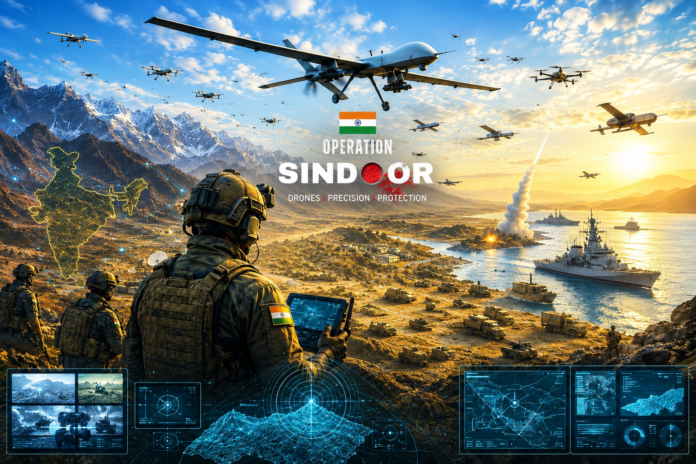
On May 7, 2026, India reaffirmed the efficacy of Operation Sindoor, underscoring its strategic clarity in cross-border force application in response to any terrorist action or cross-border violation. Simultaneously, the aim was to broadcast to the world that, by confining military action to a quid pro quo, India underscored its non-escalatory posture and respect for established international norms. On the contrary, a recalcitrant Pakistan’s retaliatory response was a coordinated drone and missile strikes targeting Indian military installations, bordering on combat escalation to include nuclear sabre rattling. As a counter strike, India, on its part, conducted precision strikes to neutralise systems that had facilitated Pakistani assault and were executed under the guiding principle of “equal intensity in the same domain.” This retaliatory response of targeting only those installations directly involved in the aggression balanced the imperative of selective punitive deterrence with its overarching commitment to escalation control and early de-escalation. In effect, India’s calibrated response, Operation Sindoor, has decisively altered the security dynamics between
India and Pakistan.
Whereas, despite the severity of the impact of Operation Sindoor buttressed by Pakistan’s desperate call for a ceasefire, their military leadership chose to describe their four-day conflict with India ‘Marka-e-Haq’ as a battle between two ideologies where truth had prevailed. Notwithstanding this tall claim, largely dismissed by the international community, Operation Sindoor has been a watershed not only in its military dynamics but also in establishing a new normal in India’s counter-terrorism response. The fact that there has been no major terrorist incident during the past year is a testimony in itself. That apart, Operation Sindoor, even as it is ongoing, has discarded several longstanding shibboleths in India’s strategic and diplomatic thinking. For the first time, New Delhi has made it clear that it will not distinguish between terrorists and those supporting them, and that any future terrorist attack will be considered an ‘act of war’.

This parliamentary formulation is momentous, as it explicitly puts the onus on the Pakistani state and society, making it clear that the choices they make in pursuing the policy of terrorism can no longer have ‘plausible deniability’ and that military action will be escalatory with devastating consequences. Therefore, cross-border terrorism against India will no longer be an impact-drawn rhetoric or a ‘cost-free option’ but one that will redraw the contours of national sovereignty. A closer analysis espouses a few derivatives that merit strategic considerations.
Operation Sindoor – Military Derivatives
Militarily, the short but intense campaign showcased the execution of a multi-domain operation of such scale and complexity involving precision strikes and counter strikes by air, drones, supersonic cruise missiles and artillery proactively engaging predetermined targets, specific to Pakistan’s non-state action, and intended to obliterate terrorist infrastructure with minimum collateral damage. Further, pursuant to the adversary’s retaliation in the conventional domain, similar strikes followed suit as a deliberate reactive counterresponse against military targets aimed at neutralising and degrading Pakistan’s war-waging potential. The fact that air dominance was so preponderant that the scale of degradation and destruction carried out by the Indian military in less than 96 hours forced the adversary to call for cessation of hostilities, knowing fully well that any further escalation would have triggered a full-scale war that Pakistan could ill afford. It demonstrated India’s nationalistic resolve to punish the perpetrators and their sponsor, unmindful of the consequences that perhaps could have led to a full-scale war. The underlying fact clearly distinguished India’s attack as being terror-specific, while Pakistan’s was random retaliation on predictable lines, prompting a full-scale escalation.
However, on hindsight, should the option of a full-scale war have been exercised by Pakistan, the escalation would be in the missile domain where it purports to exercise ‘full-spectrum deterrence’ to counter India’s conventional military advantages. Its short- and medium-range ballistic missiles (Shaheen, Ghauri, Ghaznavi) and advanced cruise missiles (Babur, Harbah, Ra’ad), with recent developments, including the Fatah-III supersonic cruise missile, are likely to be employed against military and civilian infrastructure. What will be of military consequence will be the indiscriminate nature of targeting civilian infrastructure, to include cities and towns, as proclaimed by Pakistan’s Defence Minister Khawaja Asif, warning India that in case of a future conflict between the arch-enemies, Islamabad would respond by attacking West Bengal’s capital Kolkata.
Operation Sindoor has discarded several longstanding shibboleths in India’s strategic and diplomatic thinking. For the first time, New Delhi has made it clear that it will not distinguish between terrorists and those supporting them, and that any future terrorist attack will be considered an ‘act of war’
This follows the stratagem of indirect pressure through humanitarian distress while pursuing a policy of strategic defence across the entire battle space. The operation will also be equally supported by drone warfare of the kind witnessed in the Middle East. Thus, the contours of conventional battle will largely undergo a change to factor in ‘full spectrum irrationality’ as a key component of conflict with Pakistan, necessitating a rethink in our operational paradigm.

Missile Defence System: Under the circumstances enumerated above, air defence or an impregnable iron dome concept will have to be put in place across the national capital and large urban centres besides all national assets across the country, particularly those within Pakistan’s striking distance. In this matter, India has been quick to implement an air defence umbrella by a multi-layered Air Defence ‘Dome’ designed to counter drones, missiles, and other modern aerial threats. Dubbed the Capital Dome, the system pairs the Quick Reaction Surface-to-Air Missile (QRSAM) with the Vertically Launched Short Range Surface-to-Air Missile (VL-SRSAM), offering continuous, overlapping protection. Mounted on 8×8 vehicles, the QRSAM can detect and engage targets on the move up to 30 km, while the VL-SRSAM adds 360-degree coverage within a 10-km radius. To complement the engagement cycle, Akashteer, a mobile Air Defence Network, has been developed to digitise air defence control, enhancing situational awareness and operational coordination among air defence entities.
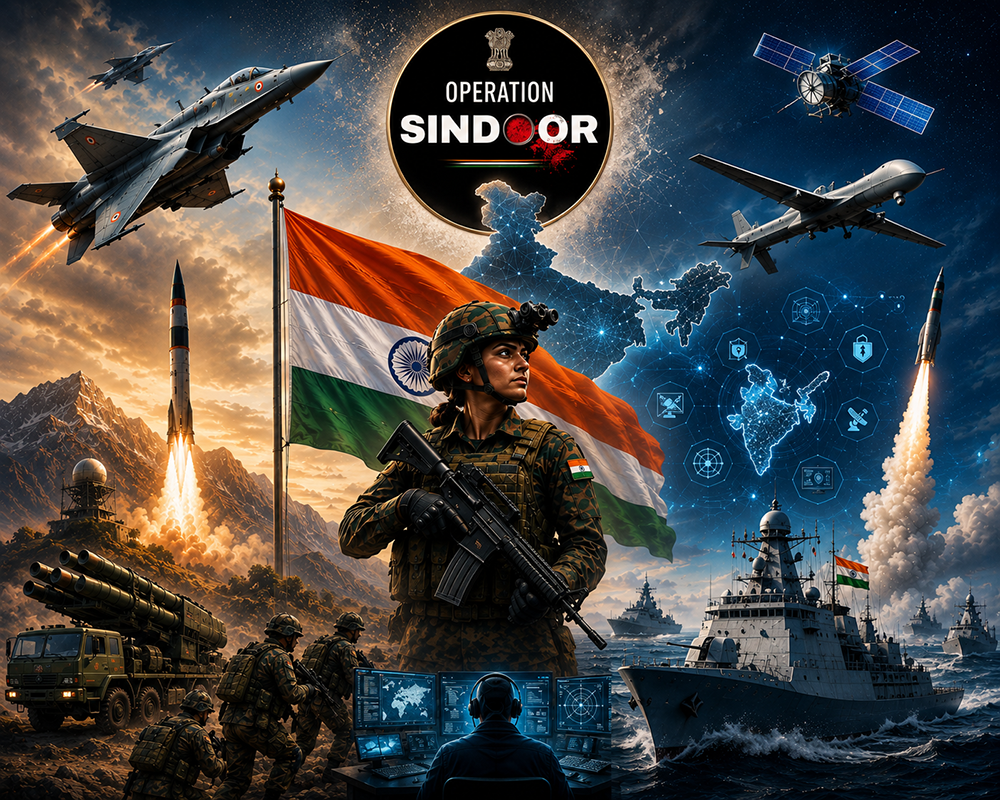

Long Range Interdiction: As part of its offensive capability, India is rapidly advancing its autonomous and targeting systems to enhance strategic deterrence and combat efficiency, particularly in long-range interdiction roles. The enhancement of air power by way of inducting Medium Multi-Role Combat Aircraft (MMRCA) will play a significant role in strategic as well as battlefield interdiction; it will have to be adequately complemented by long-range deep strike cruise missiles. In this regard, the Agni-V missile, equipped with Multiple Independently Targetable Re-entry Vehicle (MIRV) technology, allowing a single missile to deliver multiple warheads, including nuclear warheads, to multiple targets simultaneously, will play a stellar role.
Apart from that, Agni-VI, a highly advanced, nuclear-capable Intercontinental Ballistic Missile (ICBM), is designed to feature an estimated range of 8,000 to 12,000 km with similar MIRV technology to strike up to 10 distinct targets simultaneously. The payload is designed to carry up to 10 nuclear or thermonuclear warheads. As a countermeasure against air defences, it is designed to use decoys and chaff. Its launch mechanism is planned for canister-based, mobile road/rail platforms as well as potential submarine-launch capabilities to ensure survivability and strong ‘second-strike’ options. These are over and above all the conventional missile systems in India’s inventory. It suffices to say that the wherewithal of neutralising Pakistan’s long-range assets is well within our capability.
Counter Drone Systems: Recent conflicts have seen the dramatic use of drones to carry out precision strikes against a variety of targets and at varying depths, thereby altering battlefield dynamics. The clandestine employment capabilities and varying payload capacities of these systems have opened a plethora of options for use as a low-cost countermeasure. Therefore, the fact that drones will play a significant role in any future conflict with Pakistan is a foregone conclusion. Suitable countermeasures have to be implicit in our planning. TRIYAM-3D is an indigenous AI-powered autonomous air-defence system designed to counter drones using Gatling-gun style weapons, featuring acoustic AI threat detection. Presumably, over time, this shield will also be suitably integrated with anti-drone capability.
Indrajaal, an indigenous counter-drone multi-layered autonomous anti-drone system deployed to protect key Indian Army and Naval installations, is marking a significant milestone in India’s transition towards AI-enabled autonomous airspace defence. At the core of Indrajaal’s architecture is its proprietary SkyOS C5ISRT platform, which integrates Command, Control, Communications, Computers, Cyber Defence, Intelligence, Surveillance, Reconnaissance, and Targeting into a single cohesive system, enunciating the paradigm that network centric decision making and execution is a prerequisite to augment speed of precision engagement is an AI driven eco system, which can significantly alter the outcome of any campaign. These AI-based developments are designed to reduce operational costs and improve response times. India is also actively developing AI-based underwater autonomous vehicles and predictive analysis tools for effective border management.
Operational Paradox: The paradox of modern warfare exemplifies the premise that increased technological precision in weapons does not necessarily lead to faster or more decisive victory. In fact, the precision paradox defeats the notion that precision equals rapid strategic victory. Coupled with this is the information-escalation Paradox. In the current digital age, information is weaponised, where a viral false story can trigger escalation as quickly as a physical strike, necessitating a serious focus on perception management. This is equally compounded by the ease of information availability. In this milieu, achieving the desired end state will be more complicated than the traditional conflict outcomes.
In recent times, diplomacy and warfare have often taken a near-simultaneous approach rather than sequentially, with temporary ceasefires being used for tactical readjustment rather than true de-escalation. Given these paradoxical dynamics, modern conventional battle is characterised by a state-on-state, high-intensity combat that emphasises destroying an enemy’s military capability through integrated, precision-guided firepower rather than just attrition in a reasonable time frame. The essence would be to annihilate the adversary before reaching the culminating point.
To do this, the battle space has to be addressed in all tiers in near simultaneously i.e tactical, operational and strategic depth. long-range precision strikes coupled with geographical battlefield isolation by a tri-service force matrix would perhaps set the stage for decisive annihilation as part of a blitzkrieg. Thus, the tenets of erstwhile operational art remain largely relevant except that the means of achieving it in time and space and the components of combat have largely changed. Further, this time-bound strategy has to be technologically driven to achieve the desired combat degradation and operational objectives.
Therefore, doctrinally, the erstwhile ‘Cold start’ has been rightly metamorphosised to ‘Cold Strike’ where speed of engagement is paramount. Herein lies the efficacy of long-range interdiction that is crucial to degrade operational sustainability and decimate reserves in depth. What follows will need the attention of a deliberate manoeuvre force for annihilation. However, this postulate has to be viewed against the backdrop of India’s commitment to no, if not, minimum collateral damage. Notwithstanding the above, in an ‘all of Nation approach’ to defeat the adversary, the effort would be to achieve the political objectives with minimum loss of life and collateral damage. Nuclear option shall predominantly remain as a deterrence rather than a weapon of mass destruction.
Contours of Recent Conflicts
Viewed in this context, the ongoing conflicts have provided valuable insight into the nature of conflict in the context of precision engagement and, more importantly, the efficacy of a superior force. This phenomenon is the cornerstone of asymmetric warfare, where the operationally weaker force employs unconventional tactics to neutralise the advantages of the stronger opponent to achieve disproportionate results. A case in point is the ongoing US-Israel-Iran war in the Middle East. To that extent, examination of each of the ongoing conflicts merits value addition.
Ukraine-Russia War: By contrast, the ideological objectives of the Ukraine-Russia conflict are characterised by a profound, irreconcilable clash between Russian neo-imperialism and Ukrainian national self-determination. Russia seeks to enforce a ‘historical unity’ that denies Ukrainian sovereignty, while Ukraine fights for its survival as an independent, European-aligned state. Russia’s core ideological motivation revolves around reconstructing a sphere of influence and reasserting its identity as a great power in opposition to the West.
Ukraine, on the other hand, focuses on ideological goals that are essentially existential, focusing on liberty, sovereignty, and a European future. This imbroglio has resulted in a protracted confrontation where the war has transitioned from a war of impact or special military operation to a long, grinding battle of attrition.
Russia bets on destroying Ukrainian statehood gradually, while Ukraine relies on resilience. Thus, peace negotiations stumble due to these core ideological differences. It revolves around Ukraine’s demand for a peace based on international law and full territorial sovereignty, whereas Russia uses negotiations as a tactic to force ‘capitulation’. In the process, the battlefield remains dynamic, and the envelopment of targets is predominantly civilian infrastructure, hitherto unheard of in any conflict where the kinetic engagements are unmindful of collateral damage.
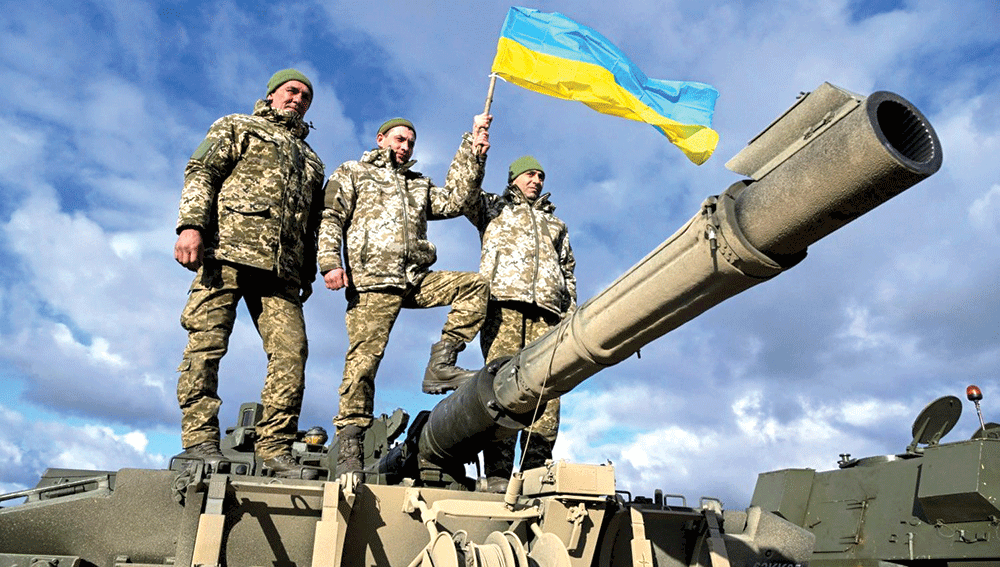
The 4-year war has degenerated into one of prolonged endurance-based creeping attrition with huge collateral damage and no sight of conflict termination. It has clearly pronounced the death of the United Nations as a neutral custodian and arbitrator of peace, while the war has become a way of life.
Operations in Gaza: In Gaza, it is prefaced by the brutal annihilation of Hamas, unmindful of the death and destruction of the Palestinians. The ideological and strategic objectives of Israel’s operations in Gaza focus on eliminating Hamas’s power, reshaping the territory’s governance, and establishing long-term security control to prevent future attacks like that of October 7, 2023. These goals are driven by a security-centric ideology to fundamentally alter the Gaza Strip’s political landscape, involving the reoccupation of territory to enforce these changes. It entailed dismantling Hamas and removing Hamas as a governing body and its military threat in Gaza, besides establishing a ‘security perimeter’ to negate the resurgence of terrorist attacks against Israel ever again.
Having set the stage, the next move was replacing local governance by installing a new, non-Hamas civilian administration in Gaza, potentially involving Arab forces or alternative local leadership, rather than returning to Palestinian control. Paramount in all the above was securing the release of all the remaining Israeli hostages, both living and deceased, which in itself has been a major and increasingly difficult political objective.
It is thus obvious that in doing so, an attempt is being made by Israel to reshape regional dynamics. It is viewed as part of a broader, US-backed effort to weaken the ‘Axis of Resistance’ and force a regional shift towards peace by adopting a ‘Super-Sparta’ model, characterised by perpetual mobilisation and the use of extreme force to deal with perceived existential threats. This plan largely supersedes the earlier ‘Mowing the Grass’ strategy, which entailed periodically weakening Hamas and moving towards a goal of full ideological and military elimination of the organisation. However, in real terms, this prolonged yet devastating military operation has resulted in mass displacement, reflecting an ideological push by far-right elements to permanently alter the demographic landscape of Gaza to potentially facilitate the return of Jewish settlements.
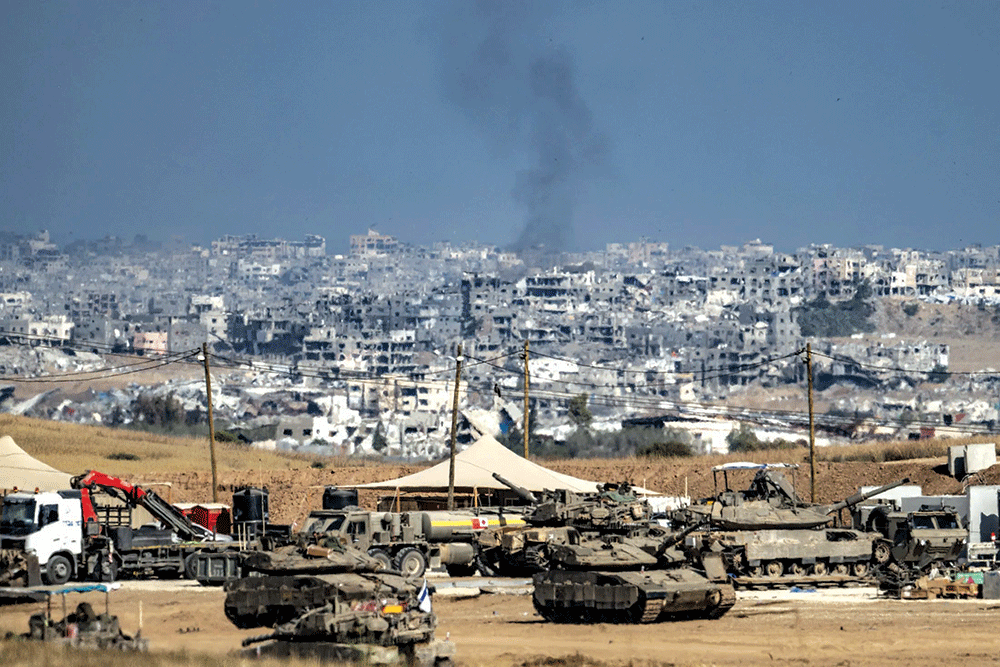
Notwithstanding these Israeli operational imperatives, the stark realities are contradictions and challenges that Israel is facing in its operational pursuit. Despite relentless destructive pressure on Hamas and repeated calls for the return of hostages, the remaining hostages are often used as human shields, complicating military efforts and negotiations. Furthermore, while Hamas has lost control over northern Gaza, it remains a viable fighting force, with its disarmament remaining a stalled demand. Thus, a permanent and lasting peace remains elusive in Gaza. What remains are the ghosts of skeletal buildings and the distant cry of orphaned children echoing the scale of death and destruction unparalleled in human history.
Operation Epic Fury and its Fallout: The US-Israel-Iran conflict has starkly demonstrated the limitations of conventional military superiority against an opponent with low-cost asymmetric capability. The US-Israel strategic dominance over Iran has met with Iran’s strategy of deterrence by denial and deterrence under fire. It relies more explicitly on deterrence by punishment, targeting critical infrastructure, to raise the cost of war while disregarding global military conventions.
Iran chose to exploit the maritime passage across the Strait of Hormuz to de facto weaponise oil and gas to seek a global response to US irrationality. Iran decided to target the global economic gateway by disrupting shipping in the Strait, using sea mines, fast boats and drone strikes to create a hybrid threat to maritime traffic, calling it the ‘Hormuz Toll Tax’ strategy
Strategically, collateral damage is intrinsically inbuilt to seek political and economic leverage. This synthesis would indicate that the efficacy of a conventional battle in the traditional sense is no longer an attempt to destabilise the enemy but to capitulate strategic vulnerability at all costs to not only raise the cost of war but to leverage it for political gains.
In addition, the choice of strategic targets for indirect strikes is not limited to military targets alone but has stretched onto strategic assets, viz., oil fields, water purification plants, etc., that have a compelling effect on the course of the campaign. Iran’s targeting of US forces as well as oil fields in the Gulf countries has had a dual impact of not only crippling the combat capability of the US in the Gulf but also militarily stalling its aggressive design despite gross intimidation of the extreme kind, besides strategically imposing an economic cost.
Thus, Iran did not crumble under US or Israeli military pressure despite being a technologically superior force whose application of force, including ground forces, was sharply calibrated to avoid a confrontation. On the contrary, Iran has emerged more unpredictable, resolute and firm in upholding its national interests despite the capitulation of its leadership, resulting in changing the strategic equation of the region.
A closer look will reveal that the war has been deliberately regionalised. In fact, Iran is not treating the confrontation as a bilateral exchange with Israel or the United States, but as a multi-theatre conflict in which different fronts — Lebanon, Iraq, the Persian Gulf, and maritime chokepoints — are integrated into a single strategic space. This allows Tehran to stretch the US and Israeli resources, complicating their planning and creating a constant operational vacuum and uncertainty of pressure points, thereby capitalising attrition as its war strategy.
In the ultimate analysis, while the US-Israel duo has been the perpetrator, Iran is not seeking a quick end to the war, but is instead trying to sustain pressure over time — militarily, politically, and economically — to alter the adversary’s cost-benefit calculus as well as permanently alter the security dynamics of the region. In that sense, the objective is not battlefield victory in a conventional sense, but producing a new strategic equation in which the threshold for attacking Iran remains prohibitive.
Exploiting the Geographic Vulnerability: Another important facet has been the exploitation of geographic vulnerabilities. At the operational level, Iran chose to exploit the maritime passage across the Strait of Hormuz to de facto weaponise oil and gas to seek a global response to US irrationality. Iran chose to target the global economic gateway by disrupting shipping in the Strait of Hormuz, using sea mines, fast boats, and drone strikes to create a hybrid threat to maritime traffic.
Calling it the ‘Hormuz Toll Tax’ Strategy, Iran has managed to thwart the US intimidation, besides invoking global outrage on the US-Israel initiated conflict for early termination. It has effectively used it as a bargaining chip for conflict termination and long-term peaceful resolution in the region.
The cessation of hostilities seems elusive for the time being, but surely the intended economic effect has been significantly pronounced globally, allowing Iran to adopt a hardline stance to any peace proposal not in its favour, besides withstanding US intimidation and shifting the overall momentum to place the United States on the defensive in a sustained way. In that sense, Hormuz has been central to Iran’s ability to convert geography into leverage and to widen the war beyond the Middle East.
Paradox in the Indian Context
In the Indian context, Operation Sindoor has been demonstrative of India’s military intent and capability, while the cessation of the Indus Water Treaty is a geographical leverage over Pakistan. It is hard to perceive water war as a trigger in a future conflict with Pakistan, given their rhetoric on water ownership; however, a terrorist action will certainly be treated as an act of war. Apart from that, the conflict may also choose to be retributive by way of planning a reunification or annexing PoK, a long-standing political parliamentary resolution of 1994.
Therefore, in the event of a conflict, it is a foregone conclusion that the physical combat engagement of the campaign will be prolonged in nature. It could also perhaps draw a red line to encompass PoK in its current form by military means. Dissecting this further, going forward, both sides will have targeting concerns and have compelling reasons to worry about what the targeting precedents from this conflict (Op Sindoor) might mean for escalation risks in the next one. India’s opening salvos hit Muridke — LeT’s well-known headquarters — and a major Jaish-e-Mohammed complex in Bahawalpur.
Those strikes told a clear story of proportionality, striking terrorist bases for terrorist violence. But they also exhausted two of the most symbolic, politically sellable sites that had long been on India’s short list. Should another attack occur, New Delhi may feel compelled to reach deeper into Pakistan to find sites with comparable political and operational value. That apart, the focus will be to degrade Pakistan’s war-waging potential to carry out a calibrated attrition battle till its final capitulation.
These anxieties may well shape Pakistani doctrine going forward, nudging it towards earlier mobilisation and, paradoxically, faster escalation in a future conflict. All this will be under the spectre of a nuclear conflagration, which cannot be lost sight of. Thus, India must be prepared for a ‘hybridised’ battlespace, ensuring rapid air dominance and surgical destruction to secure victory through a swift and decisive ground action. The next war with Pakistan will certainly be a long-drawn conflict of attrition with a questionable sustainability factor.
India must be prepared for a ‘hybridised’ battlespace, ensuring rapid air dominance and surgical destruction to secure victory through a swift and decisive ground action. The next war with Pakistan will certainly be a long-drawn conflict of attrition with a questionable sustainability factor
Civil Defence: The collateral damage caused in all the ongoing conflicts suggests a replication by Pakistan. Therefore, what stands out is the requisite air defence coupled with well-prepared and coordinated Civil Defence measures to such contingencies. Priority has to be prevention and mid-course neutralisation of incoming aerial threats, besides handling the disaster on occurrence through an institutionalised disaster relief mechanism across the length and breadth of the country. The Civil Defence Corps, raised with ex-servicemen forming the core and integrating several big hospitals, will be an operational necessity.
In conclusion, this synthesis of conflicts presents a very complex stratagem of conflict management. In the quest for using war as an instrument of state policy to achieve political objectives, there seems to be no end state or finality. In that sense, it is no longer tending towards conflict resolution but presents itself as a managed condition of accepted neutrality aiming for temporary de-escalatory gestures for combat regrouping and resuscitation, regardless of human suffering. The fact that the modern battlefield is no longer confined to the kinetic domain but dispersed across technological, financial, informational, and political interpretive arena it requires concerted political calibration to reach the desired end state as soon as possible.
At the political level, the ambivalence of ideological rigidity must give way to compromise through dialogue and diplomacy. It is therefore axiomatic that in this transformed operational theatre, victory is no longer a terminus but a provisional construct, and war itself has become a managed condition without finality, oscillating between perception and reality, action and consequence and across a web of interdependent domains.
War by itself has become a function of sustainability, endurance, flexibility, and interpretive management that constitute vital components of political and ideological leverage. At the macro level, it is the political narrative derived from the quantum of deliverable ordinance that determines strategic effect. It is the capacity to coexist with indeterminacy that defines the art of modern warfare.

The writer is a former GOC of the Indian Army and presently serves as a Strategic Consultant and Principal Advisor. The views expressed are of the writer and do not necessarily reflect the views of Raksha Anirveda





