


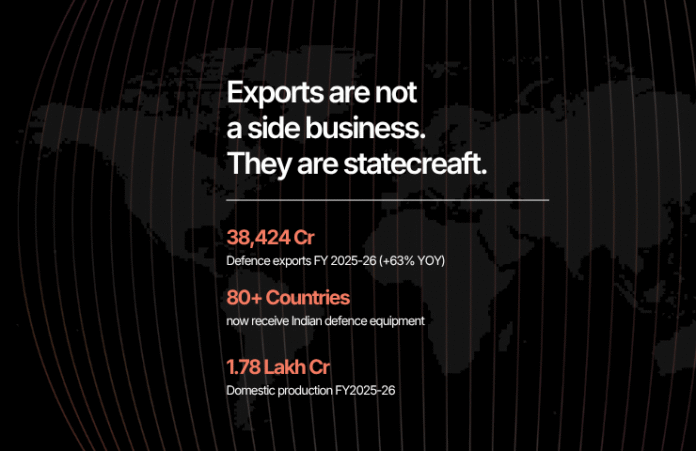
India’s defence exports reached a record ₹38,424 crore in FY2025-26, a rise of nearly 63% over the previous year. Indian-made equipment now reaches more than 80 countries, and the number of exporting firms has grown to 145. A decade ago, in 2013-14, that figure stood at ₹686 crore. This is no longer an aspiration. It is a trajectory.
It also tracks something larger. As India’s geopolitical weight grows, its defence industry has become an instrument of that influence. The question is no longer whether India can export. It is whether India can convert momentum into a permanent seat at the top table.

From the World’s Largest Importer to a Rising Exporter
The Decade in Numbers
Domestic defence production touched ₹1.78 lakh crore in FY2025-26, a 110% jump in five years. The defence budget rose from ₹2.53 lakh crore in 2013-14 to ₹7.85 lakh crore in 2026-27, and nearly 65% of equipment is now produced at home.
Why the Pivot is Strategic, Not Just Commercial
Here is the paradox to confront. India remained the world’s second-largest arms importer through 2020-24, a top-tier military power that still buys more than it sells. Every export deal now does double duty: it earns revenue and builds the interoperability and trust that turn buyers into long-term partners. Exports are not a side business. They are statecraft.
What India Exports and Who is Buying
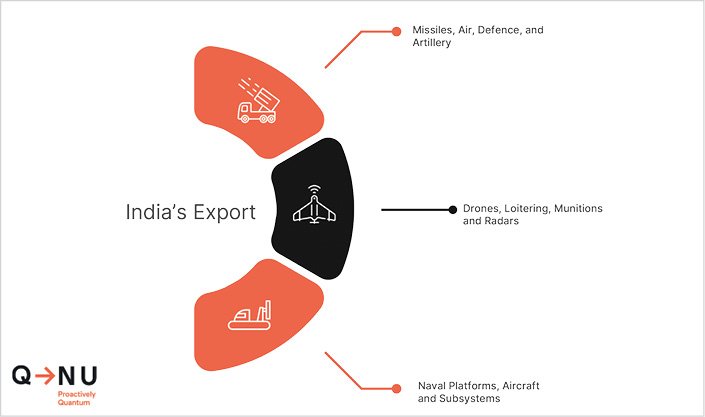
Missiles, Air Defence and Artillery
BRAHMOS is the flagship. The Philippines became its first foreign buyer in 2022, with deliveries from 2024, and Vietnam and Indonesia are close behind. Armenia has emerged as one of India’s largest customers for finished platforms, taking Akash air defence, Pinaka rocket systems, and ATAGS howitzers worth more than two billion dollars.
As India’s geopolitical weight grows, its defence industry has become an instrument of that influence. The question is no longer whether India can export. It is whether India can convert momentum into a permanent seat at the top table
Drones, Loitering Munitions and Radars
Loitering munitions such as Nagastra and SkyStriker are drawing interest, including from Cyprus. Indian radars already serve Armenia, Myanmar, and Sri Lanka. The May 2025 conflict with Pakistan, which tested indigenous systems in combat, has sharpened global attention on Indian hardware.

Naval Platforms, Aircraft and Subsystems
India exports offshore patrol vessels, fast interceptor boats, Dhruv helicopters, and maritime patrol aircraft across the Indian Ocean. It also supplies roughly 2.8 billion dollars of components to firms like Boeing and Lockheed Martin, placing Indian suppliers inside the global value chain.
The Markets That Matter
The Neighbourhood and the Indian Ocean Region
Under Neighbourhood First, Bangladesh, Maldives, and Sri Lanka all operate Indian systems, and India has extended 37 lines of credit worth 14.27 billion dollars. Proximity, financed well, is a market.

Africa and Southeast Asia: Affordability as an Advantage
In Africa and Southeast Asia, buyers tend to prioritise affordability over the last increment of performance. South Africa, Egypt, Kenya, and Algeria have shown interest in Arjun tanks, Pinaka, BRAHMOS, and Akash. This is where India can win volume.
Europe and the West: From Recipient to Supplier
The more striking shift is upmarket. France has shown interest in Pinaka, and Greece and Armenia feature among India’s growing customer base, while the United States now sources defence components from India. The traditional supplier-recipient relationship is reversing.
India’s exports still skew toward friendly nations with limited budgets, often through non-competitive arrangements and the top exporter ranks remain dominated by the United States, France, Russia and the UK
The Next Frontier: AI, Quantum and Cyber
What the World Will Want to Buy from India Next
The next decade of demand is for software-defined warfare: artificial intelligence, autonomous systems, electronic warfare, and quantum technology. India’s defence-technology market is projected to reach roughly nineteen billion dollars by 2030, with close to half driven by AI, autonomy, and quantum. India’s ADITI and iDEX schemes already fund exactly these priorities, from cyber to quantum to autonomous weapons.
Quantum-Safe Communications as a Sovereign Export
Securing all of it is its own export category. As adversaries pursue harvest-now, decrypt-later attacks, the systems India sells must protect data for their full-service life. India has already demonstrated an indigenous 1,000-kilometre quantum-secure communication network under the National Quantum Mission. Sovereign, standards-compliant security is becoming a product in its own right, not a feature bolted on later.
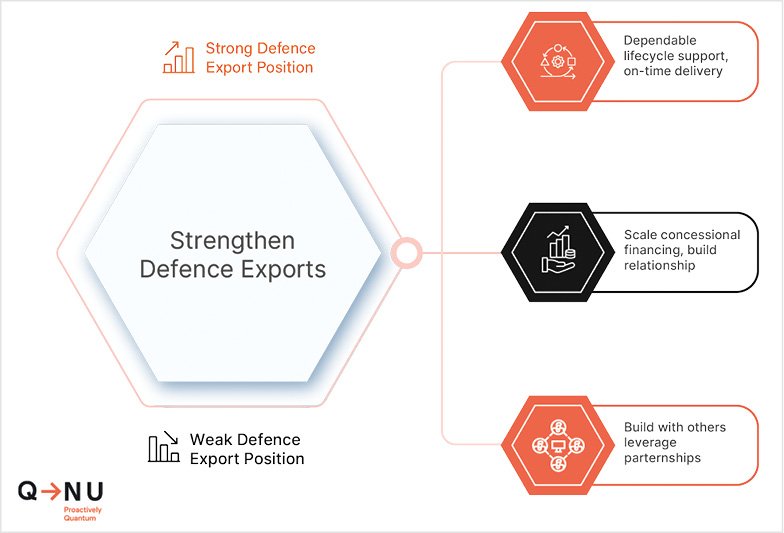
How India Can Strengthen Its Position as a Defence Exporter
Win on Trust: Quality, Delivery and Lifecycle Support
Buyers do not just purchase a platform. They buy decades of spares, repair, and upgrades. India must match its order wins with dependable lifecycle support and on-time delivery, the logistical and institutional areas where past efforts have faced barriers. Reliability is the real moat.
Defence Diplomacy, Lines of Credit and Government-to-Government Deals
Concessional financing has opened doors from Mauritius to a Dornier loan for Guyana. India should scale this deliberately, pairing credit lines with training and joint exercises so equipment sales mature into lasting relationships.
Co-Development and Technology Partnerships
The fastest route up the value chain is to build with others. Co-development partnerships already run inside the defence corridors, from Safran with HAL to Boeing with Mahindra and Israel Aerospace Industries with Bharat Electronics. Partnership is leverage.
The Policy Reforms That Will Decide the Decade
Faster Export Clearances and a Single Window
The Open General Export Licence now allows specified items to specified destinations under a single permit, and the SCOMET munitions list has been made public. The next step is a genuine single-window clearance, because in arms sales a slow yes is often a no.
Financing, Offsets and Long-Term Contracts
Foreign direct investment of up to 74% via the automatic route and a sharper offset policy have pulled in global manufacturers. Long-term order visibility and export financing must now match, so suppliers can invest ahead of demand.
Securing What We Export: Protecting Data and IP
As exports turn digital, India must protect both the intellectual property in its platforms and the data they carry. Quantum-safe and cyber-resilient design belongs in export products from the start. Trust, once lost, does not return.
India has done the hard part: it has proven it can build and sell. The harder part is sustaining it, holding quality, depth and trust as volumes rise. Make the next decade about reliability and advanced capability and the top league stops being an aspiration. It becomes the address
The Decade That Decides: Top League or Missed Opportunity
Be honest about the gap. India’s exports still skew toward friendly nations with limited budgets, often through non-competitive arrangements, and the top exporter ranks remain dominated by the United States, France, Russia, and the UK. The target of ₹50,000 crore by 2029 is within reach. But the top league is not won on volume to neighbours. It is won by selling advanced systems, on merit, to demanding buyers. India has the industrial base, the demand pull, and the strategic moment. The next ten years decide whether it uses them.
Final Thoughts
India has done the hard part: it has proven it can build and sell. The harder part is sustaining it, holding quality, depth, and trust as volumes rise. Make the next decade about reliability and advanced capability, and the top league stops being an aspiration. It becomes the address.
Call to Action
For policymakers and industry, the brief is simple. Treat the next ten years as the window they are. Build for the buyer, secure what you sell, and compete on merit, not just price.

The writer is Chief Marketing Officer at QNu Labs, India’s pioneering quantum cybersecurity company incubated at IIT Madras. An IIM-Calcutta alumnus with 22+ years of global marketing leadership, she has led quantum security thought leadership initiatives positioning India’s “Made in India, Made for the World” quantum capabilities across defence, government, and enterprise sectors globally. The views expressed are of the writer and do not necessarily reflect that of Raksha Anirveda





