


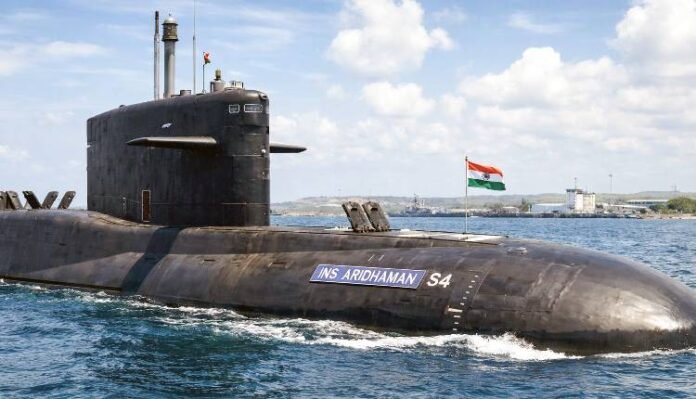
New Delhi: Pakistan has no effective response to India’s advancing nuclear capability, as New Delhi has quietly crossed a critical threshold by deploying nuclear warheads at sea while Islamabad lacks a submarine capable of carrying them and does not even have a realistic timeline for acquiring one.
A report has highlighted that the gap between the two countries is widening in a way that is restructuring the entire deterrence architecture of the subcontinent. The report underlined that Pakistan has not, and perhaps cannot, match India’s progress. This widening gap is described as the most important strategic development in South Asia since Islamabad tested its first nuclear device in 1998.

India’s deliberate opacity surrounding submarine operations ensures survivability, as the location, weapons load, and authorisation status of its nuclear submarines remain unknown to adversaries, making them impenetrable in a first strike. India has spent over a decade building towards this capability while global attention was elsewhere.
India’s nuclear submarine fleet has steadily expanded. The INS Arihant was commissioned more than a decade ago, followed by the INS Arighaat equipped with the K-4 missile with a range of 3,500 kilometres. The INS Aridhaman joined the fleet earlier this year, and the INS Arisudan is anticipated to arrive in 2027. This will give India four operational Submersible Ship Ballistic Nuclear (SSBNs). Such a fleet allows for a rotation where one submarine is always at sea, one in transit, one in maintenance, and one in training, ensuring year-round patrols and survivability.
India has also hardened its pre-emptive attack submarine base on the eastern coast, known as INS Varsha, and established an operational jetty in Agalega Island in the western Indian Ocean. This facility enables submarines to receive logistical support without returning to the Indian mainland, extending their patrol area significantly.
The Stockholm International Peace Research Institute’s 2026 yearbook implied that India has shifted from storing nuclear warheads ashore to deploying them on submarines at sea, a development New Delhi has not officially announced.

A submarine on continuous patrol, armed with nuclear-tipped missiles, is by definition impenetrable. Its location is unknown, its warheads are already mated to its missiles, and its patrol area spans millions of square kilometres from the Bay of Bengal to the waters near Agalega Island.
The geometry of a disarming first strike against such a force does not work, regardless of how many missiles an adversary commits to the attempt.

Pakistan’s sea-based nuclear capability remains limited to the Babur-3 cruise missile, which is believed to have potential nuclear capability and might be deployed on an Agosta-class diesel-electric submarine in 2027.
However, a nuclear-tipped cruise missile on a conventional submarine is fundamentally different from a ballistic missile on a nuclear-powered SSBN. Diesel-electric submarines must surface or snorkel frequently to recharge batteries, making them detectable. Their endurance lasts weeks, not months, and they cannot maintain continuous long-range patrols with the necessary second-strike survivability.
In contrast, nuclear-powered submarines can remain submerged for months, making them far more survivable. Conventional submarines are vulnerable to detection by surface ships, fixed underwater sensors, and patrol aircraft, whereas nuclear-powered SSBNs evade such measures due to their extended endurance and stealth.
This technological disparity underscores Pakistan’s strategic vulnerability and highlights India’s consolidation of a credible nuclear triad.
India’s progress reflects a deliberate strategy to ensure assured retaliation capability, a cornerstone of nuclear deterrence. Pakistan’s reliance on land-based missiles and aircraft leaves its arsenal exposed to pre-emptive strikes, while its limited submarine program offers no credible second-strike option.
The widening gap between the two nations is reshaping the strategic balance in South Asia, with India firmly establishing itself as a state capable of maintaining survivable nuclear deterrence at sea.






