


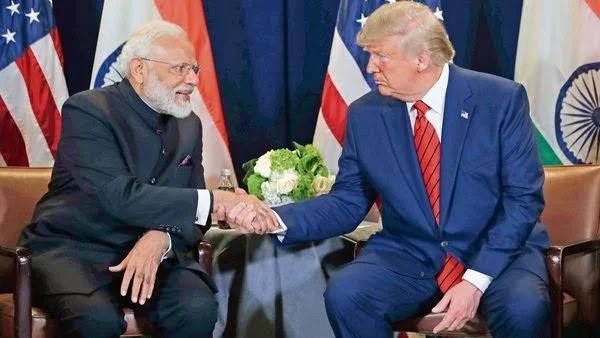
In more than two decades of steadily improving India-US relations, New Delhi is witnessing, for the first time, a situation in which strong anti-India sentiments are being actively encouraged in Washington. President Donald Trump appears determined to undo all painstaking efforts that his predecessors, including Bill Clinton, George W Bush, Barack Obama, Joe Biden, and Trump himself in his first term, made to strengthen US-India relations.
However, serious efforts to build mutual trust, deepen strategic cooperation and transform bilateral ties into a defining partnership of the 21st century now risks being undermined and discarded. President Trump, a few days ago, signed into law a congressional bill that allows America to impose tariffs up to 100% on India, China and other countries that continue buying Russian oil and gas.

As if it were not enough, the US barred eight IT firms, including India’s TCS, Wipro, Infosys, and HCL, from participating in its Permanent Labour Certification Process, which allows employers to set in process sponsorship of Green Cards for employees. Further adding insult to injury, US Vice President J D Vance described foreign workers hired on H1-B visas as “foreign indentured servants.”
IAF chief A P Singh’s remarks following the two-week-long Exercise Tarang Shakti-2026 provide a glimpse of India’s growing concern. “Your people don’t even let us go near the aircraft, and you are talking about selling it to us,” he said when asked if the US had made any official offer to sell F-35 fighter jets to India
Clearly, this reflects growing desperation in the Trump administration, which seeks to make India dance to its tune and call on all issues ranging from trade to energy and geopolitics. Last year, he termed India, the world’s fastest-growing economy, the dead economy.
Just last week, when Finance Minister Nirmala Sitharaman said India’s trade talks with the US have plateaued, Trump and his Cabinet colleagues were left rattled. They want India to eliminate or reduce tariffs on a wide range of American agricultural products, including tree nuts, fruits, animal feed and soybean oil.
Yet they are not ready to listen to India’s demand for the removal of uneven US tariff policy. They are dead against New Delhi’s purchase of Russian oil. If New Delhi goes ahead with the purchase of Russian oil, then it will attract tariffs of up to 100% under the new Graham Act. But the same will not apply to them.

Americans will be importing millions of barrels of diesel from Russia to ease the inflationary burden on consumers. Trump said Russia will immediately supply the US and other countries with over 300,000 tons of diesel, another 500,000 tons in November, and one million tons immediately thereafter. The US President added that Russia would deliver another three million tons of diesel within a short period of time.
It is self-deluding to blame Trump alone for worsening India-US ties. Democrats are also responsible for damaging ties with India and the recent Congressional bill that allows America to impose tariffs up to 100% on India, China and other countries for purchasing Russian oil is a clear example in this regard
This double standard in the US’s policy seems to have miffed India, and its reflection can be seen in Finance Minister Sitharaman’s statement on trade talks with America.

Analysts say that although such moves have impacted India’s bilateral relations, it will not be long before trust between the two countries begins to erode. Chief of Air Staff Chief Marshal A P Singh’s remarks following the two-week-long Exercise Tarang Shakti-2026 provide a glimpse of this growing concern.
While sharing the stage at a press conference with General Kevin Schneider, Commander of US Pacific Air Forces, in Jodhpur on October 11, IAF Chief A P Singh, in response to reporters’ questions, took a swipe at the US’s F-35 programme, telling the top American commander that US personnel don’t even let Indian officials near the stealth jet.
“Your people don’t even let us go near the aircraft, and you are talking about selling it to us,” A P Singh said when asked if the US had made any official offer to sell F-35 fifth-generation fighter jets to India. Even if wrapped in friendly banter, the statement was sharp and marked with unmistakable scepticism about the US’s approach to ties with India.
On September 25, Trump shared on Truth Social a video clip of Pakistani Prime Minister Shehbaz Sharif’s speech at the United Nations, in which Sharif thanked the American president for his timely intervention in bringing Operation Sindoor to an end
Navtej Sarna, India’s former Ambassador to the US, very aptly wrote in his article in The Week, “It is now time to apply the cold edge of the scalpel, cut the fat and get to the heart of the matter. Acceptance of the problem is crucial to any resolution. We need to accept, without caveats, that the relationship has cratered significantly. In America’s eyes, India is not the strategic partner that we believed we were.”
He argues that it is self-deluding to blame Trump alone for worsening US relations with India. Democrats are also responsible for damaging ties with India and the recent Congressional bill that allows America to impose tariffs up to 100% on India, China and other countries for purchasing Russian oil is a clear example in this regard.
Obviously, India will have to accept that the priority of the US has changed; it seeks to improve relations with China, while drawing Pakistan closer to its strategic calculations, keeping in mind the Iran factor. On September 25, Trump shared on Truth Social a video clip of Pakistani Prime Minister Shehbaz Sharif’s speech at the United Nations, in which Sharif thanked the American president for his timely intervention in bringing Operation Sindoor to an end.
Although Trump offered no comment, his decision to endorse the video by uploading on his social media handle indicates the narrative he chose to support on the India-Pakistan conflict. In the video, Sharif describes Operation Sindoor, launched in May 2025 in response to the Pahalgam terrorist attack, as an act of external aggression, while crediting Pakistan’s Army Chief, Asim Munir, for what he portrays as courageous leadership during the confrontation.
Stronger engagement with Japan, South Korea, Europe, Australia, Southeast Asia, Russia and other important partners must be actively pursued to expand New Delhi’s strategic options, provide greater room for manoeuvre and reduce its vulnerability to coercion by a hegemonic power like the US
This shows Trump’s willingness to amplify a Pakistani narrative that is unfavourable to India. The US President has been at the forefront of projecting himself as a saviour of the deadly conflict between India and Pakistan in May last year. In his speech at the UN, Trump claimed that his administration successfully resolved eight major global conflicts, including the India-Pakistan military confrontation.
He described Pakistan as a ‘great country’ and called its Prime Minister Shehbaz Sharif a ‘terrific man’. This growing convergence between Washington and Islamabad, and the American attempt to claim credit for resolving India-Pakistan tensions, should serve as reminders that strategic partnerships are ultimately governed by national interests rather than diplomatic rhetoric.
Given this reality, the time has come for India to call a spade a spade and stop being unduly accommodating towards the US. It must adopt a more assertive and pragmatic foreign policy, one that safeguards India’s national interests rather than bending under American pressure.
Stronger engagement with Japan, South Korea, Europe, Australia, Southeast Asia, Russia and other important partners must be actively pursued to expand New Delhi’s strategic options, provide greater room for manoeuvre and reduce its vulnerability to coercion by a hegemonic power like the US.

The writer is a senior journalist with wide experience in covering international affairs. The views expressed are of the writer and do not necessarily reflect the views of Raksha Anirveda





