


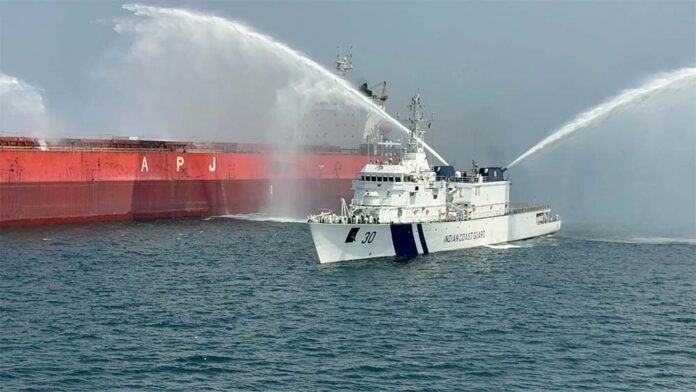
The 12th National Maritime Search and Rescue Exercise, SAREX-2026, was held off Paradip on October 8 under the aegis of the National Maritime Search and Rescue Board. Its central operational objective was to strengthen interoperability among agencies and reduce the time needed to respond when lives are at risk at sea. According to Coast Guard Director General Paramesh Sivamani about 32 vessels were involved, alongside aircraft from the Indian Air Force.
The exercise, conducted under the theme “Leveraging Technology to Strengthen SAR Preparedness and Maritime Safety”, drew participants from the Coast Guard, Navy, Air Force, Shipping Corporation of India, Directorate General of Shipping, Fisheries, Customs, Marine Police, Paradip Port Authority and Odisha’s state administration. Thirty-two observers from 30 countries also attended, with international delegates briefed on the live scenario and involved in a tabletop search-planning exercise.

The sea phase tested a mass-rescue response to two emergencies unfolding together: a passenger aircraft carrying 228 people ditched near Paradip Port, and its fuselage struck the container vessel MV Zumba, causing structural damage and fire. The scenario demanded an organised response to people in the water, a fire aboard a ship and the need to coordinate aircraft, vessels and shore-based teams.
The assets deployed included 15 Coast Guard ships, three Dornier aircraft, three Advanced Light Helicopters, one Chetak helicopter, an Air Force C-130J and Mi-17, two Navy ships, and civil, state and shore-based support units. The exercise activated an Incident Command Post and included firefighting, helicopter evacuations, life-raft deployment – including air-dropped rafts – rescue basket operations, scramble-net procedures, Jason Cradle and Gemini recovery. A remotely operated vehicle demonstration added an underwater-response element.
Sivamani said the purpose was not simply to showcase equipment, but to practice how agencies work together under pressure. The tabletop session for foreign observers was designed to explain how a search is planned while a live operation is under way, giving participants a view of the decisions and coordination that underpin rescue work. Interoperability can determine whether available aircraft, ships and rescue teams act as a single response network or as separate units.
International observers also focused on India’s maritime capabilities and domestic manufacturing. Blaise Taylor, a counsellor with the Australian Border Force, praised the Coast Guard’s search-and-rescue capacity and pointed to a recently signed memorandum of understanding between Australia and the ICG. He said the agreement signalled an intention to deepen cooperation not only in rescue work but also in maritime law enforcement. Taylor also commended Indian-built vessels and other locally produced assets.

A Tanzanian observer, Lieutenant Colonel Alann Bashaula, described the exercise as educational and demanding, noting the value of skills and facilities for rescue operations. He praised the use of remotely operated equipment and the fact that many of the participating ships were built in India, saying domestic production could help reduce dependence on other countries and build capability.
The drill builds on earlier SAREX editions that have tested large-scale emergency response and cooperation with international partners. The 2024 exercise off Kochi, for example, simulated an aircraft carrying 250 passengers losing contact with air traffic control, and included life-raft drops, helicopter evacuation and drone-delivered lifebuoys. The changing scenarios underline the need to rehearse multiple types of distress rather than rely on a single response template.

SAREX-2026 concluded with a renewed emphasis on a faster, technology-enabled search-and-rescue framework. Its practical measure of success will be whether agencies can convert the lessons into clearer coordination, quicker decisions and effective rescues when a real distress call arrives.






