


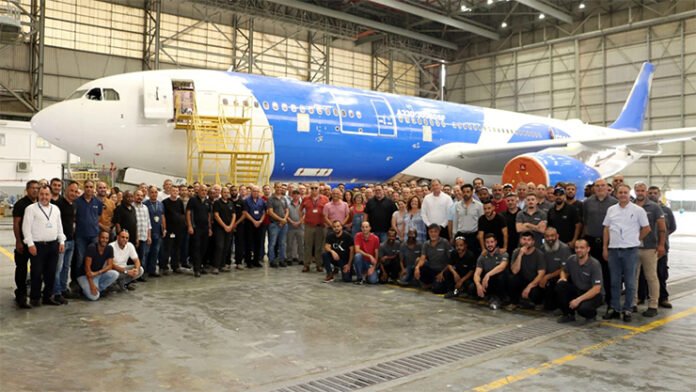
Tel Aviv: Israel Aerospace Industries (IAI) has marked a significant milestone in its Airbus A330-300 conversion program.
Earlier this month the first aircraft was moved into the hanger to start the conversion process following the successful completion of the final design review (FDR).
As part of the preparation and pre-production process, IAI has established two supply chains to ensure stability and consistency of production. Between 2025 and 2028, IAI will convert 30 Airbus A330-300 aircraft from passenger-to-freighter (P2F) configurations.
The converted Airbus A330-300 aircraft will provide a competitive and advanced solution for cargo and commerce companies looking to expand and improve their widebody cargo jet fleets.
The converted model will increase the cargo space, improve the Turn Around Time (TAT) cargo-loading capacity due to the unique cargo-door placement, and support and enhance operations relating to cargo jet flights.
IAI’s Aviation Group is a world leader in passenger-to-freighter (P2F) conversions, successfully converting several types and models of aircraft. It is known worldwide for its MRO activities as a centre of knowledge, innovation and excellence, ensuring long-term, dedicated customer support and a rapid response for all aircraft needs.
Shmuel Kuzi, VP and GM of IAI’s Aviation Group, commented, “The entry of the first Airbus A330-300 into the passenger-to-freight conversion process is a significant milestone in the expansion of our portfolio for customers who choose to benefit from IAI’s extensive knowledge, uncompromising quality, and attractive pricing in the field of aircraft cargo conversion.”
This achievement comes as IAI Aviation Group continues to break new records, with the first-ever Boeing B777-300ER (Big Twin) conversion, expected to be certified by global aviation authorities in the coming months.
Earlier this year, IAI also launched its new Global Control Centre (GCC) system, designed to manage and monitor major projects such as the company’s international aircraft conversion programs. This system, developed in-house, leads to a reduction in the conversion time for each aircraft, optimises planning and logistics processes, and allows for the targeted and horizontal management of errors or challenges that may arise.
The GCC system also allows the conversion process to be clearly presented in real-time to the company’s existing or new customers.

-The writer is an Israel-based freelance journalist. The views expressed are of the writer and do not necessarily reflect the views of Raksha Anirveda





