


The earlier drama concerned acquisition; the new reality concerns access. This distinction matters more than the political theatre suggested. Ownership carries administrative, legal and political burdens. Strategic access can deliver many of ownership’s benefits without them. Bases, logistics, surveillance, movement rights, communications, intelligence cooperation and restrictions on hostile military or economic activity together create a powerful sphere of influence.
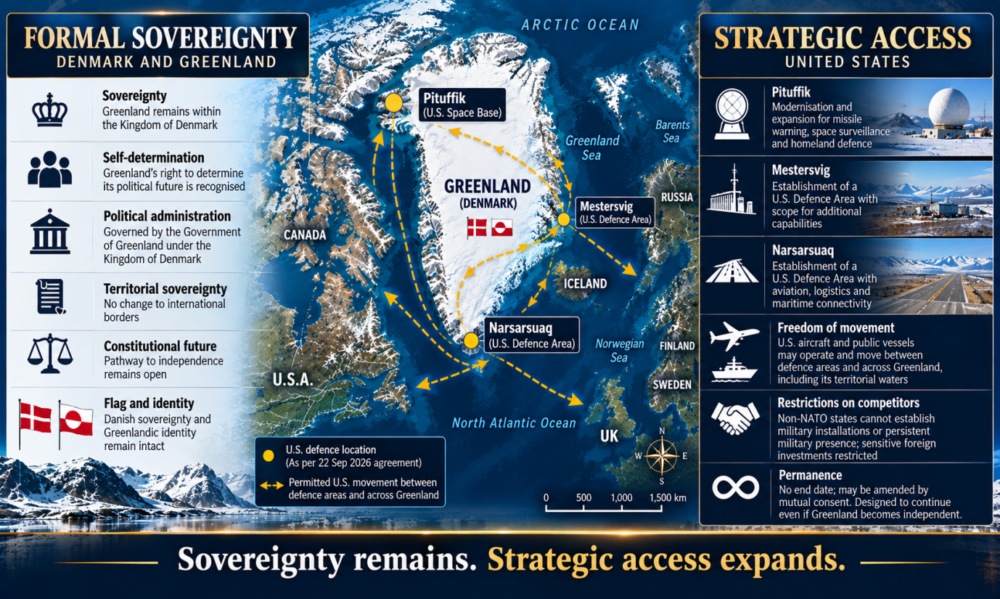
The new agreement demonstrates this model clearly. It lets the United States modernise and expand Pituffik Space Base, establish Defence Areas at Narsarsuaq and Mestersvig, and create further Defence Areas by mutual consultation, all while Denmark and Greenland keep formal sovereignty. It has no end date, and remarkably anticipates a future independent Greenland remaining bound to NATO and to the agreement’s obligations. The real question is no longer who owns Greenland, but who can operate there, build there, exclude rivals and preserve this security architecture through any political change.

Three Points, One Architecture
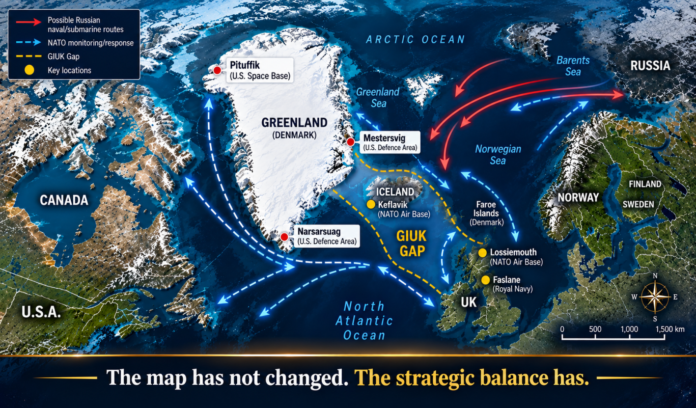
Pituffik anchors the north, vital for missile warning, space surveillance and defending North American approaches. Mestersvig covers the east, facing the Greenland Sea and Arctic approaches. Narsarsuaq forms a southern node for aviation and North Atlantic logistics. Individually each has military value; together they form a distributed American security network across the island.
By securing bases, surveillance, and movement rights in Greenland while leaving formal sovereignty with Denmark, the US gains all the benefits of control without the political burdens
Their worth lies not in numbers but in connectivity, mobility and room for expansion. The agreement also permits extensive movement of US forces and vessels through Greenland. Geography becomes infrastructure, and infrastructure becomes power, as a remote island is woven into the operational geometry of North American and North Atlantic defence.
The GIUK Gate
Greenland’s importance grows further within the Greenland-Iceland-UK (GIUK) corridor, a maritime gateway linking the Arctic and North Atlantic to the wider ocean and central to naval surveillance and movement. Russia’s Northern Fleet, Arctic bases and undersea capabilities make the High North significant well beyond polar territory.
NATO now treats the Arctic as increasingly vital to collective security; Finland and Sweden have strengthened its northern posture, and the alliance launched Arctic Sentry in 2026. North American defence increasingly begins farther north, while European defence depends on secure northern approaches, placing Greenland at the junction of the Arctic, the Atlantic and North America – making durable access to it unusually valuable.

Canada: The Wedge
Between the American mainland and Greenland lies Canada, a sovereign Arctic power, NATO member and NORAD partner with the United States. Ottawa is asserting Arctic sovereignty, modernising NORAD and expanding its northern military presence, announcing major 2026 investments in Arctic surveillance, infrastructure and defence while deepening integrated operations with Washington.
This raises a pressing question: as American access across Greenland grows, might Canada’s Arctic position become more entangled with American continental defence? Could economic integration, defence cooperation and infrastructure connectivity quietly create strategic dependence without any formal transfer of territory?

From Pituffik to Narsarsuaq, Greenland forms the crucial hub of a broader Western security network. Integrated with the GIUK corridor and NATO’s northern posture, geography is transformed directly into operational power
And if the American security perimeter eventually tightens from Alaska through Canada to Greenland, what happens to Canadian strategic autonomy? Nothing suggests Canada is being absorbed – it is investing heavily in its own sovereignty and NORAD – but geography itself may generate pressure toward deeper continental integration.
The Arctic Ring
The wider picture is more revealing still. From Alaska and Canada through Greenland and Iceland to Norway, Sweden and Finland, a connected Western security architecture is forming around the Arctic, officially framed as a response to Russian activity and China’s growing interest.
NATO’s Arctic policy documents record expanded exercises, Arctic Sentry and strengthened northern capabilities. Yet, the trajectory these developments create deserves scrutiny. Would a politically weaker or less cohesive NATO push Washington toward more bilateral, direct access arrangements? Could the logic of securing northern approaches eventually reach into the Scandinavian Arctic?
These are not predictions of established plans, but possibilities arising from geography, military technology and the Arctic’s rising strategic value. Greenland cannot be understood alone; it is one piece of a still-forming northern security system.
The China Question
China enters through economics as much as military power. Greenland’s strategic value includes critical minerals, infrastructure, technology, ports and future resource development. The new agreement restricts control, significant influence and access to sensitive information by investors from outside NATO, its partners and the EU, while also barring non-NATO military installations or persistent presence without agreement.
This shows how modern strategic competition now extends well beyond soldiers and ships to financing, technology, supply chains, resource development and the blocking of rivals’ footholds. Greenland has become a case study in the merging of military and economic security, as climate change, technology, resources and geopolitical rivalry converge to raise the Arctic’s strategic stakes.
While framed as defensive cooperation, an open-ended agreement designed to outlast even Greenlandic independence suggests a broader ambition: laying the groundwork for enduring American primacy in the High North
The Intent Question
It would be premature to call the agreement proof of a plan to dominate the Arctic. Washington frames it as defending Greenland, North America and the North Atlantic; Denmark calls it NATO-based cooperation.
But intent must be judged through capabilities and institutions, not declarations alone. Why create new Defence Areas and allow more of them? Why restrict strategic competitors? Why make the agreement open-ended, and explicitly designed to survive Greenlandic independence?
Each provision has its own security logic, but together they raise a larger question: is Washington merely defending Greenland, or building lasting American primacy across the Arctic? Answering that requires further evidence, economic data, military assessment and sustained observation.
India Cannot Look Away
Though not a direct Arctic actor, India has significant stakes in scientific research, climate change, energy, minerals, shipping, connectivity and its longstanding relationship with Russia – all of which stand affected by a rapidly changing Arctic security environment.
Greater militarisation, increasingly contested maritime routes, shifts in Russia’s northern posture, or an expanded Chinese economic and strategic role would carry consequences reaching far beyond the polar region alone.
The Arctic is no longer an isolated polar frontier. With far-reaching consequences for international trade, resource flows, and Indo-Pacific security, global powers like India must treat the region as an interconnected strategic theatre
India should therefore watch the Arctic not merely as a scientific curiosity or economic frontier, but as a strategic theatre linking Europe, Russia, North America and the Indo-Pacific – requiring careful awareness of who controls access, infrastructure, information and resources, without necessarily militarising its own Arctic policy.
Greenland Gone
Greenland remains Greenland: Denmark keeps sovereignty, and Greenland keeps the right to shape its political future. But sovereignty and strategic control are not the same thing.
The new agreement builds an enduring American military framework capable of expanding and designed to outlast political change. What matters is not an acquisition that never happened, but the architecture that now exists.
The Arctic contest may ultimately be decided not by flags changing colour but by bases, access, infrastructure, surveillance, investment rules, alliances and the exclusion of rivals. “Greenland Gone” is not a claim that Greenland now belongs to America – it is a warning that strategic geography can be secured without sovereignty ever changing hands, leaving open whether Greenland’s strategic future can truly remain its own.

Lt Gen Rajeev Chaudhry (Retd) writes on contemporary national and international issues, strategic implications of infrastructure development towards national power, geo-moral dimension of international relations, and leadership nuances in a changing social construct. The views expressed are of the author and do not necessarily reflect the views of Raksha Anirveda





