


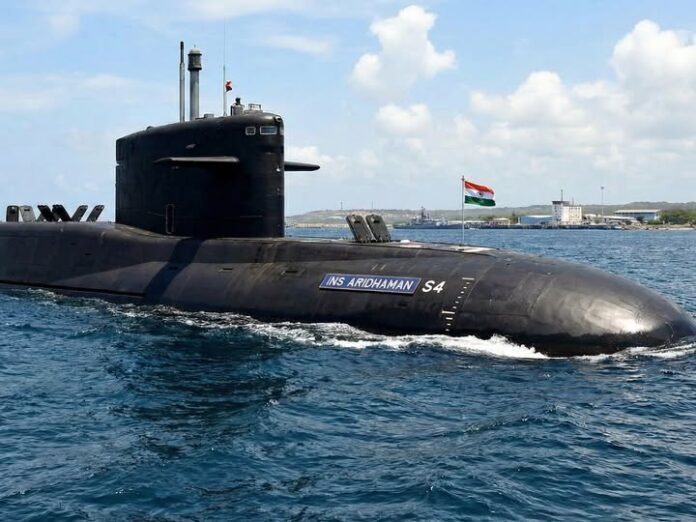
New Delhi: India’s naval capabilities are set to receive a significant boost with the anticipated commissioning of its third indigenous nuclear-powered ballistic missile submarine, INS Aridhaman, designated as S4 in the Arihant class. This development promises to enhance the nation’s sea-based nuclear deterrence amid evolving regional security dynamics.
The submarine is currently undergoing its final phases of sea trials, with commissioning expected between April and May this year, according to sources close to the project. In December last year, Navy Chief Admiral D K Tripathi confirmed that INS Aridhaman would enter service in 2026, marking a key milestone for India’s underwater strategic forces.

Constructed under the secretive Advanced Technology Vessel (ATV) project at the Ship Building Centre in Visakhapatnam, INS Aridhaman represents an advancement over its predecessors. At approximately 7,000 tons, it is notably larger than the 6,000-ton INS Arihant and INS Arighaat, allowing for expanded weapons capacity and improved endurance.
Armed with a formidable payload, the vessel will carry 24 K-15 Sagarika submarine-launched ballistic missiles (SLBMs) with a range of 750 km, alongside eight K-4 SLBMs boasting a 3,500 km reach. These missiles can target much of Asia, providing India with robust second-strike options in a nuclear scenario.
Upon commissioning, INS Aridhaman will enable India to maintain three operational Arihant-class SSBNs under the Strategic Forces Command (SFC) for the first time. This triad of submarines—INS Arihant, INS Arighaat, and INS Aridhaman—will significantly bolster continuous patrol capabilities.
The broader strategic objective is to achieve ‘Continuous At-Sea Deterrence’ (CASD), a doctrine ensuring at least one SSBN remains on patrol 365 days a year. This survivable platform is essential for credible deterrence, particularly against potential first-strike threats from adversaries.

INS Aridhaman’s enhanced missile loadout surpasses that of its siblings, which are limited to fewer K-4 variants due to space constraints. The K-4’s extended range addresses gaps in coverage, extending India’s nuclear umbrella deeper into potential threat zones.
Complementing these indigenous efforts, the Indian Navy is advancing lease negotiations for Russia’s Akula-class nuclear-powered attack submarine (SSN), known as Chakra III. Delivery is projected for 2027 or early 2028, adding conventional strike and anti-submarine warfare prowess to the fleet.

In parallel, India and Germany are finalising an $8-10 billion Project-75(I) agreement for six advanced diesel-electric submarines featuring Air-Independent Propulsion (AIP) technology. This deal underscores India’s push towards a balanced, multi-layered submarine force capable of blue-water operations.
These acquisitions come at a pivotal moment, as regional rival Pakistan progresses with its $5 billion deal from 2015 to acquire eight Hangor-class diesel-electric attack submarines from China. Equipped with modern sensors and AIP, these platforms aim to tilt the undersea balance in the Arabian Sea.
The Hangor-class submarines, built with significant Chinese technical assistance at Karachi Shipyard, feature advanced stealth and endurance profiles. Their induction could challenge Indian maritime dominance in the Indian Ocean Region (IOR), prompting New Delhi’s accelerated naval modernisation.
India’s indigenous submarine programme, rooted in the ATV project initiated decades ago, has overcome technical hurdles in miniaturised nuclear reactors and composite hulls. INS Aridhaman’s success validates this self-reliance, reducing dependence on foreign suppliers for strategic assets.
Future iterations, including the larger S4* (INS Aridhaman successor) and Project P-75 Alpha SSNs, will further integrate K-5 missiles with intercontinental ranges. These developments align with India’s no-first-use nuclear policy, emphasising assured retaliation.
Operationally, the SFC’s expanded SSBN fleet will demand robust infrastructure, including forward bases at Rambilli and advanced missile handling facilities. Integration with space-based assets for navigation and targeting will enhance patrol effectiveness.
Geopolitically, INS Aridhaman’s entry strengthens India’s position in the Quad framework and partnerships like AUKUS-adjacent collaborations. It counters China’s expanding South China Sea presence and Pakistan’s submarine buildup, securing vital sea lines of communication.
INS Aridhaman’s commissioning heralds a new era of credible sea-based deterrence for India, fortifying national security in an increasingly contested maritime domain.






