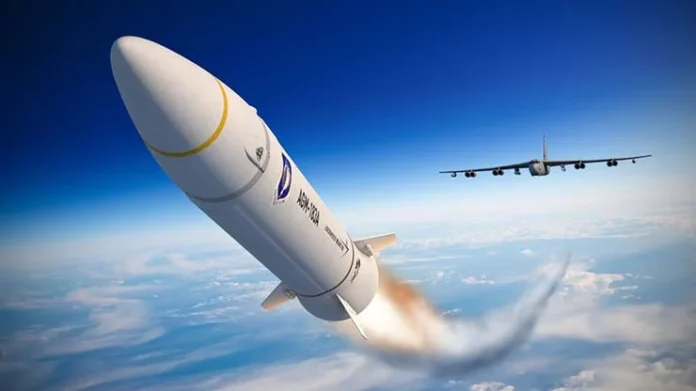
Washington: The US Air Force conducted the first test launch of a fully operational prototype of its hypersonic Air-launched Rapid Response Weapon.
The test of the Lockheed Martin-made AGM-183A ARRW, which was carried out on December 9 off the coast of Southern California, was deemed successful, the Air Force’s 96th Test Wing said in a statement December 12. It was carried out by the 412th Test Wing at Edwards Air Force Base in California.

The prototype hypersonic missile was launched from a B-52H Stratofortress bomber, the wing said, and then rapidly accelerated to greater than five times the speed of sound. The missile then completed its planned flight path and detonated, the wing said, and the early results show all the test’s objectives were met.
“The ARRW team successfully designed and tested an air-launched hypersonic missile in five years,” Brig. Gen. Jason Bartolomei, program executive officer for the Air Force’s armament directorate. “I am immensely proud of the tenacity and dedication this team has shown to provide a vital capability to our warfighter.”
Russia and China have invested heavily in developing their own hypersonic weapons, and the US military has faced pressure, including from lawmakers, to show more progress on its own hypersonic capabilities. The successful test of the operational ARRW prototype continues a series of successful tests for the program in 2022, marking a turnaround from a disappointing 2021 that left the effort in trouble.
ARRW had three straight test failures in 2021, all stemming from problems during the launch process. Lawmakers delivered a stinging rebuke of the program in March and cut nearly $161 million in requested procurement funding from the fiscal 2022 budget, citing the program’s testing failures and delays.

That streak was broken in May, with a successful test of ARRW’s booster performance. Another successful booster test followed in July, paving the way for all-up-round testing. After those two successful tests, the Air Force’s top acquisition official said the service was encouraged by ARRW’s progress, but was still trying to figure out the next steps for the program.
Andrew Hunter, assistant Air Force secretary of acquisition, technology and logistics, said in July that the future of ARRW doesn’t solely depend on how well the weapon works. The service was also still trying to figure out what mix of weapons it will need to counter future threats, and how well a hypersonic weapon such as ARRW might fit into that arsenal.

“Obviously, you wouldn’t buy something that doesn’t work,” Hunter said. “But even if it does work, it’s got to be the right contribution to the overall weapons mix and the highest priority targets. That’s what’s driving [Air Force] decision making.”