


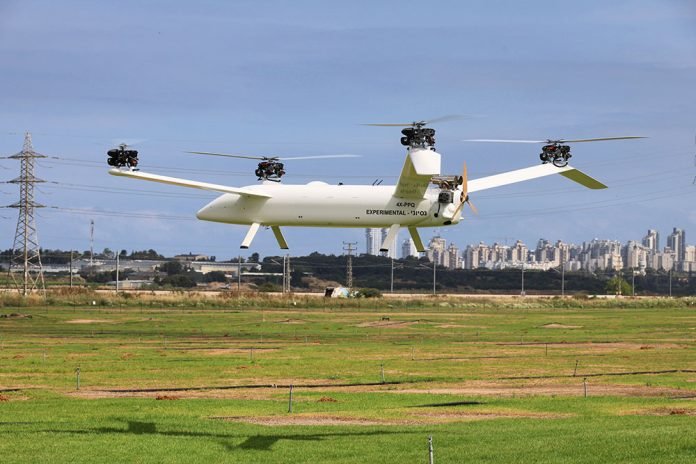
Tel Aviv: The market is flooded with many types of unmanned VTOL systems. But what Israeli company Efix Aviation unveiled a few days ago is with no doubt a major breakthrough based on a combination of technologies developed by the company.
As the unmanned aerial ecosystem evolves rapidly, driven by demand for advanced platforms that combine vertical take-off and landing (VTOL) versatility with the efficiency of fixed-wing airplanes, Israel-based Efix Aviation has unveiled a unique technical philosophy of combining proven aviation concepts into a new kind of aircraft that transcends traditional categories.

The EFIX300 is a hybrid-electric heavy-lift rotorcraft designed to solve critical gaps in mission flexibility, safety, and operational independence, based on proprietary, technologies setting a new standard for both defence and civil applications.
At the core of the EFIX300 lies its hybrid-electric propulsion system, four gimballed rotors, autorotation capabilities, and highly efficient fixed wing. Its independent hybrid-electric propulsion system integrates four electric-driven rotors for vertical take-off, hover, and landing operations with a combustion-based pusher engine for cruise flight.
According to Efi Kastiel, the company’s CEO, this architecture is designed to charge the onboard batteries during flight, eliminating the operational constraints of fully electric VTOLs, which often require extensive ground infrastructure.
”The gimballed rotor system is a standout patented feature, with each rotor mounted on a dynamically adjustable platform that provides thrust vectoring across a wide range of angles both in pitch and roll axes at speeds exceeding 100°/s,” he added.

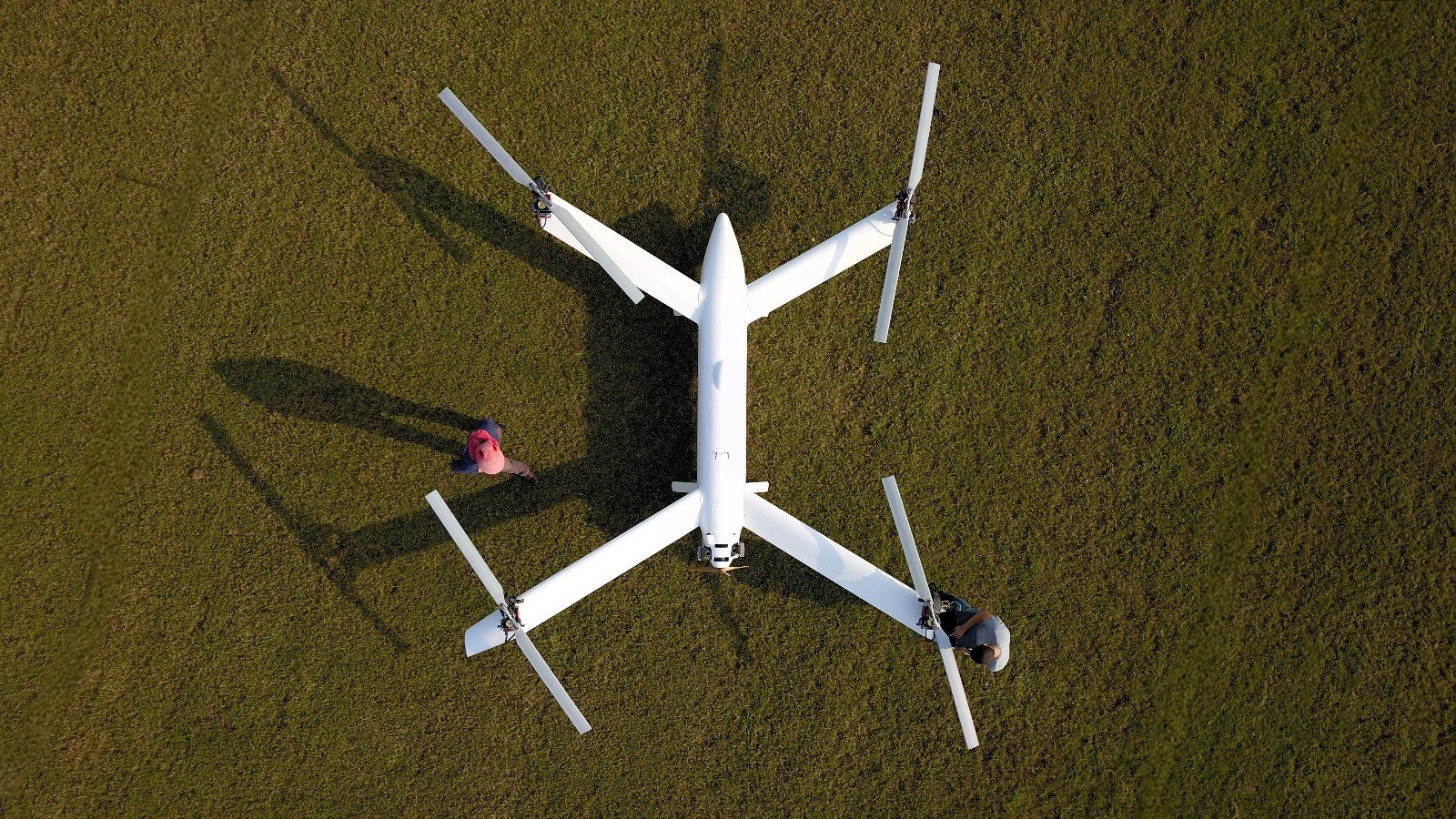
According to Kastiel, the system provides outstanding stability during hover operations in winds reaching 50 knots, while enabling optimal integration between rotors and wing during transition and cruise phases. The gimballed design dramatically reduces mechanical loads across the rotor heads by eliminating bending moments, significantly improving system reliability and reducing maintenance requirements.

“With a remarkably low disk loading of just 12 kg/m2, the EFIX300 achieves highly efficient hover capabilities while maintaining quiet operation through low rotor tip speeds,” said Kastiel.
Another very special capability of EFIX300 is that it incorporates autorotation capabilities across all flight phases, not just as a critical and certification-mandatory safety feature that allows the rotorcraft to glide and land safely in the event of power loss, but innovatively leverages autorotation during the transition phase, creating a safe overlap between lift generation methods as the aircraft moves from hover to forward flight.
During cruise, the rotors continue to autorotate, driven by the relative airflow from forward movement, enabling aircraft maneuvering while requiring no direct power input and serving as an ever-present safety system. The autorotating rotors improve flight efficiency and eliminate torque on the rotor shafts and gears, thus contributing to reliability.
The aerodynamic efficiency of EFIX300 is enhanced by its high aspect-ratio slim wing design, which produces most of the lift during cruise while ensuring minimal hover interference. This configuration enables a lift-to-drag ratio of 10:1 which matches conventional airplanes and delivers 2.5 times better efficiency than traditional helicopters, thus extending range and endurance. The wings feature a clean design without control surfaces, resulting in a simpler structure and enhanced reliability.
The EFIX300’s architecture provides the ability to maintain stable hover (the most demanding phase) even after loss of one electric motor, like no other quad-rotor is able to do. This, combined with the blend of two independent propulsion systems and the ability to perform autorotation, ensures a robust system with multiple layers of redundancy across all flight phases.
As per Kastiel, the EFIX300 can carry a 136 kg payload over 500 km and achieve a 15 hours endurance with a 50 kg payload.

“These metrics with the all-weather ability and infrastructure independence capabilities open new horizons in unmanned aerial ecosystem. Full-scale flight testing is underway, with hover tests in high winds already completed. Efix is targeting a defence-grade version by the end of 2026 for a range of defense mission profiles, from intelligence, surveillance, and reconnaissance (ISR) to logistics, maritime, border security, and special missions,” the company’s CEO told Raksha Anirveda.
Planned civil variants, supported by straightforward paths to civil certification due to built-in autorotation compliance, will well serve middle-mile logistics missions, infrastructure inspection, agriculture, sea-shore supply and emergency services like firefighting and disaster response. Moreover, the EFIX300 serves as a modular baseline for scale-up, including a planned 1-ton class platform capable of carrying over 400 kg payload, and optional future manned versions, and ultra heavy-lift variants.
The Israeli company protects its technological advantage with a robust IP portfolio of six patents filed, including two granted in the US covering platform architecture, the gimballed rotor system, safety mechanisms, and operational concepts, setting the company apart in the increasingly crowded VTOL segment.
The company that has developed the unique EFIX VTOL is led by founder and CEO Efi Kastiel, a former Israeli Air Force UAV pilot, private helicopter and aircraft pilot, and rotary wing expert, together with accomplished co-founders Aviv Tzidon, an ex-IAF fighter pilot, and Dekel Tzidon, experienced enthusiast, both previously co-founders of Eviation, combining decades of practical aviation experience with cutting-edge technology development.
Kastiel added that the capabilities of the EFIX300 makes it an ideal aerial platform for intelligence missions and as a platform for launching weapon system. “We plan to be in the market in the next18 months,” he concluded.

-The writer is an Israel-based freelance journalist. The views expressed are of the writer and do not necessarily reflect the views of Raksha Anirveda





