


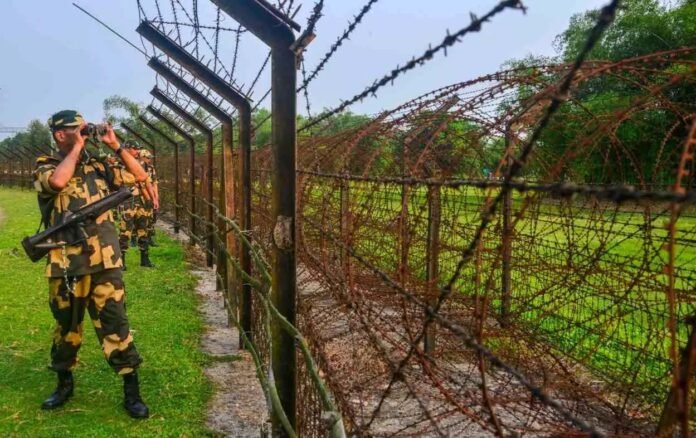
On the surface, the Union Home Ministry’s plan to build nearly 40 permanent Subsidiary Intelligence Bureau (SIB) campuses across West Bengal’s border districts reads like a procurement note. Some 50 acres of land, 1-1.5 acres per site, office-cum-residential compounds to replace the rented flats from which most SIB units outside Kolkata currently operate. It is easy to file the story under real estate and move on.
That would be a mistake. Buried in the logistics is a change in how India intends to hold its eastern frontier, a move from border management to border intelligence, and eventually to something closer to border influence. For decades the India-Bangladesh line has been read through the vocabulary of the Border Security Force: patrols, floodlights, barbed wire, and the endless argument over how much of West Bengal’s 2,217 kilometres remains unfenced. Nearly 600 kilometres still do. The new proposal accepts a quieter truth that practitioners have long understood: a fence can stop a body, but only intelligence can stop an intention.

Rented premises are porous. Landlords change, leases lapse, neighbours notice who comes and goes, and classified traffic cannot be reliably shielded inside a shared commercial building. Permanent compounds allow hardened communications, controlled access, secure data handling and the physical perimeter that intelligence work demands
Why Permanence Matters
The distinction is not academic. Rented premises are, by their nature, porous. Landlords change, leases lapse, neighbours notice who comes and goes, and classified traffic cannot be reliably shielded inside a shared commercial building. Permanent compounds allow hardened communications, controlled access, secure data handling and the physical perimeter that intelligence work demands. More importantly, they permit something the SIB has rarely enjoyed on this frontier: continuity.
Human intelligence is not extracted; it is cultivated. It is built slowly, over years, from transporters and traders, fishermen and village elders, local constables and panchayat workers who trust one particular officer and no one else. Every time a detachment rotates out of a rented room, that ledger of relationships is written off. Permanent campuses let officers stay embedded long enough to accumulate what no satellite can provide: the institutional memory of a specific stretch of a specific river. Forty nodes rather than one office per district suggest exactly this ambition: a distributed intelligence grid, layered beneath the BSF’s fence and the state police’s beat, rather than a handful of headquarters watching from a distance.
The eastern border has always demanded intelligence-led policing rather than pure interdiction. With the recent transfer of 142.79 acres of land to the BSF for outposts and fencing, the intent becomes clear. The state is building two things at once: the hard layer that contests the line itself, and the soft layer that works the hinterland behind it
A Border Unlike the Western One
This logic is sharpened by geography. India’s western frontier is militarised, thinly peopled and, for long stretches, fenced into legibility. The east is the opposite: dense, riverine, agricultural, and bound together by shared language, kinship and generations of informal trade. Families straddle the line; markets ignore it. Here, surveillance hardware alone yields diminishing returns. The threats that matter – document fraud that launders identities, smuggling corridors that double as terror-logistics routes, the occasional attempt by a hostile service or extremist facilitator to exploit the porosity – are not visible from a watchtower. They surface only in patterns that a well-sourced local officer learns to read. This is why the eastern border has always demanded intelligence-led policing rather than pure interdiction, and why the Home Ministry now appears willing to fund that recognition in concrete.
Read alongside the recent transfer of 142.79 acres to the BSF for outposts and fencing, the intent becomes clear. The state is building two things at once: the hard layer that contests the line itself, and the soft layer that works the hinterland behind it. Fence, patrol, local police, SIB node, IB headquarters, a graduated architecture in which each layer buys time for the next. The plan is to detect a threat at the recruitment and financing stage, far inland, rather than at the moment a silhouette crosses a paddy field at night. Anticipation is always cheaper than pursuit.

The Bricks are the Easy Part
None of this is guaranteed by architecture, and the sober caveats belong in the same breath as the applause. First, buildings do not generate intelligence; trained people do. Forty campuses will demand a cadre of officers who can be recruited, trained, and, hardest of all, persuaded to stay in difficult postings long enough to become useful. Without that human investment, the state will have built forty expensive addresses.
Second, there is the Centre-State knot that shadows every security initiative in Bengal. Land is a state subject, and a government frequently at odds with New Delhi controls the vested plots the project needs. The Centre’s stated readiness to purchase land where the state hesitates is not a footnote; it is a signal that Delhi expects friction and intends to route around it. Whether that yields cooperation or a fresh turf dispute will shape the timeline as much as any budget line.

Large, permanent, visibly hardened compounds are secure and conspicuous. But buildings do not generate intelligence; trained people do. Forty campuses will demand a cadre of officers who can be recruited, trained, and, hardest of all, persuaded to stay in difficult postings long enough to become useful. Without that human investment, we will only have 40 expensive addresses
Third, there is an operational paradox worth naming. Large, permanent, visibly hardened compounds are secure and conspicuous. A fortress announces itself to satellites and local watchers alike in a way an anonymous flat never does. The IB will have to reconcile the security of permanence with the low profile that field intelligence has always relied upon.
And fourth, the caveat that must not be treated as an afterthought: civil liberties. The tools that make forward-deployed intelligence powerful – pattern analysis, facial recognition, lawful interception, open-source and social-media monitoring – are precisely the tools that, left unbounded, corrode the trust these officers depend on to work. Intelligence dominance built by alienating the very border communities it patrols is a contradiction that collapses under its own weight. The measure of this project will not be acres acquired or towers raised, but whether it can tell the overwhelming majority of law-abiding residents apart from the handful who threaten them, lawfully, and without turning a frontier population into a register of suspects.
Seen as a whole, the 40 offices are less a construction plan than a statement of doctrine: that on India’s most complicated border, persistent intelligence is now treated as core infrastructure, on par with the fence and the force. It is the right instinct, and a belated one; the eastern frontier has waited a long time to be taken as seriously as the western. Whether that instinct becomes the right outcome depends entirely on everything that concrete cannot supply: people, patience, and restraint.

The writer is an expert on geopolitics, national security, and counter-terrorism; and he regularly contributes his subject thought-leadership and academic commentary with several publications in newspapers, journals, and periodicals. He works with investigative agencies, regulatory bodies, financial institutions and enterprises, providing strategic and regulatory advisory. The views expressed are personal and do not necessarily carry the views of Raksha Anirveda





