


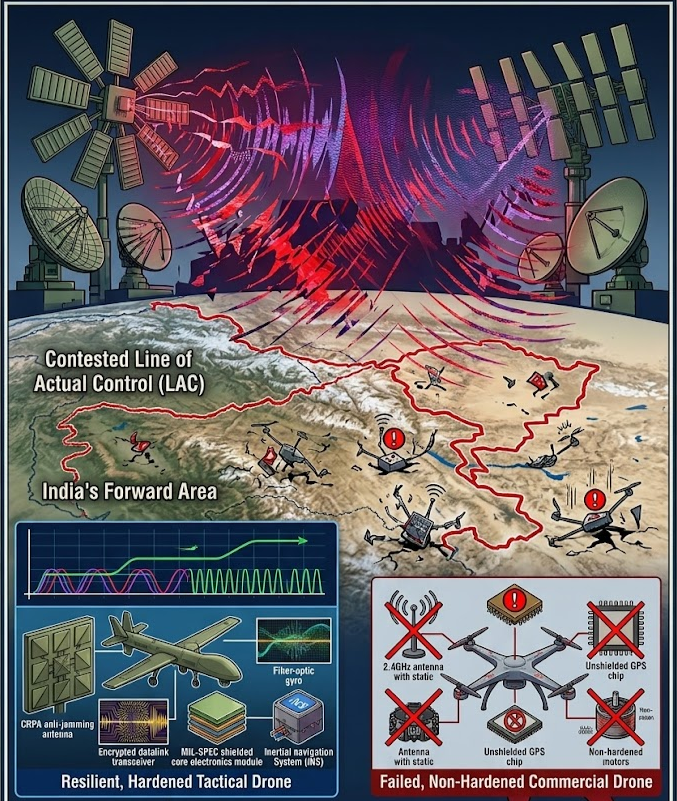
Adrone that performs well in a demonstration but loses navigation or its control link under enemy jamming is not a dependable combat capability. Along the Line of Actual Control (LAC), where altitude, terrain and electromagnetic interference compound, the consequences are immediate. The platform may be airborne yet unable to complete its mission, and the money spent on it, the operator’s effort and the commander’s plan then count for little.
This is the procurement challenge India must confront. China’s investment in electronic warfare (EW) means Indian military drones must be assessed in a contested electromagnetic environment, not merely on their performance in benign conditions. The issue is no longer how many drones can be inducted or how quickly, but whether they continue to deliver effect when an adversary seeks to deny navigation, communications and control. A drone intended for high-threat deployment must therefore be evaluated under realistic jamming and spoofing. A commercial platform with an unprotected navigation receiver and a conventional control link should not be presumed suitable merely because its airframe performs well.

The QR Problem: Resilience Without a Definition
Qualitative Requirements (QRs) shape what the Army ultimately gets for its money. If EW resilience is included in a requirement without specifying how it will be measured, tested and priced, the phrase becomes little more than a declaration of intent. A drone for high-threat deployment may need an anti-jamming GNSS receiver with a controlled-reception-pattern antenna (CRPA), a secure, interference-resistant control link, inertial navigation, an independent navigation backup, shielded electronics and a verified supply chain.
A drone for high-threat deployment may need an anti-jamming GNSS receiver with a controlled-reception-pattern antenna (CRPA), a secure, interference-resistant control link, inertial navigation, an independent navigation backup, shielded electronics, and a verified supply chain. All this adds cost, weight, power draw, and integration complexity
These features add cost, weight, power draw and integration complexity. A CRPA antenna assembly alone can reportedly add 200 to 400 grams before any sensor is mounted. Whether the airframe, payload, endurance and EW protection fit within the specified all-up weight and budget must be determined through engineering and costing, not assumed in the QR, before the tender is issued.
The post-Sindoor trials in late 2025 reportedly found that many of the 46 indigenous manufacturers assessed struggled under simulated adversary jamming, and that systems built on commercial chipsets with conventional control links were particularly vulnerable. The Army’s subsequent emphasis on EW resilience is necessary, but it cannot solve the problem by inserting a hardening clause into a tender. It requires realistic costing, measurable acceptance criteria and independent validation. Otherwise, manufacturers face a demanding standard with no clear definition of compliance, and contractual assurances may be mistaken for demonstrated performance.
The 3,000-Drone Tender: Can ₹200 Crore Deliver This?
A tender for 3,000 EW-resilient drones, reportedly valued at more than ₹200 crore and specifying a 7 kg all-up weight, raises a basic question about credibility. At ₹200 crore for 3,000 drones, the average contract value is approximately ₹6.67 lakh per unit. Whether this is sufficient for the specified EW protection depends on the contract’s scope, including payloads, testing, spares and support.

Headline prices cannot answer that question. A should-cost assessment can, based on verified component quotations and integration and testing costs. EW protection must be costed as part of the complete system, not treated as a feature manufacturers can absorb. The tender should include a transparent, component-level breakdown of mass and cost. If the performance cannot be achieved within the weight and price ceilings, the Army must decide what to change: the requirement, the budget, or the buy structure. The wrong approach is to keep all three constraints on paper and let manufacturers reconcile them after the award. A drone that meets price and weight but fails its operational test is not value for money.
A tender for 3,000 EW-resilient drones, reportedly valued at ₹200 crore, raises a basic question about credibility. Whether the average value of ₹6.67 lakh per unit is sufficient for the specified EW protection depends on the contract’s scope, including payloads, testing, spares and support
The Tethered Drones: What is the Price Buying?
A parallel procurement of tethered drones at a reported ₹15 lakh per unit raises a different question: does the price reflect the capability being purchased? Ground-fed power extends endurance, and a fibre-optic link, where fitted, reduces dependence on radio-frequency control. Neither makes the system immune to interference or attack, but both remove specific vulnerabilities.

The cost assessment must separate the airborne platform from the tether, ground power unit, winch, control equipment, payload, and support. The payload is the place to start. A surveillance camera with an integrated laser rangefinder is reported to cost between ₹10 lakh and ₹15 lakh. A tethered platform may require less navigation and control-link complexity than a free-flying, EW-resilient drone, but the comparison must include the tether, power supply, winch, and payload. If the platform price approaches the payload price, the cost breakdown should explain why. The Army should require a transparent breakdown, including lifecycle costs and acceptance criteria, so that every major cost aligns with a defined capability.
What a De Novo Review Must Address
A review must do more than reword existing QRs. It must link the threat, the required effect, the system architecture, the estimated cost, and the acceptance test, ensuring each requirement is measurable and each major cost is evidenced. That is how the Army separates a genuinely EW-resilient platform from one that merely carries the label.
The tender should include a transparent, component-level breakdown of mass and cost. If the performance cannot be achieved within the weight and price ceilings, the Army must decide what to change: the requirement, the budget, or the buy structure
Threat-Led QR Formulation: Every drone QR for the Northern and Eastern theatres must begin with the operational threat and specify navigation, communications and mission-continuity standards under representative jamming and spoofing. Operational users must provide documented inputs before the QR is finalised, and those framing it must understand what their choices mean for weight, power, endurance, integration and cost.
Realistic Should-Cost Analysis: Pricing must be built upward from a credible system design, not backward from a fixed budget. Where non-Chinese components are mandated, their availability, qualification and cost must be established, not assumed, and the estimate independently reviewed before the tender is issued. If the budget cannot support the required performance, the decision must be explicit: revise the specification, increase the allocation, or procure a different capability.
NavIC and Componentised Architecture: India’s regional constellation should be integrated into military drone navigation wherever technically feasible, alongside other sources and inertial backup. However, an Indian satellite service alone does not protect against jamming or spoofing, so the entire architecture must be tested with satellite signals degraded, manipulated, or unavailable.
Procurement should also separate the airframe from the mission electronics and the EW protection package, with defined interfaces, standards and supply-chain accountability. That lets the Army judge the cost and quality of each subsystem without losing sight of the whole.
Mandatory EW Certification and Leadership Education: No drone for a high-threat theatre should be inducted without demonstrating its specified EW performance. Testing must cover navigation and communications threats, and mission continuity and recovery behaviour when systems degrade, with results recorded against measurable criteria and with clear authority for certification and any exception.
Urgency is justified, but speed cannot substitute for validation. A drone that meets its contract but cannot complete its mission under representative electronic warfare conditions has failed the purpose for which it was bought
If formally validated, the three-tier post-Sindoor selection process is a starting point for a consistent framework. It should be codified in procurement procedures, not left as an arrangement that urgency can bypass. Regular workshops involving the Army, DRDO, test agencies and proven manufacturers would align expectations with engineering reality. Senior commanders must understand what EW resilience can deliver, what it cannot guarantee and what it costs, before requirements are approved and contracts signed.
The Cost of Getting This Wrong
Ukraine’s experience shows that a drone’s effectiveness cannot be separated from the electromagnetic environment in which it operates. Russian and Ukrainian forces continue to adapt their jamming and counter-drone measures. The lesson is not that a fixed share of drones will fail, but that performance against one threat configuration may not hold against another. Along the LAC, altitude, terrain and interference compound, so systems must be tested against the threats they are likely to face and remain upgradeable as those threats evolve. Urgency is justified, but speed cannot substitute for validation. A drone that meets its contract but cannot complete its mission under representative EW conditions has failed the purpose for which it was bought.
Conclusion
India must build its drone capability around the electromagnetic threat it faces, not the performance a manufacturer can demonstrate under favourable conditions. The number of drones procured is an input. Their ability to complete missions under hostile conditions measures combat capability. The next tender must make operational performance, not contractual compliance alone, the basis for acceptance. What matters is not how many drones reach the frontline, but how many can still complete their missions when the adversary tries to stop them.

The writer, a PVSM, AVSM, VSM has had an illustrious career spanning nearly four decades. A distinguished Armoured Corps officer, he has served in various prestigious staff and command appointments including Commander Independent Armoured Brigade, ADG PP, GOC Armoured Division and GOC Strike 1. The officer retired as DG Mechanised Forces in December 2017 during which he was the architect to initiate process for reintroduction of Light Tank and Chairman on the study on C5ISR for Indian Army. Subsequently he was Consultant MoD/OFB from 2018 to 2020. He is also a reputed defence analyst, a motivational speaker and prolific writer on matters of military, defence technology and national security. The views expressed are personal and do not necessarily carry the views of Raksha Anirveda





