


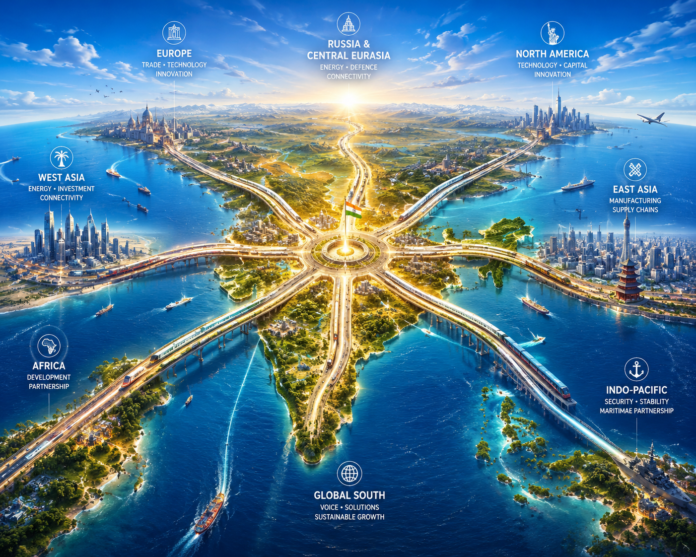
The greatest advantage a nation can possess in an uncertain world is not an alliance. It is choice. The world India entered at independence was a world of blocs. The world India entered after the Cold War was one of American primacy. The world India is entering today is neither. Power is becoming more dispersed, economic interdependence more weaponised, technology more strategic and geopolitics more transactional. Wars in Europe and West Asia, tensions in the Indo-Pacific, contested supply chains, sanctions, tariff wars and the race for artificial intelligence have exposed a hard truth: dependence, in the 21st century, can become vulnerability.
For India, the answer cannot be to choose one camp over another. It has to be to build enough relationships, capabilities and alternatives to remain free to choose. That is the new strategic imperative.

From a Changing World to a Changing India
India’s foreign policy has always been shaped by the world around it. Strategic autonomy was born from the experience of colonialism and the pressures of the Cold War. It gave India the freedom to refuse alignment with competing power blocs and to preserve its independent decision-making.
But autonomy in today’s world requires more than political independence. A country dependent on one market, one technology ecosystem, one source of energy, one defence supplier or one supply chain cannot exercise unlimited strategic freedom.
India therefore needs to move from strategic autonomy to strategic optionality.
Strategic Optionality is the New Autonomy
Optionality does not mean indecision. It means the opposite. It is the ability to say yes to one partner without having to say no to another. It is the ability to cooperate with the United States in advanced technology while maintaining other economic and strategic relationships. It is the ability to work with Europe on trade, France on strategic technology, Japan and Australia on the Indo-Pacific, South Korea on manufacturing and shipbuilding, Russia on energy and legacy defence capabilities, and the Gulf on investment, energy and connectivity.

Optionality is cooperation with the US on advanced technology while maintaining other economic and strategic relationships; working with Europe on trade, France on technology, Japan and Australia on the Indo-Pacific, South Korea on shipbuilding, Russia on energy, and the Gulf on investment and energy
This is not diplomatic opportunism. It is risk management at the level of the nation-state. A smart investor does not put all his wealth into one asset. A smart military does not depend upon a single capability. A smart nation should not depend upon a single geopolitical ecosystem. India is increasingly constructing a diversified strategic portfolio.
- Portfolio of Partnerships: The remarkable feature of India’s external engagement today is not simply its geographical spread. It is its functional diversity.
Britain offers market access and opportunities for services and investment. The European Union represents an enormous economic and technological ecosystem. France brings strategic technology, defence and a shared interest in strategic autonomy. Japan and Australia strengthen India’s Indo-Pacific architecture. South Korea offers opportunities in manufacturing, electronics and shipbuilding. EFTA nations bring capital and investment possibilities. The Gulf offers energy, finance, logistics and connectivity. Russia remains important for energy and defence.

And America remains indispensable in advanced technology, defence, space, investment and the Indo-Pacific. The objective is not to make all these relationships identical. It is to make them mutually reinforcing. This is perhaps the most sophisticated form of multi-alignment: not balancing one power against another, but using different partnerships to advance different national interests.
- Technology: New Strategic Frontier: The next great contest among nations will not be fought only over territory. It will be fought over algorithms, semiconductors, quantum computing, biotechnology, cyber capabilities, space systems, telecommunications, critical minerals and advanced manufacturing.
Technology is becoming the new geography of power. A country that controls critical technologies can exercise influence far beyond its borders. A country dependent upon technologies it cannot access, manufacture or replace can find its strategic choices constrained without a single soldier crossing its border.
As technology is becoming the new geography of power, India needs partnerships that build tech sovereignty. Therefore, India must learn, adapt, manufacture, and eventually innovate. The objective of tech partnerships must be capability creation, not technological dependence by another name
India therefore needs technology partnerships — but partnerships that ultimately build technological sovereignty. India does not need to invent everything alone. It needs the ability to learn, absorb, adapt, manufacture and eventually innovate. The objective of technological partnerships must therefore be capability creation, not technological dependence by another name.
- Return of Maritime India: There is another dimension to India’s emerging strategic architecture that deserves far greater attention: the sea. More than 90 per cent of India’s trade by volume moves by sea. The Indian Ocean connects India’s economy to the Gulf, Africa, Europe and the Indo-Pacific. Global energy supplies, container traffic, undersea cables and critical supply chains pass through waters that are central to India’s security.
India’s maritime partnerships with France, Australia, Japan, the United States, South Korea, New Zealand and the Gulf therefore have significance beyond naval diplomacy.
Even shipbuilding must be viewed through this larger strategic lens. India’s aspiration to become a major shipbuilding power is therefore simultaneously an industrial, economic and geopolitical ambition.
- Foreign Policy Begins at Home: There is, however, a limit to what diplomacy can achieve. India can sign trade agreements, attract investment and establish technology partnerships. But their real value will depend upon India’s ability to convert external opportunity into domestic capability.
That requires competitive manufacturing, world-class universities, skilled human capital, efficient logistics, reliable infrastructure, deeper research ecosystems, predictable regulation and faster execution. A country cannot become a global power merely by having a global foreign policy.
There is a limit to what diplomacy can achieve alone. So, India needs the ability to convert external opportunity into domestic capability, which requires competitive manufacturing, world-class universities, skilled human capital, efficient logistics, reliable infrastructure, deeper research ecosystems, predictable regulation and faster execution
Its domestic capabilities must be able to carry the weight of its diplomatic ambitions.
Architecture of a Multipolar India
The emerging Indian model is neither isolationism nor alliance dependence. It is a form of purposeful multi-alignment.
America can be India’s strategic partner without becoming its strategic patron. Russia can remain important without becoming India’s strategic anchor. Europe can become a major economic partner without India becoming part of a geopolitical bloc. France can cooperate with India on advanced technology while India retains complete strategic independence. Japan and Australia can strengthen India’s position in the Indo-Pacific without requiring India to abandon its independent choices. This is not ambiguity. It is maturity.
India is beginning to understand that strategic independence does not require strategic distance. One can cooperate deeply without surrendering sovereignty of choice.
India Chooses its Own Geometry
The great transformation taking place in Indian foreign policy is therefore not about how many countries India visits, how many agreements it signs or how many strategic partnerships it announces.
For decades, India asked the world for space. Today, it is creating its own, building markets without becoming dependent on one market, seeking technology without surrendering technological autonomy, expanding defence partnerships without entering a rigid alliance structure, and strengthening maritime ties while building indigenous capacity
It is about something deeper. For decades, India asked the world for space. Today, India is increasingly creating its own. It is building markets without becoming dependent on one market. It is seeking technology without surrendering technological autonomy. It is expanding defence partnerships without entering a rigid alliance structure. It is strengthening maritime relationships while building indigenous capacity. It is attracting investment while seeking manufacturing power at home.
The world ahead will be turbulent. Great-power rivalry will intensify. Technology will become more political. Trade will become more strategic. Supply chains will become instruments of influence. Nations will increasingly use economic power to pursue geopolitical objectives.
In such a world, India’s greatest strategic asset may not be its ability to predict what another power will do. It will be its ability to respond without being trapped by dependence.
Strategic autonomy was the India that refused to be told whom to follow. Strategic optionality is the India that has built enough strength, partnerships and alternatives to decide where it wants to go.
And perhaps that is the most consequential shift of all: India is no longer waiting for the world to choose it. India is building the power to choose its own path.

Lt Gen Rajeev Chaudhry (Retd) writes on contemporary national and international issues, strategic implications of infrastructure development towards national power, geo-moral dimension of international relations, and leadership nuances in a changing social construct. The views expressed are of the author and do not necessarily reflect the views of Raksha Anirveda





