


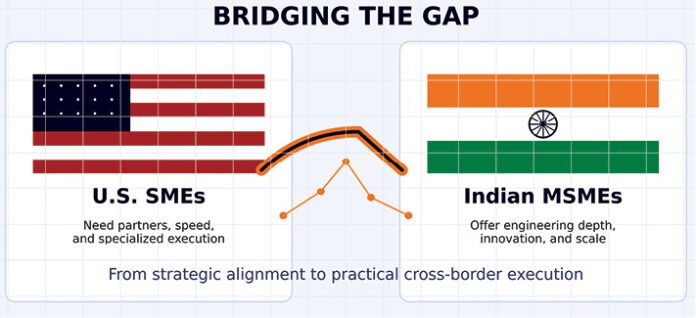
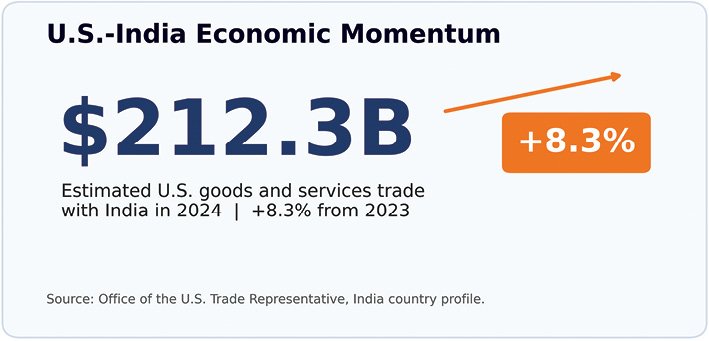
The United States and India have significantly strengthened their strategic and economic partnership over the last decade, particularly in defence innovation, advanced technology, manufacturing, and startups. Initiatives such as INDUS-X and India’s iDEX have created frameworks to encourage collaboration between startups, innovators, and private-sector enterprises from both countries.
Despite this momentum, small and medium enterprises (SMEs), startups, and MSMEs in both countries continue to face substantial barriers in establishing meaningful business partnerships. Interest remains high, but practical collaboration is often limited by gaps in market knowledge, regulatory understanding, financing access, trust-building mechanisms, and operational support.

Strategic Alignment is Strong, but SME Execution Remains Weak
India and the United States are increasingly aligned across defence, semiconductors, artificial intelligence, aerospace, cybersecurity, clean energy, and advanced manufacturing. Governments on both sides recognise that innovation ecosystems – especially startups and SMEs – are critical drivers of economic growth and technological competitiveness.
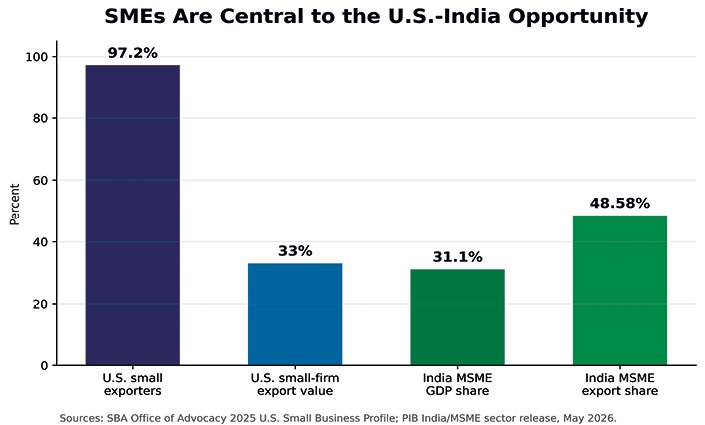
Large corporations often possess the legal, financial, and operational capabilities necessary to navigate international partnerships. SMEs, however, rarely have comparable resources, even though they are often more innovative and agile.
As a result, many promising US and Indian SMEs express interest in working together but fail to convert opportunities into sustained business relationships.
Key Bilateral Innovation Initiatives
INDUS-X: The India-US Defence Acceleration Ecosystem (INDUS -X), was launched to deepen cooperation between the defence innovation ecosystems of India and the United States. The initiative is designed to connect defence companies of all sizes, startups, incubators, accelerators, investors, universities, and government stakeholders.

- Connect startups and SMEs in both countries
- Accelerate defence technology collaboration
- Facilitate investor and industry participation
- Promote co-development and co-production
- Strengthen defence supply-chain resilience
Although INDUS-X has generated enthusiasm through summits, startup showcases, and networking events, many SMEs still struggle to move from discussions to executable partnerships.
iDEX: India’s Innovations for Defence Excellence (iDEX) initiative was launched by the Ministry of Defence to encourage innovation among startups, MSMEs, individual innovators, industry, R&D institutions, and academia for defence and aerospace applications.

- Support indigenous innovation
- Provide grants and incubation support
- Enable startup and MSME participation in defence innovation
- Build domestic technological capability for future defence and aerospace needs
iDEX has helped create a startup culture within India’s defence ecosystem. However, international integration, especially with US-based SMEs, remains limited by regulatory, procedural, and market-access complexity. The problem is not lack of opportunity. The problem is the missing operating layer between strategic intent and commercial execution.
Why SMEs Want to Collaborate
Complementary Strengths: Indian SMEs and MSMEs bring cost-effective engineering talent, rapid software development capabilities, manufacturing scalability, frugal innovation, and emerging deep-tech ecosystems. US SMEs bring advanced R&D, access to global defence and enterprise markets, venture capital networks, product design expertise, and mature commercialisation practices.
Together, these complementary strengths create strong incentives for collaboration. Yet complementary capabilities do not automatically translate into successful partnerships.
Supply Chain Diversification: Global geopolitical tensions and supply-chain disruptions have increased interest in diversified manufacturing and technology partnerships outside traditional hubs. India is increasingly viewed by US companies as a strategic manufacturing alternative, a democratic technology partner, and a growing innovation market. Indian SMEs, in turn, view the United States as a high-value technology market and a gateway to global defence and enterprise ecosystems.
Core Challenges Preventing Effective Collaboration
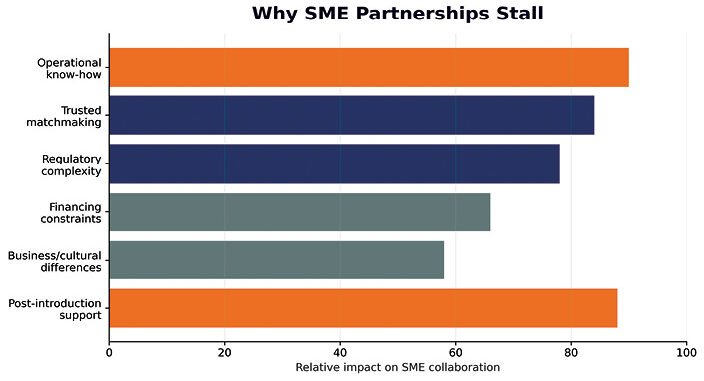
Most SMEs lack practical understanding of cross-border contracting, US export-control regulations such as ITAR and EAR, Indian defence procurement systems, intellectual property protection, international taxation, and compliance requirements. Even when business interest exists, companies often do not know how to initiate or structure collaboration.
Absence of Trusted Matchmaking and Execution Support: Current initiatives often focus on conferences, announcements, and strategic dialogues. What SMEs need, however, is longer-term matchmaking support, partnership facilitation, technical due diligence, legal onboarding assistance, and post-introduction execution support. Without this operating layer, companies often fail to identify reliable partners or sustain momentum after initial conversations.
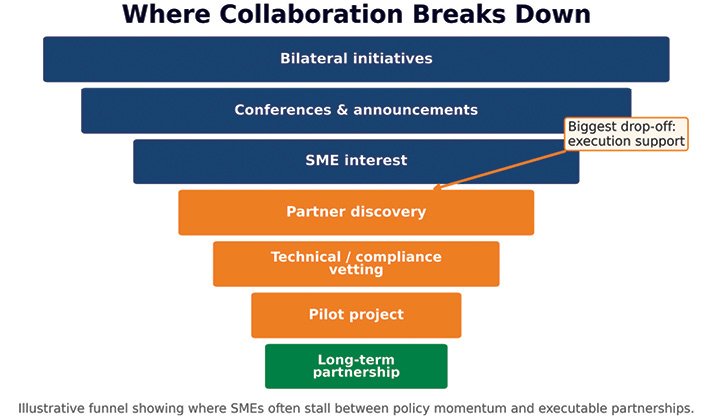
Regulatory, Financing and Cultural Barriers: US-side challenges include export controls, security requirements, defence compliance, and contracting complexity. India-side challenges include procurement bureaucracy, localisation requirements, certification delays, and public-sector purchasing processes. In addition, cross-border collaboration requires travel budgets, legal expenses, product adaptation, certifications, and pilot funding. Most SMEs operate with limited capital and cannot absorb long international sales cycles.
Differences in decision-making timelines, contract expectations, communication styles, risk tolerance, and procurement behaviour can further slow progress. Trust-building often takes longer than SMEs anticipate.
Sector-Specific Opportunities
Defence technology offers potential collaboration in drone systems, AI-enabled surveillance, electronic warfare software, edge computing, and battlefield communications. INDUS-X can become a major catalyst if procurement pathways become more SME-friendly.
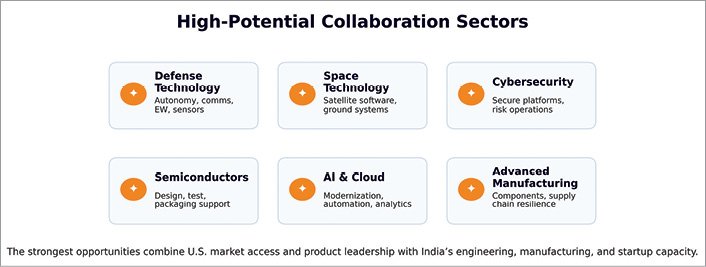
Semiconductors create opportunities for US design firms, testing and packaging partnerships, equipment suppliers, and talent collaboration. Cybersecurity offers a natural pairing between Indian engineering scale and US market frameworks. Commercial space ecosystems in both countries are rapidly growing and present opportunities in satellite systems, launch technologies, Earth observation analytics, and space software.
Recommendations
The next phase of US-India cooperation should focus not only on high-level strategic partnerships but also on operational tools that allow SMEs to participate meaningfully.
- Create bilateral SME facilitation cells that provide regulatory guidance, legal templates, export-control awareness, taxation guidance, and market-entry support.
- Develop trusted matchmaking networks with verified partner databases and sector-specific collaboration platforms.
- Launch joint pilot funding programmes to reduce early-stage risk and accelerate trust-building.
- Simplify procurement access through SME-friendly pathways, faster approval mechanisms, and sandbox testing environments.
- Build cross-border incubators and accelerators that help startups understand market expectations in both countries.
- Increase industry mentorship from experienced multinational executives, defence contractors, and technology leaders.
The Role of a Cross-Border Execution Bridge
A company with trusted connections in both countries can solve the gap by operating as a cross-border execution bridge rather than a simple broker. The bridge company can assess technical needs, identify suitable partners, vet capabilities, structure pilots, coordinate compliance review, and provide project governance.
For US SMEs, such a bridge reduces the risk of choosing the wrong partner and helps convert broad technical needs into executable scopes. For Indian SMEs and MSMEs, the bridge creates access to serious US opportunities and helps present their capabilities in a way that US buyers understand.
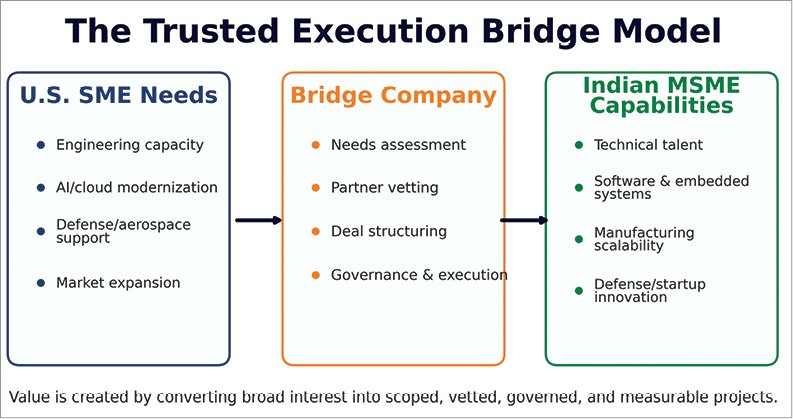
The highest value is created after the introduction. Without governance, escalation management, milestone tracking, and technical review, cross-border partnerships can stall quickly. A trusted execution bridge keeps both sides aligned until the relationship produces measurable outcomes.
Summing Up
The strategic alignment between India and the United States has created unprecedented opportunities for SME collaboration, especially in defence, technology, and advanced manufacturing. Initiatives such as INDUS-X and iDEX represent important first steps toward building a connected innovation ecosystem.
However, enthusiasm alone is insufficient. SMEs require operational support, trusted networks, financing access, and simplified regulatory pathways to translate bilateral intent into commercial reality.
If these barriers are successfully addressed, the United States and India can unlock a powerful new era of bilateral industrial and technological cooperation – one driven not only by large corporations and governments, but also by the thousands of SMEs and startups that form the backbone of innovation in both countries.

–The writer is a globally recognised aerospace, defence, and national security executive with more than two decades of leadership experience driving enterprise transformation, mission-critical operations, and strategic growth across highly regulated defence, aerospace, and advanced technology sectors. He has held senior executive leadership roles with some of the world’s most respected aerospace and defence organisations, including BAE Systems and Raytheon. He holds an MBA in Programme Management from George Washington University and a Master’s degree in Electrical Engineering from Mississippi State University. The views expressed are personal and do not necessarily reflect the views of Raksha Anirveda.





