


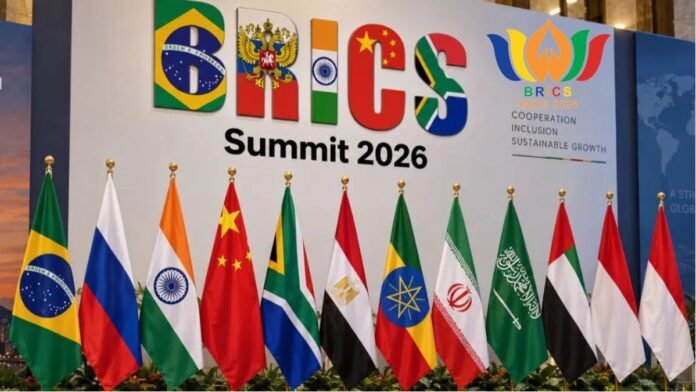
After a hectic two-day deliberation at the leadership level, the 18th BRICS summit concluded successfully, overcoming the concern that geopolitical differences between the UAE and Iran might act against the unanimous adoption of a joint communiqué in New Delhi.
This fear was not unwarranted in the background of what happened at the BRICS’s Foreign Ministers Meeting on May 14-15. It ended without a joint statement due to sharp divisions between the UAE and Iran over the Middle East conflict.

Optics and Reality
Obviously, reaching a consensus among member states, especially when the Middle East war is still going on, is not a mean achievement. But by bringing consensus within 11 BRICS countries, India demonstrated that it has the capability to navigate successfully any challenge.
Moreover, it showed that India can become a bridge-builder rather than a bloc leader aligned with one camp. It was apparent when New Delhi played a meaningful role in arranging a meeting between Iranian President Masoud Pezeshkian and UAE Crown Prince Sheikh Khaled bin Mohammad bin Zayed Al Nahyan on the sidelines of the BRICS summit.
“The UAE, the Emiratis and other countries of the region are our brothers. We have been living together for a long time and we have had trade. We have supported each other,” said the Iranian President. He added, “Right now, we have a good relation with the UAE and we can expand it with other countries.” Without India’s effort Tehran could not have turned a new page in their bilateral relations that have soured due to the Iran war.
Presence of Chinese President Xi Jinping and Russian President Vladimir Putin at the BRICS summit added further weight to India’s clout. After a gap of seven years, the Chinese President visited India for the BRICS summit. He had deliberately given a miss to the G-20 summit in New Delhi in September 2023. And for Putin, it was the first in-person participation at a BRICS summit outside Russia since the Ukraine war began.

The summit overcame serious divisions between Iran and the UAE, which had previously prevented a joint statement at the foreign ministers’ meeting. India’s success in securing consensus among all 11 members demonstrated its ability to manage competing interests during an active Middle East conflict
In the selection of outreach countries too, India displayed pragmatism and invited influential multilateral and regional groups. Philippines President Ferdinand Marcos Jr who currently chairs ASEAN, African Union Chairperson Évariste Ndayishimiye who is also Burundi’s President, the current Chair of the Community of Latin American and Caribbean States (CELAC)-Uruguay, the Gulf Cooperation Council Chair-Bahrain, the UN Secretary General, the Directors-General of WHO, WTO, International Solar Alliance, Coalition for Disaster Resilient Infrastructure, chiefs of New Development Bank and AIIB.
Smart Moves

This was the first BRICS summit where several new institutional and practical initiatives were pushed. For instance, a BRICS Continuity and Implementation Mechanism was proposed to ensure that no initiatives and outcomes get disrupted due to customary annual rotation of the chairship.
This was also the first BRICS summit, where the setting-up of a secure digital repository was proposed to ensure that every decision, the nodal point, timeline and implementation status was recorded.
In the backdrop of killing of several Indian seafarers in attacks on merchant vessels in and around the Strait of Hormuz since the US-Israeli war on Iran began in February, New Delhi proposed establishing a Seafarers Emergency Support Network to ensure that they get adequate support during times of difficulty.
This was also the first BRICS summit in which India called for UNSC reform through text-based negotiations, backed by a clearly defined timeline and concrete outcomes.
India’s demand for the Security Council’s reform has been a recurring feature in almost every BRICS summit. In the 2023 BRICS summit in Johannesburg, India had used the “defined timeline” phrase for reform of the Security Council.
At the Kazan summit of the BRICS in 2024, India changed the phraseology to “time bound manner” on reform of the UNSC. The Rio de Janeiro BRICS summit in 2025 witnessed India calling for the urgent need for reform of institutions like UNSC, IMF, World Bank and WTO.
Therefore, it was the first BRICS summit where emphasis was laid on the UNSC reform through text-based negotiations with clearly defined timeline and concrete outcomes.
Other initiatives pushed by India included health-focused Training Hub Network, the India Centre for BRICS Industrial Competencies and the BRICS-New Development Bank Knowledge Portal.
Rather than aligning exclusively with one geopolitical camp, India positioned itself as a mediator. Its efforts to facilitate a meeting between Iranian President Masoud Pezeshkian and UAE Crown Prince Sheikh Khaled bin Mohammad bin Zayed Al Nahyan highlighted New Delhi’s growing diplomatic influence in the region
However, while India advanced several proposals and initiatives at the summit with considerable clarity, the meeting also marked the first BRICS leaders’ summit to produce a 45-page joint declaration comprising 140 paragraphs, making it the longest joint communiqué in the group’s two-decade long history.
Diplomatic Hedging
This was also the first BRICS summit where efforts were made to accommodate individual members’ concern without India letting its strategic balance suffer.
For instance, without naming the US or Israel in the context of the Iran war, the BRICS declaration expressed serious concern over “deliberate attacks on civilian infrastructure and peaceful nuclear facilities under full safeguards of the International Atomic Energy Agency (IAEA).”
If it showed BRICS members’ willingness to accommodate Iran’s concern over the US-Israel imposed war, it also demonstrated that the group under the chairmanship of India would not hesitate to call a spade, a spade.
The BRICS, despite being packed with the US’s heavyweight Middle East allies such as the UAE, Saudi Arabia and Egypt, called attacks on civilian infrastructure and peaceful nuclear facilities unlawful and in violation of international law and relevant resolutions of the IAEA.
The BRICS declaration also expressed deep concern over the continued escalation of tensions in the Middle East and called “for exercising maximum restraint, as well as avoiding actions that could further aggravate the situation.”
“We urge to ensure the protection of civilians and civilian infrastructure in accordance with the purposes and principles of the Charter of the United Nations in their entirety and interconnectedness, including respect for the sovereignty and territorial integrity of the states,” the BRICS communiqué maintained, without directly condemning the US and Israel for their war against Iran.
Yet, the most glaring omission was any mention of the ongoing war in Ukraine. The Delhi declaration of the BRICS raised concern over the Middle East war, terrorism and extremism in Syria and worsening humanitarian crisis in Sudan, but it did not mention the Russia-Ukraine war, though it was the part of the Rio de Janeiro declaration in 2025.
India promoted several initiatives to improve BRICS continuity and implementation, including a secure digital repository for tracking decisions, timelines and progress. Other proposals included a Seafarers Emergency Support Network, a health-focused Training Hub Network and new platforms for industrial cooperation and knowledge-sharing
This notable shift in the BRICS’ stand under the chairship of India drew criticism, with several analysts questioning the reason behind the omission and its implications for the group’s position on the Ukraine conflict.
Failing to Catch Snake by its Neck
The BRICS declaration strongly condemned the April 2025 Pahalgam terrorist attack. This is considered as a major diplomatic outcome for India as it could not have been part of the Delhi declaration had it not been backed by China, a known ally of Pakistan.
Remember, when Operation Sindoor was launched to avenge the killing of 26 people in Pahalgam in Jammu and Kashmir – 25 Indians and one Nepali citizen – by Pakistan-based terrorists, China had not only supplied weapons to Islamabad, but also provided direct on-ground technical assistance, real-time intelligence sharing and military hardware maintenance to it during four-day war between India and Pakistan in May 2025.
In this background, if India managed to get the Pahalgam incident in the BRICS declaration, it is undoubtedly a significant diplomatic gain, given that China always provides diplomatic shield for Islamabad against international pressure.
However, this was the second time the BRICS declaration, endorsed by Beijing, categorically condemned the Pahalgam terrorist attack. In the Rio de Janeiro hosted BRICS summit too, killing of 26 people in Jammu and Kashmir by Pakistan-based terrorists was condemned.
The 45-page communiqué addressed attacks on civilian infrastructure and nuclear facilities without directly naming the United States or Israel. This language accommodated Iran’s concerns while preserving India’s strategic flexibility. However, the omission of the Russia-Ukraine war raised questions about the declaration’s changing geopolitical priorities
Both 2026 and 2025 BRICS declarations reaffirmed commitment to combating terrorism in all its forms and manifestations, including the cross-border movement of terrorists, terrorism financing and safe havens.
Both declarations maintained that terrorism should not be associated with any religion, nationality, civilisation or ethnic groups and that all those involved in terrorist activities and their support must be held accountable and brought to justice in accordance with relevant national and international law.
Yet, both declarations refrained from directly naming Pakistan as the perpetrator of the terrorist attack in Jammu and Kashmir in April 2025. Obviously, China could have been a factor behind not explicitly naming Pakistan as a perpetrator of the Pahalgam attack.
Keeping US on Tenterhooks
In order to reduce reliance on US dollars due to geopolitical tensions, economic sanctions and America’s tariff policy, BRICS leaders at the summit discussed use of local currencies in trade within the group.
However, the Delhi declaration made no mention of common currency. Instead, it acknowledged the efforts of the BRICS Payment Task Force (BPTF) towards exploring pragmatic solutions for efficient cross-border payment mechanisms.
BRICS leaders discussed reducing dependence on the US dollar by encouraging trade settlements in local currencies and improving cross-border payment systems. However, the declaration made no commitment to creating a common BRICS currency, confirming that the group is pursuing practical financial cooperation rather than monetary integration
“We acknowledge the work done to study the cross-border interoperability of payment and messaging channels, and the discussions on promoting trade settlements and investments using BRICS local currencies,” said the 2026 BRICS declaration.
Intent is clear: BRICS has no plans for creating a single currency; instead, it is focused on promoting the use of local currencies in cross-border trade.
Overall, the 2026 BRICS summit was less about producing breakthroughs than about demonstrating what India could achieve by balancing competing interests within an increasingly heterogeneous grouping.
The unanimous declaration, despite sharp geopolitical differences among members, showed that BRICS can still find common ground on issues where its members have divergent strategic interests.
For India, however, the summit provided an opportunity to project itself not merely as the chair of an expanding grouping, but as a pragmatic bridge-builder capable of keeping rival camps engaged without sacrificing its own strategic interests.

The writer is a senior journalist with wide experience in covering international affairs. The views expressed are of the writer and do not necessarily reflect the views of Raksha Anirveda





