


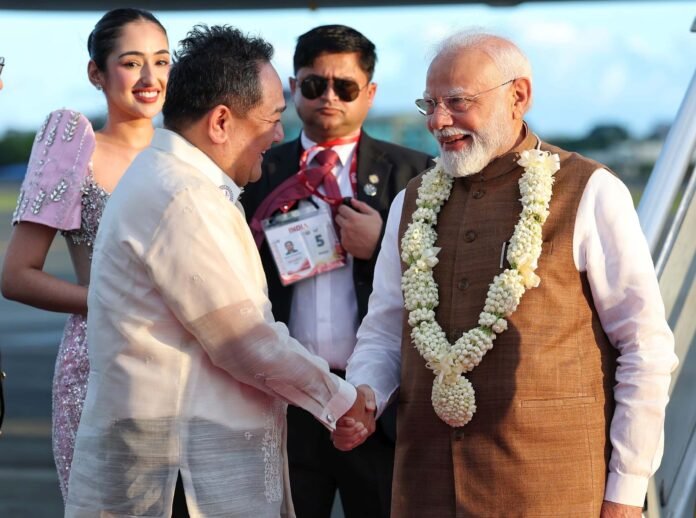
Prime Minister Narendra Modi is in Manila for the 23rd ASEAN-India Summit and the 21st East Asia Summit, at the invitation of Philippine President Ferdinand Marcos Jr. His programme includes a dinner hosted by Marcos and bilateral meetings on the sidelines; he is also expected to engage with the Indian community. The visit, scheduled for November 16-18, places India in a busy diplomatic week as the Philippines chairs ASEAN.
Modi at ASEAN’s Table
The Prime Minister has described ASEAN as central to India’s Act East policy and its MAHASAGAR vision. That formulation reflects a strategic reality: India’s interests in Southeast Asia are no longer limited to commerce or historical ties. They span connectivity, maritime security, technology, supply-chain resilience and people-to-people links. The East Asia Summit provides an additional, ASEAN-led setting for discussions with regional leaders and major powers on security and shared challenges.

Marking 2026 as the ASEAN-India Year of Maritime Cooperation, PM Modi must push for a UNCLOS-compliant South China Sea code while defending India’s engagement-over-isolation stance on Myanmar without appearing indifferent to the crisis
Manila’s agenda is likely to include maritime cooperation and regional stability, alongside trade. The year 2026 has been designated the ASEAN–India Year of Maritime Cooperation. Myanmar will be a difficult subject: India has argued against diplomatic isolation, citing its border, security concerns and connectivity projects, while ASEAN continues to grapple with how to respond to the crisis. New Delhi’s challenge is to advocate engagement without appearing indifferent to the conflict’s human and political costs.
The Leader Meetings: Confirmed and Anticipated
The clearest scheduled bilateral engagement is with Marcos, whose invitation underpins the visit and whose government is hosting the summit. Officials have said bilateral meetings with other leaders are being planned, but public reporting available before the summit does not provide a definitive list of confirmed one-to-one appointments. PM Modi’s participation in multilateral sessions will, in any case, offer opportunities for direct exchanges with ASEAN and East Asia Summit leaders.
The most prominent additional encounter is the Quad leaders’ meeting, scheduled for November 17. It is expected to bring PM Modi together with Trump, Australian Prime Minister Anthony Albanese and Japanese Prime Minister Sanae Takaichi, the first Quad leaders’ gathering in two years. The White House has said the leaders will discuss shared interests in Indo-Pacific peace, prosperity and security. This is a confirmed multilateral meeting, not evidence of separate bilateral appointments with each leader.
With bilateral trade hitting $128.37 billion in FY 2025-26, New Delhi is pushing for an early conclusion to the ASEAN-India Trade in Goods Agreement (AITIGA) review to improve market access and fix trade imbalances
President Trump is therefore the other major world leader PM Modi is expected to meet in Manila, through the Quad. Xi Jinping and Vladimir Putin, however, are not reported as attending the Manila summit or as scheduled to meet PM Modi there. Their separate, reported trilateral with Trump is connected to APEC in Shenzhen, China, not to Manila’s ASEAN gatherings.

The Trade Pact that is Not Yet an FTA
India’s trade relationship with ASEAN provides the larger economic backdrop. The Ministry of External Affairs says India-ASEAN trade reached $128.37 billion in financial year 2025-26. New Delhi is seeking an early conclusion to the review of the ASEAN-India Trade in Goods Agreement, or AITIGA, which it hopes will improve market access and address concerns over trade imbalances. The review is still under discussion, not a completed Manila deliverable.
The Philippines relationship requires a sharper distinction. India and the Philippines do not yet have a bilateral free trade agreement. Reporting in July said the countries had agreed on terms of reference for negotiations on a preferential trade agreement, with talks expected to follow the AITIGA review. A PTA is narrower than a comprehensive FTA: it can lower tariffs on selected goods rather than liberalise trade across a broad range of sectors.

Building on Manila’s landmark $375 million BrahMos missile purchase, India aims to deepen ties through training, maintenance and joint maritime exercises that bolster regional stability without framing the partnership as purely anti-China
That is not a reason to understate the opportunity. The Philippines’ envoy has pointed to room to expand bilateral goods trade, while Manila has expressed interest in reducing barriers on pharmaceuticals. A carefully designed PTA could give businesses clearer access and help diversify trade, but it must be negotiated, not announced prematurely as a concluded deal. Modi’s visit can provide political impetus; the hard work will be balancing product access, domestic sensitivities and practical implementation.
Defence Ties: From a Missile Contract to a Relationship
Defence cooperation is already more concrete. In 2022, the Philippines became the first foreign customer for India’s BrahMos supersonic cruise missile, signing a $375 million contract for three shore-based anti-ship missile batteries. Manila has since indicated interest in acquiring additional systems and submitted a wish list to Indian counterparts. The existing deal gives the relationship a practical foundation, but any further purchase would require its own decisions and agreements.
The strategic significance is broader than arms sales. The Philippines faces persistent maritime tensions, while India has a growing interest in the western Pacific and the security of sea lanes. Training, maintenance, information-sharing and joint maritime engagement could make the partnership more durable than a single procurement. India should frame defence cooperation as support for Philippine capability and regional stability, not as an effort to turn Manila into an instrument of a contest with Beijing.
The true measure of PM Modi’s Manila mission will be ensuring the Quad complements ASEAN centrality while delivering sustained economic and security partnerships across the Indo-Pacific
At the ASEAN level, India can also build on the second ASEAN-India Maritime Exercise and other cooperation, while affirming that any South China Sea Code of Conduct should conform to international law, including the UN Convention on the Law of the Sea. That combination, practical security cooperation with a clear legal principle, offers India credibility. It avoids both passivity in the face of coercion and rhetoric that could make ASEAN partners wary of being forced to choose sides.
India’s Strategic Opportunity
PM Modi’s Manila visit is a test of whether India can connect summit language to useful outcomes. On trade, that means advancing the AITIGA review and clarifying the path toward a Philippines PTA. On defence, it means following the BrahMos relationship with sustainable training and maritime cooperation. At the Quad, India can press for practical work while ensuring that the grouping complements ASEAN rather than bypassing it.
The value of the week will not be measured by the number of leaders in a photograph. It will be measured by whether India listens to regional priorities, negotiates honestly about trade, and contributes capabilities without inflaming divisions. Manila offers PM Modi the chance to show that Act East is not merely a slogan: it is a sustained commitment to partnership, prosperity and a maritime order grounded in rules.

-The writer is a New Delhi-based senior commentator on international and strategic affairs, environmental issues, an interfaith practitioner, and a media consultant. The views expressed are personal and do not necessarily carry the views of Raksha Anirveda






