


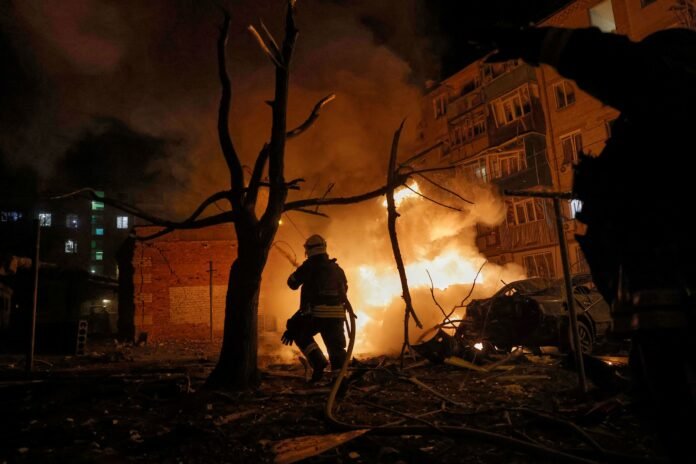
Victory or defeat in a modern-era war is not a measure of losses. In the Russia-Ukraine war ongoing since February 2022, Ukraine has suffered extensive devastation, but it is still standing upright. And Russia has not gained victory, despite being recognised as a great military power, almost on par with the United States. Instead, Russia has also gone through unprecedented destruction. Victory has been elusive to both sides. In fact, Ukraine has given Russia a befitting reply. It is a fit case of ‘No Victor; No Vanquished’.
Take the case of the US/Israel-Iran war since February 28, 2026. In July 2026, Defence Secretary Pete Hegseth told the US Senate that the war has cost $37.5 billion and defended the administration’s request for a further $67 billion to restock the Pentagon’s arsenal and avoid looming budget shortfalls. The US also incurred about $113 million in costs, including nearly $80 million responding to events such as the evacuation of US citizens and State Department personnel, reports said, adding that about 9,000 Americans have left the region on charter flights and buses. As reported, the US has lost some 81 fighter jets/drones. Even after all this, there is no victory in sight.

Think of the time when Donald Trump claimed that 5-6 fighter jets had been downed during India’s Operation Sindoor, which led to Pakistan’s jubilant claims of victory — though Trump had never clarified which country. Surprisingly, his estimates kept changing from 5 to 7 to 11. Anyhow, Donald Trump’s wild statement became a ‘certificate’ for General Asim Munir to have himself promoted to ‘Field Marshal’. But Trump had to later learn a hard lesson of modern war that the extent of losses does not qualify victory — it has a direct correlation with the selected objective of war by the ‘initiator’. Iran might have fended off defeat, like Ukraine, but it was no victory for it either.
Wars, as history tells us, in whatever period of time, whether pre-historic times or in the 10th century AD or even in the 20th or the 21st century, do begin with a definite objective. The initiator always thinks of ‘victory ’ when he starts it. It is a different matter whether he achieves it or not
There was a plethora of articles, post-Operation Sindoor, in the Indian, Pakistani and world media, both electronic and print, with bizarre articulation of arguments of success or failure of Operation Sindoor. Some of these authors gave an impression of a confused salesman in a chemist shop, where a patient goes to buy a tablet for a headache. The salesman tells the person that the best headache medicine is to ‘smash the head’: If there is no head, there won’t be any headache!
Was the problem solved? No! Instead, the owner of the shop was lying prostrate on the ground with a ‘split headache’. Some authors contend that the ‘initiator of a military conflict’ sometimes has no ‘aim’ or ‘objective’! Does it mean that the war-maker only was smashing ‘own head’ with a view to seeing his own destruction, to follow the principle: if you do not exist, there is no enemy. But it is a pigeon illusion — close the eyes, and it won’t see the cat.
I elaborate my points on this thought process of narratives and perceptions, victory and defeat, success and failure in succeeding paragraphs. I will also explain modern war philosophy vis-a-vis the last war templates (21st century vis-a-vis 20th century) and the role of technology:

The ‘aim of war’ and its ‘achievement’ are correlated. How much is achieved, in turn, defines the extent of ‘victory’. In other words, the degree of achievement defines ‘full’ or ‘partial’ victory. It is very much required to understand this phenomenon because ‘partial victories’ lead to ultimate ‘full victory’
# Modern wars are neither popularity contests nor elections in a democracy, where narratives build perceptions and lead to victory. Honestly speaking, it is the ‘initiator’ of the war, say, the aggressor, who should be the ‘judge’ and the ‘prosecutor’. It is he who decides the contours of victory, according to the call of his intentions, which led him to war. It is measured in terms of damage done and extent of incapacitation enforced on the adversary. Frankly speaking, war should only be initiated by the aggressor if he is sure (100%) of some positive results. But miscalculations do take place, as is the recent case of Russia and the US. It is they who have failed to achieve what they had set out to achieve. Ukraine and Iran checkmated them respectively. But it is the aggressor’s prerogative to make this assessment, based on his objective set forth.
# Wars, as history tells us, in whatever period of time, whether prehistoric times or in the 10th century AD or even in the 20th or the 21st century, do begin with a definite objective. The initiator always thinks of ‘victory ’ when he starts it. It is a different matter whether he achieves it or not. Hitler never thought that he would lose the war when he opened up a second front against the Soviet Union. He got inebriated with his initial successes on both fronts. But was that victory? However, if you consider his initial purpose of gaining ‘Lebensraum’, it was ‘victory ’ if he had stuck to it. It was ‘aim-plus’ or ‘military greed’ that led to the fall of not only ‘Hitler’ but his ‘Third Reich’.

# Therefore, ‘aim of war’ and its ‘achievement’ are correlated. How much is achieved, in turn, defines the extent of ‘victory’. In other words, the degree of achievement defines ‘full’ or ‘partial’ victory. It is very important to understand this phenomenon because ‘partial victories’ lead to ultimate ‘full victory’. The war can thus be ‘staggered’ to move bound by bound, from one victory to another, by consolidating the gains of previous victory. This often happens in ‘stalemated conflicts’. The Cold War between the US and the Soviet Union lasted almost 45-46 years after the end of the Second World War; ultimately, it ended in the dissolution of the USSR.
Stalemating a military conflict is also a ‘winning strategy’. It is in this context that I see the success of ‘Operation Sindoor’ and ‘Operation Rising Lion’. Limited objectives lead to limited successes
#Stalemating a military conflict is also a ‘winning strategy’. It is in this context that I see the success of ‘Operation Sindoor’ and ‘Operation Rising Lion’. Limited objectives lead to limited successes. In the modern era of the 21st century, it is most essential to proceed in a progressive manner by consolidating earlier gains. The wars today are not a ‘Brute Force’ display but of ‘Brain Force’ usage.
# It is essential to learn a lesson from the epic Ramayana, where Lord Rama preferred to use his ‘brain’ by adopting an ‘invisible approach’ to kill King Bali, the elder brother of Sugriva. It was a victory, but partial, because the final aim was to fight Raavan and defeat him. The epic Ramayana is the best example of a stalemated war between two ‘enemies’, with both achieving partial successes. However, final victory belonged to the one who was not intoxicated with partial successes. Hitler made the same mistake that Raavan had made.
# One must note that initial successes cannot be the ‘final victory’. But they are the steps which are carefully taken to reach the ultimate objective. In the 21st century, technology plays a major role in selecting the objective and purpose of war, as well as the requisite means to achieve the said objective. Final victory is the complete (100%) accomplishment of the purpose of going to war.
# An adage goes in military parlance that one may win a battle but lose the war. Even if one agrees with the Pakistani narrative that India had lost 5-6 fighter jets (though the quantity is doubtful), it is no indication of Pakistan’s success or victory. Narratives do not decide the outcome of war. They act as a ‘smoke screen’ to hide the real fact, but how long?
Even if one agrees with the Pakistani narrative that India had lost 5-6 fighter jets (though the quantity is doubtful), it is no indication of Pakistan’s success or victory. Narratives do not decide the outcome of war. They act as a ‘smoke screen’ to hide the real fact, but how long?
# India might have failed to properly project the extent of its success in Operation Sindoor to a ‘biased and prejudiced world’, but the facts had tumbled out of the extreme damage and pain suffered when General Asim Munir of Pakistan cried aloud at Tampa (USA) that Pakistan would take half the world with it if further pounded by India. It was the first admission of India’s victory in Operation Sindoor.
# The false narrative of the victory of Pakistan in Operation Sindoor had burst with the ‘Tempa-Cry’ of Asim Munir. The world had come to know the truth. False narratives give momentary pleasure, but the ultimate truth brings out the ultimate joy. History does not judge you by trappings of lies but the legacy one leaves behind. Therefore, one must not draw wrong lessons from Operation Sindoor — a warning to Indian politicians seeking proof of Indian victory.
# Wars are now getting into ‘invisible’ mode. Technology has affected three major areas of war-fighting, namely, lethality, accuracy and distance. Weapon systems have achieved 100 per cent ‘kill-probability’ of an intended target with devastating effect at ranges beyond the visual range (BVR). What more, it also enables weapon systems to engage multiple targets concurrently at much larger distances. Radars/satellites/missiles: MIRV/drone swarms; DEW (Direct Energy Weapons), such as Laser guns and EMP systems, as well as biological and chemical agents have totally revolutionised war-making. Add to it real-time and instant communication systems, which make target detection, acquisition, and engagement computerised precision. Anything, moving or stationary, single or concentrated, visible to the naked or electronic eye, would meet its Waterloo. Biological agents like Corona would not give a chance even to realise what is hitting them.
India might have failed to project the extent of its success in Operation Sindoor to a ‘biased and prejudiced world’, but the facts had tumbled out of the extreme damage and pain suffered when General Asim Munir of Pakistan cried aloud at Tampa (USA) that Pakistan would take half the world with it if further pounded by India. It was the first admission of India’s victory in Operation Sindoor
Finally, I conclude my arguments by quoting Alvin Toffler and Heidi Toffler from their book, ‘War and Anti-War’, first published in 1993, which cautioned the world of the emerging form of ‘Bloody and Brain Force Wars’. To quote them, “If war was ever too serious a business to be left alone to Generals, then, today, it is all the more serious to leave it to uninformed, uninitiated and unaware, whether in uniform or otherwise.”
It was 1993; the book had warned the “uninitiated and uninformed, whether in uniform or otherwise“ not to meddle in war-making anymore, which has more and more become the domain of technical minds; war is no more a charge of the light brigade. It is the charge of the missiles, drones, lasers, electromagnetic pulses (EMP) and biological agents, unseen and unheard. These weapon systems have, therefore, shifted emphasis from kinetic conflicts to non-kinetic means of breaking up the adversary’s will to fight. ‘Implosion’ therefore is the preferred way to defeat the enemy.
Is India ready to checkmate ‘Implosion’? The rise of organisations such as CJP and their movement is a warning sign. Money can buy loyalties of people. Isn’t it happening?

-An ex-NDA and Wellington Staff College graduate, Col Rajinder Singh is a renowned author and security analyst. He has authored four books, two individually and two in collaboration. His best-selling books are Kashmir – A Different Perspective and The ULFA Insurgency. The views expressed are of the author and do not necessarily reflect the views of Raksha Anirveda





