


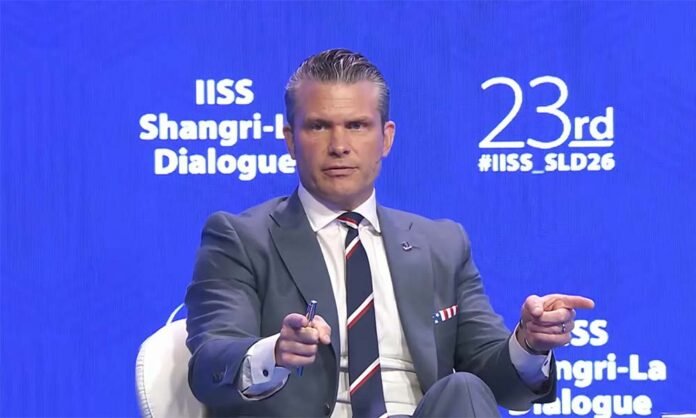
Participating at the 23rd Shangri La Dialogue in Singapore on May 30, US Secretary of Defence Pete Hegseth warned that the US would resume attacks on Iran if a satisfactory deal is not reached.
Just three-day ahead of Pete Hegseth’s warning, the Centre for Strategic and International Studies (CSIS), a US-based prominent think tank, in its report said, it would take two years and, in some cases, more than three years to replenish critical munitions used heavily during America’s war against Iran.

Clearly, whatever the US Secretary of Defence said was sharply different from ground reality. Yet, he used the threat of resumption of war against Iran to send a message to the world and in particular, China that America is still a superpower and it will deal with any situation on its own terms.
US’s Credibility Crisis
Undeniably, this was bravado, which lacked any credibility. Iran, despite being further weakened – economically and militarily due to the US-Israel joint war, has repeatedly stated that it will not agree to any deal with America that fails to secure the rights of Iranians. Tehran has already exposed the US – both on the credibility and reliability front, while portraying Washington DC as an inconsistent negotiating partner.
During the Iran war, Washington DC left its Gulf allies to fend for themselves as Tehran used every weapon at its disposal – from drones to missiles to hit the UAE, Saudi Arabia, Qatar, Bahrain and Kuwait in retaliation against joint US-Israel attacks on Iran. This led to questioning US’s security commitments to its allies.
While Gulf countries are still evaluating pros and cons of such changes in the US’s approach towards the region, it seems to be America’s Indo-Pacific partners who worry that Washington DC may not protect them from China’s expansionist design
While Gulf countries are still evaluating pros and cons of such changes in the US’s approach towards the region, it seems to be America’s Indo-Pacific partners who worry that Washington DC may not protect them from China’s expansionist design. Suspension of the $14 billion arms package by the US to Taiwan even after it was approved by Congress, has triggered deep concerns among Japan, South Korea and the Philippines who feel that America under President Trump is not focused on countering China.

Suspension of the arms package to Taiwan took place soon after a meeting between US President Donald Trump and Chinese President Xi Jinping in Beijing on May 15. In that meeting Xi Jinping had issued a stark warning to his US counterpart, maintaining that the Taiwan issue could become “very dangerous” if mishandled.
The US, which claims to be a lone military and economic superpower, was left to squirm in humiliation during Trump’s visit to China. With little to gain in terms of any deal, the first ever US presidential visit in nine years in reality turned out to be a damp squib. The readout of Trump and Xi Jinping’s final bilateral talks provided little information on what had been achieved by the meetings.

The US, which claims to be a lone military and economic superpower, was left to squirm in humiliation during Trump’s visit to China. With little to gain in terms of any deal, the first ever US presidential visit in nine years in reality turned out to be a damp squib. The readout of Trump and Xi Jinping’s final bilateral talks provided little information on what had been achieved by the meetings
Despite this, the Trump administration’s conciliatory tone towards Beijing has surprised and shocked several countries in the Indo-Pacific region. At the Shangri La Dialogue, Pete Hegseth said the US’s relations with China “are better than they have been in many years,” while pointing directly to the May 14-15 summit between President Trump and Chinese leader Xi Jinping.
Japan’s Concern
For Japan, which remains locked in a territorial dispute with China over the Senkaku Island in the East China Sea, such rhetoric is unsettling. It has led to questioning the strength of the US’s commitment to its allies. Questions are also being raised whether the US’s efforts to stabilise its ties with China could come at the expense of its allies’ security concerns.
Japan is already rattled by the expansion of the operational range of Chinese aircraft carrier strike groups and increasing China-Russia joint military exercises in the region. Besides, China has increased its grey-zone activities in the Taiwan-controlled Dongsha Islands, a coral island lying in the northern part of the South China Sea. Experts say if the Dongsha Islands were occupied, future conflict scenarios could go beyond the Taiwan Strait and allow China to apply military pressure on Taiwan from both northern and southern directions.
Japan, the world’s third largest economic power, feels that if such situations emerge, it will have a direct bearing on its existence. Last year in November, Japanese Prime Minister Sanae Takaichi told the Diet that the country’s Self-Defence Forces could be deployed under the right to collective self-defence to a worst-case scenario such as China’s invasion of Taiwan or its naval blockade. Takaichi had argued that Japan’s such move would constitute a “survival-threatening situation” for the country.
If Taiwan is considered by Beijing as a core of Chinese nationalism, Japan increasingly sees the self-administered island as integral to its own strategic survival. Any attempt by China to capture or isolate Taiwan would impact Japan’s security environment, sea lines of communication, regional power balance, thereby making the island an issue of existential importance for Japan.
For many South Korean analysts, Taiwan’s security is closely linked to the broader balance of power in the region. They argue that any perception of wavering US commitment to Taiwan could undermine confidence in Washington’s security guarantees across the region. Such concerns are particularly relevant for South Korea, which relies heavily on its alliance with the US to deter threats from North Korea while maintaining stability in an increasingly competitive strategic environment
Philippines’ Wariness
As tensions with China in the South China Sea are growing, the Philippines has expanded its defence cooperation with India, Japan, Australia, Canada and New Zealand. In Manila, there are concerns about Washington DC’s long-term strategic focus in the Indo-Pacific region.
Filipino Defence Secretary Gilberto Teodoro said his country was not worried about any reduction in US’s deterrence capabilities in the Indo-Pacific region due to the war in the Middle East, but he warned that China could try and seize any perceived opening in the region. Last week, on the sidelines of the Shangri La Dialogue in Singapore, Teodoro told the media that the Philippines remains under “severe threat” from China.
Recently, China has increased its naval presence around Taiwan, including the transit of an aircraft carrier through the Strait. While satellite images show China installing a barrier at the mouth of the Scarborough shoal in the South China Sea.
South Korea’s Worry
In South Korea, around 28,500 US troops are stationed to help guard against North Korea and China’s aggression. But like Japan, South Korea has voiced its concern over the Trump administration’s move to press a pause button on the supply of arms to Taiwan, despite growing threat to the self-administered island.
South Korean analysts have expressed fear that the US’s decision on suspension of the arms package could weaken deterrence and embolden China in the Indo-Pacific. As per media reports, President Trump, after meeting Xi Jinping in Beijing said the 14 billion Taiwan arms package was being “held in abeyance” and that its approval “depends on China.”
A weak deterrence in the Taiwan Strait could have far-reaching consequences, with the possibility of China exerting greater pressure on its neighbours and reshaping the security architecture of the Indo-Pacific in ways that could adversely affect South Korean interests
This statement has been made by the US President at a time when a large segment of the South Korean population view China as a security threat. In fact, public concerns have been fuelled by Beijing’s growing military capabilities, its assertive behaviour in the Taiwan Strait and the South China Sea, and its expanding strategic partnership with North Korea and Russia.
For many South Korean analysts, Taiwan’s security is closely linked to the broader balance of power in the region. They argue that any perception of wavering US commitment to Taiwan could undermine confidence in Washington’s security guarantees across the region. Such concerns are particularly relevant for South Korea, which relies heavily on its alliance with the US to deter threats from North Korea while maintaining stability in an increasingly competitive strategic environment.
South Korea also has deep economic and strategic interests in the Indo-Pacific. It depends on secure sea lanes for trade and energy imports, while regional stability remains essential for its long-term prosperity.
In this background, a weak deterrence in the Taiwan Strait could have far-reaching consequences, with the possibility of China exerting greater pressure on its neighbours and reshaping the security architecture of the Indo-Pacific in ways that could adversely affect South Korean interests.

The writer is a senior journalist with wide experience in covering international affairs. The views expressed are of the writer and do not necessarily reflect the views of Raksha Anirveda





