


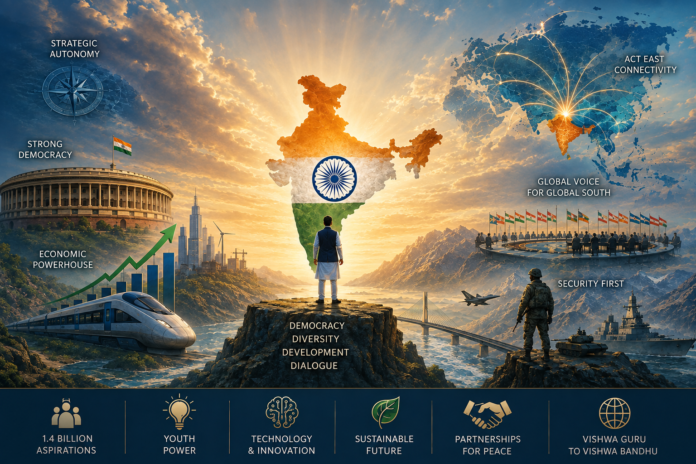
As the world stands at an inflection point, the meaning of “global power” has shifted radically—from a rigid Cold War binary dominated by the US and the dollar to a redefined concept of “global influencer.” This new paradigm is multipolar and values the capacity to contribute to global economic flows, partner in times of crisis, and influence international events militarily or politically with footprints worldwide. In that sense, India fits the bill holistically, given its current economic status, technological threshold, and the political cornerstone of being multi-aligned while fiercely pursuing strategic autonomy and retaining power projection to its immediate neighbours.
Beyond this, as traditional power structures are redefined and new paradigms emerge, the imperative for a global influencer is no longer a choice between hard or soft power projection but the art of smart power — blending coercive force with persuasive influence as key drivers in international mediation and conflict resolution. India has emerged as an unbiased and trusted ally that nations look to in times of distress. In doing so, it strives to safeguard its strategic interests by steering the triad of power, purpose and partnership, gradually transforming from a passive global participant to a trusted influence leader, catalysing inclusive growth and global cooperation.

Transformation of Global Polarity
Russia’s full-scale invasion of Ukraine has shaken the global order, exposing the fragility of the rules-based international system. While Western governments rallied behind Ukraine early on, their efforts have struggled to resonate beyond North America, Europe, and the Pacific. In Asia, South America, and Africa, Russian propaganda has gained traction, shaping pro-Russian views. Even some Central and Eastern European governments have openly favoured Moscow. More recently, pro-Russian narratives have gained ground in the US and Western Europe as well, further undermining Western unity.
Ironically, the Trump administration’s shift on Ukraine reflected not just a policy change but a broader embrace of a multipolar world where power dictates respect and might is right. As the US stance moved towards Russia’s position on Ukraine, it also gradually sidelined Europe by excluding the EU and NATO from key security discussions. In doing so, the US reinforced a model where major powers decide security matters on their own terms. Trump’s rhetoric of annexing Greenland and Canada—both founding NATO members—further reinforces the idea of using national security to justify territorial ambitions, echoing the logic of revisionist powers like Russia and China. In the global context, these developments are reframing global polarity, with Russia capitalising on these fractures and promoting its multipolar vision as an alternative to “Western hegemony.”
To compound matters, the US invasion of Iran on 28 February 2026 was a blatant use of coercive force by Trump, shaped by his hardline approach toward Iran’s nuclear programme. His propensity for military interventions, regime change, and reshaping geopolitical realities in US favour— combined with confidence in US military superiority—prompted this full-scale transatlantic aggression with Israel as a coalition partner. These orientations aligned closely with Israeli ambitions to restructure the Middle East and establish regional hegemony, aiming to secure peace through force—an objective reflected in both US and Russian strategic doctrine. The truth is, this is a return to old spheres of influence, with national power overriding international law and sovereignty.
Iran’s defiance and de facto control over the Strait of Hormuz have demystified American military superiority—leaving the US as one among many equals, its global credibility in tatters
China, as a major global power, has viewed the Russia-Ukraine war as a window of opportunity to expand its influence and connectivity in Central Asia—critical for the Belt and Road Initiative, energy security, trade expansion, and ethnic stability. The signing of the rail connectivity agreement between Kyrgyzstan, Uzbekistan, and China, preceding the SCO Samarkand Summit—previously stalled by implicit Russian opposition—reflects Moscow’s shrinking regional influence. That said, growing public resentment against the Chinese footprint in the region, reflected in multiple anti-China protests in Kazakhstan, Kyrgyzstan, and Uzbekistan, may inhibit closer cooperation. Additionally, human rights violations in Xinjiang against Uyghurs and other Muslim minorities—comprising ethnic Kazakhs and Kyrgyz—remain a point of contention. Even in Afghanistan, the presence of Uyghur militants under Taliban rule has deterred closer cooperation with the region.

Thus, simmering friction for strategic space continues behind the façade of cooperation. Yet the focal point of the partnership remains the challenge posed by the US-led Western order. As a strategic counterbalance, Russia and China are committed to “true multilateralism” and “respect for the rights of people”—a blueprint for a new international order.
Impact of Regional Conflicts on the Global Order
With no path to military victory in Ukraine, Russia has shifted to a war of attrition, aiming to wear down Western support and force Ukraine into a settlement on Russia’s terms. This strategy relies on political fatigue in the West—and, unexpectedly, the Trump administration’s willingness to pressure Kyiv into concessions, including abandoning NATO ambitions and accepting territorial losses. This strategic vision is not reactive but deeply embedded in Russia’s worldview, where great-power status is tied to territorial control. The war in Ukraine is Russia’s boldest move to formalise its sphere of influence and reshape the global order. Given these dynamics, it is becoming increasingly clear that the US is slowly accepting a multipolar order shaped by Russia, China, the EU, and other influential regimes.

With the unipolar moment definitively over, alternative power centres—China, Russia, the EU, and influential middle powers—are redrawing the global map. BRICS is challenging dollar dominance, and China is expanding its footprint in Central Asia despite local resentment
As for the US-Israeli strikes on Iran, they came as an unwelcome surprise, as did the Iranian blockade of the Strait of Hormuz. The constant prospect of renewed violence, combined with uncertainty over when US-Iranian tensions would abate, left governments on edge for months and cast a shadow over global economic stability. For countries in the Global South, this was another instance of decisions made in Western capitals that shook their economies while they remained voiceless. Many of these nations look at the conflict with admiration for Iran’s defiance and resilience, heralding a major shift in global power dynamics. Iran’s de facto control over the Strait of Hormuz as the new normal may end up being one of the most consequential outcomes of the war, setting a worrying precedent not only for the Middle East but globally.
Declining Status of the United States
Against this backdrop, the decline of the United States is a visible shift, driven by the inconclusive outcome of the Iran conflict. Having initiated a war with no clear goals or end state, the US finds itself in an embarrassing position, with its exit indeterminable amid escalating costs and a defiant Iran. Simultaneously, the growth of alternative power centres—headed by China, alongside the rapid rise of influential middle powers like Russia, India, and the European Union—has been instrumental in redrawing the contours of global power. The BRICS grouping, bound by shared economic and geopolitical objectives, has emerged as a serious contender challenging US hegemony. The next big step is the announcement of a BRICS currency as a direct challenge to dollar dominance in international trade.
These developments are significant, given that the Iran war has been a game-changer in demystifying US military superiority. Despite five months of relentless US bombardment, Iran remains defiant, calling for a ceasefire on its terms, leaving the US as one among many equals—and losing global credibility. A reality that could have a direct influence on issues affecting the US economy and its domestic constituencies.
To further reinforce this truth, Russia’s belligerent stance, the EU’s economic clout, China’s rapid expansion, and influential voices from the Global South like India have diluted US unipolar dominance. These factors, combined with US disagreements over global rules, environmental accords, and aggressive foreign policies promoting self-interest, have led several traditional allies to rethink their US affiliations and pursue independent strategic paths. Persistent political polarisation and governance instability have also raised credibility concerns, affecting the perceived stability and predictability of US leadership.
Traditionally, US hegemony has rested on three pillars: economic strength, military might, and cultural dominance. In recent times, these pillars are being seriously challenged, with China at the forefront. The cumulative effect has been a declining global standing and growing frustration for US leadership in the geopolitical space.
India’s policy of strategic autonomy—engaging the US, Russia, China, and Europe simultaneously—has earned it the trust of a fractured world, positioning it as a neutral arbiter and a voice for the Global South
India’s Rising Global Influence
India’s rising global influence is anchored in its status as a major economic growth engine, a leader in digital public infrastructure, and a key voice for the Global South. This emergence is one of the most significant events of our times, despite China’s expanded influence, the United States’ struggle to sustain its world role, and wars in Europe and the Middle East that have diverted attention elsewhere. India’s steady growth has catapulted it to the world’s fifth-largest economy, on track to be number three by 2047. Its growth rate of around 7.4% year-on-year remains the fastest among large countries. India’s stock market is already the fourth largest in the world, and its business confidence is higher than at any time since 2020.
India’s growing role on the global centre stage reflects its economic clout, technological inclusiveness, and military prowess. The impetus of Aatmanirbhar Bharat and defence self-reliance are catalysts in this direction. Its sustained global outreach has resulted in stronger partnerships, increased trust, and a more prominent role in shaping international conversations. In the technological domain, its digital public infrastructure and in-house solutions are increasingly being adopted by several nations, enhancing the country’s reputation as an innovation leader and digital provider.
Given its current geopolitical standing, India has been a strong proponent of inclusive global governance, greater cooperation among nations, and a stronger voice for emerging economies in international decision-making. As India continues to strengthen its economic, diplomatic, technological, and strategic capabilities, it is increasingly viewed as a trusted partner and key driver of global growth and cooperation. India is at the centre of geopolitical shifts shaping the new world order. As the world’s most populous nation with a growing economic powerhouse, India has transformed itself into a trusted global influencer despite rising headwinds—both from within the country and from changing global political dynamics.
India’s growth story is powered by a young population, digital innovation, and an ambitious reform agenda. India’s proactive engagement in global affairs and commitment to inclusive development positions it as a key engine of global growth and a laboratory for large-scale policy and technological innovation that can be replicated worldwide.
Domestically, the challenge lies in implementation of reforms, state-level capacity, and infrastructure delivery. External headwinds—US tariffs, commodity volatility, and the unpredictability of great-power rivalry—too could test India’s resilience
Takeaways
With continued focus on reform, digital transformation, and international cooperation, India is poised to realise its aspiration of becoming a resilient, inclusive, and globally competitive economy—ready to play a defining role in the new world order. The world is experiencing a structural geopolitical transition as the post-Cold War order gives way to an era shaped by political independence, technological transformation, fragmented globalisation, persistent regional conflict, and multipolar competition. India, however, due to its economic rise, demographic advantage, and mature diplomatic influence, has emerged as a force to reckon with as a global influencer. This trust is shaped by its policy of strategic autonomy, assertive foreign policy, and a “whole-of-nation” approach that integrates technology, economics, industrial resilience, cyber capability, artificial intelligence, financial systems, and trusted international partnerships.
The new India-EU FTA cements Europe’s role as a strategic trading partner. Termed the “mother of all trade deals,” it is expected to open new avenues for European and Indian companies. Despite complex relations with China—marked by both trade and strategic competition—India is softening its approach, and China seems to be working around relationships to keep India as a strategic partner. India continues to cultivate ties with Russia in defence and energy while leveraging leadership roles in forums such as the G20, BRICS, and the QUAD. The upcoming BRICS summit in 2026, chaired by India, underscores its commitment to shaping multilateral agendas and amplifying the voice of the Global South. India’s relations with the United States are focused on expanding across economics, technology, and defence.
Externally, global trade tensions—such as US tariffs and commodity price volatility—could impact export growth. Domestically, the challenge lies in effectively implementing reforms, particularly at the state level, and ensuring that infrastructure and social programs deliver their intended benefits. The transition to new economic data and regulatory systems may also create temporary confusion for businesses and investors. While challenges remain, India’s outlook is one of optimism and opportunity.

The writer is a former GOC of the Indian Army and presently serves as a Strategic Consultant and Principal Advisor. The views expressed are of the writer and do not necessarily reflect the views of Raksha Anirveda





