


India’s commercial space ecosystem is expanding rapidly, driven by rising demand for small satellite deployments across earth observation, communications and research sectors. While the Indian Space Research Organisation (ISRO) possesses proven, world-class launch capabilities, local demand for small satellite slots frequently outpaces available flight schedules. Consequently, domestic satellite operators often face multi-month backlogs or are forced to contract costly foreign launch services.
Closing the Launch Bottleneck
Founded in 2023 by hometown entrepreneurs Naveen TS Velayudham and Liwaans Amuthan, Cosmicport aims to eliminate this operational bottleneck by building homegrown, cost-effective launch vehicles. Unlike many emerging aerospace startups that outsource or procure rocket engines from third-party manufacturers, Cosmicport is developing its liquid propulsion engines entirely in-house.

The company operates out of Thoothukudi in southern Tamil Nadu, with a secondary corporate office in San Jose, California. Strategically, Cosmicport’s Tamil Nadu facility sits roughly 50 kilometres from Kulasekharapatnam, the site of India’s second spaceport dedicated specifically to small satellite launches. This physical proximity to the upcoming launch infrastructure offers significant logistical advantages for transporting rocket stages, conducting ground integration and accelerating test turnarounds.
Cosmicport plans to integrate nine Cryonix engines into its primary small-lift vehicle, dubbed “Mach Blue.” Mach Blue is designed to deliver small satellite payloads directly to low Earth orbit (LEO), serving both dedicated single-client missions and rideshare configurations
The Cryonix Engine and Mach Blue Vehicle
At the heart of Cosmicport’s technology strategy is “Cryonix,” a semi-cryogenic engine powered by a liquid methane and liquid oxygen (methalox) propellant combination. Methalox propulsion is widely regarded as the next frontier for commercial spaceflight due to its high efficiency, cleaner combustion and reduced soot generation – qualities essential for engine reusability and rapid turnaround between missions.
Cosmicport plans to integrate nine Cryonix engines into its primary small-lift vehicle, dubbed “Mach Blue.” Mach Blue is designed to deliver small satellite payloads directly to low Earth orbit (LEO), serving both dedicated single-client missions and rideshare configurations.
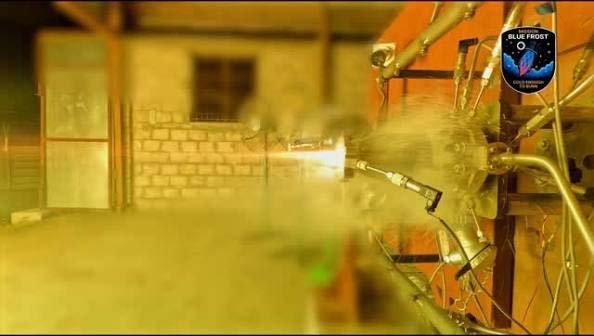
Following an initial sub-scale propulsion fire test in January 2025, Cosmicport marked a significant technical leap in July 2026 by successfully executing its first cryogenic ignition trial for the full Cryonix design. This milestone initiated the company’s broader ground test campaign, designated “Mission Blue Frost.” While ignition trials represent an early stage in propulsion qualification, they validate fundamental hardware design, fluid dynamics and ignition sequences needed before advancing to full-duration hot-fire testing.

Roadmap and Industry Support
Cosmicport operates a business-to-business model offering integrated launch services and engine development packages. To guide its engineering efforts, the startup leverages guidance from aerospace veterans, including satellite advisor Prabhakar CA, a former ISRO Satellite Centre scientist with over three decades of experience in remote sensing satellite systems.
The startup’s aggressive development roadmap targets full cryogenic engine qualification by late 2026, followed by a reusability flight demonstration in 2027. Cosmicport aims to complete stage qualification by 2028, paving the way for inaugural commercial orbital launches in 2029
The startup’s aggressive development roadmap targets full cryogenic engine qualification by late 2026, followed by a reusability flight demonstration in 2027. Cosmicport aims to complete stage qualification by 2028, paving the way for inaugural commercial orbital launches in 2029.

While pre-revenue and funded primarily through non-dilutive grant funding raised in June 2024, Cosmicport has secured substantial ecosystem support. The company has participated in the AWS Space Accelerator and receives incubator backing from Hyderabad’s T-Hub and Tamil Nadu’s Vaanam Space-tech Accelerator. Additionally, the team actively engages its local community through space clubs and STEM mentorship programmes in Thoothukudi schools, fostering regional technical talent alongside its orbital aspirations.






