


Every Independence Day invites India to look back at the distance it has travelled. Yet August 15 is also a moment to look ahead and ask a more demanding question: what will independence mean in the decades to come?
For a country moving from emerging power to global power, independence can no longer be understood only in political or economic terms. It increasingly means strategic autonomy: the ability to protect national interests, secure critical sea lanes, master advanced technologies and act with confidence in an uncertain world.

India’s transformation is already visible. Its economy has become one of the world’s most consequential growth engines. Its digital and industrial capabilities are expanding rapidly. Its diplomatic voice carries greater weight across regions and international institutions. At the same time, India is taking on greater responsibility for security and stability across the Indian Ocean Region and beyond.
Technology connects all three dimensions. It supports economic competitiveness, strengthens national security and gives diplomacy greater substance. Few areas illustrate this convergence as clearly as uncrewed aviation.
A New Maritime Reality
India’s geography has always shaped its destiny. With a coastline stretching more than 7,500 kilometres, island territories positioned along vital maritime routes and a vast Exclusive Economic Zone, the sea is central to the country’s security and prosperity.
Today, this maritime environment is becoming more complex. Commercial shipping, energy supplies, undersea infrastructure and strategic competition all converge across the Indian Ocean. Naval forces must observe wider areas, identify potential threats earlier and maintain persistent awareness, often without increasing the burden on crewed aircraft and ships.

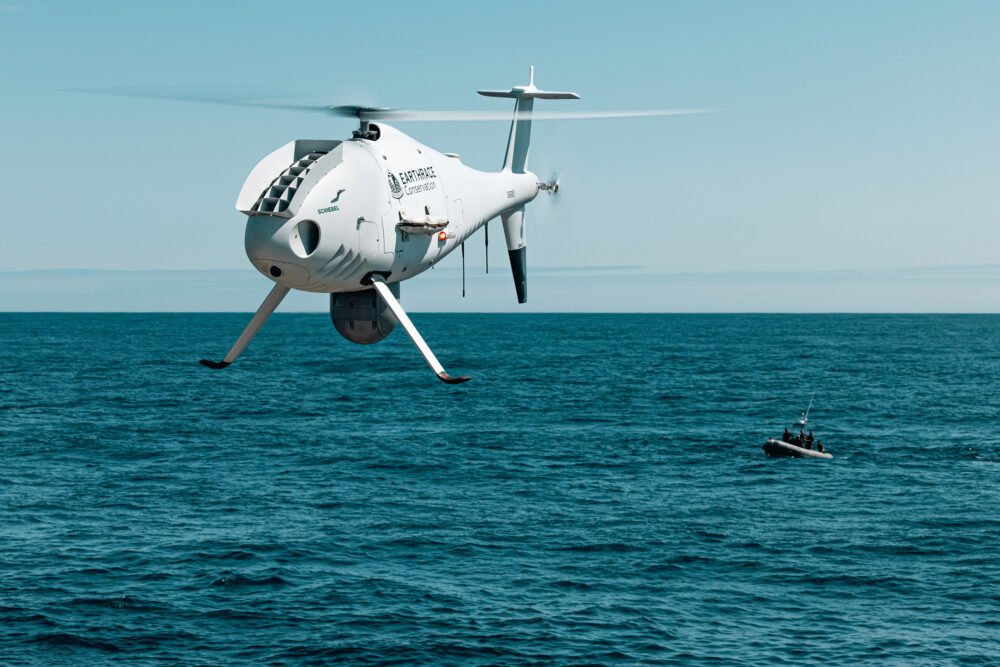
This is where uncrewed Vertical Takeoff and Landing systems are changing the equation. Operating from a ship’s deck without the need for a runway or specialised launch and recovery equipment, they can extend a vessel’s eyes and ears far beyond the horizon. They can remain airborne for hours, carry different sensor combinations and provide commanders with real-time information while reducing risk to personnel.
Technology connects all three dimensions. It supports economic competitiveness, strengthens national security and gives diplomacy greater substance. Few areas illustrate this convergence as clearly as uncrewed aviation
For India, this is not a distant concept. It is already an operational reality.

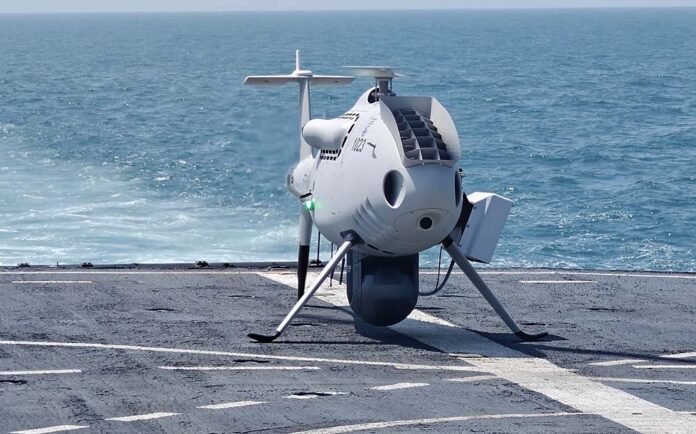
The Indian Navy’s CAMCOPTER® S-100 represents an important step in the integration of shipborne uncrewed aviation. Compact enough to operate from vessels with limited deck space, yet capable of carrying sophisticated mission payloads, the S-100 gives naval commanders an additional layer of persistent Intelligence, Surveillance and Reconnaissance capability.
Its value lies not in replacing crewed helicopters, but in complementing them. Routine surveillance, identification and monitoring tasks can be assigned to the uncrewed system, allowing crewed assets to focus on missions where their speed, payload or human judgement is most urgently required.
The S-100 can operate by day and night and in challenging weather conditions. With an encrypted data link extending to 200 kilometres, an endurance of up to ten hours depending on configuration and the ability to carry payloads of up to 50 kilograms, it can be adapted to a wide range of missions.
Electro-optical and infrared cameras, maritime radar, Automatic Identification System receivers, communications intelligence equipment and other sensors can be integrated according to operational requirements.
This flexibility matters in the Indian maritime context. A single platform can support surveillance of sea lanes, monitoring of coastal and offshore areas, search and rescue, vessel identification, anti-piracy operations, environmental monitoring and support for anti-submarine warfare. It can also provide overwatch during complex naval operations or deliver essential supplies to areas that are difficult or dangerous to reach.
From Equipment to Capability
The presence of advanced technology alone, however, does not create strategic autonomy. Real capability emerges when a country can operate, support, adapt and progressively develop that technology within its own defence ecosystem.
India has rightly placed growing emphasis on indigenous manufacturing, local maintenance, skills development and collaboration with domestic industry. The objective is not simply to acquire equipment, but to build knowledge and create lasting national capacity.
This is particularly relevant for uncrewed systems. Their operational value depends on much more than the air vehicle. Sensors, communications, software, data processing, mission planning, maintenance, training and integration with naval command systems are all part of the capability.
India possesses strong foundations in many of these areas. Its software expertise, engineering talent, expanding aerospace sector and growing network of public and private defence companies create the conditions for meaningful cooperation.
The Indian Navy’s CAMCOPTER® S-100 represents an important step in the integration of shipborne uncrewed aviation. Compact enough to operate from vessels with limited deck space, yet capable of carrying sophisticated mission payloads, the S-100 gives naval commanders an additional layer of persistent Intelligence, Surveillance and Reconnaissance capabilit
International partnerships can contribute proven platforms and operational experience, while Indian companies provide local expertise, innovation and scale. Done well, such partnerships generate benefits beyond defence. They create highly skilled employment, strengthen supply chains, support research and development and open opportunities for Indian industry to participate in global programmes.
This is where the themes of economy and technology begin to reinforce one another.
Looking Beyond the Horizon
As India’s responsibilities expand, so too will the demands placed on its uncrewed systems. Longer missions, heavier sensors, greater range and more complex operational scenarios will require a new class of platform.
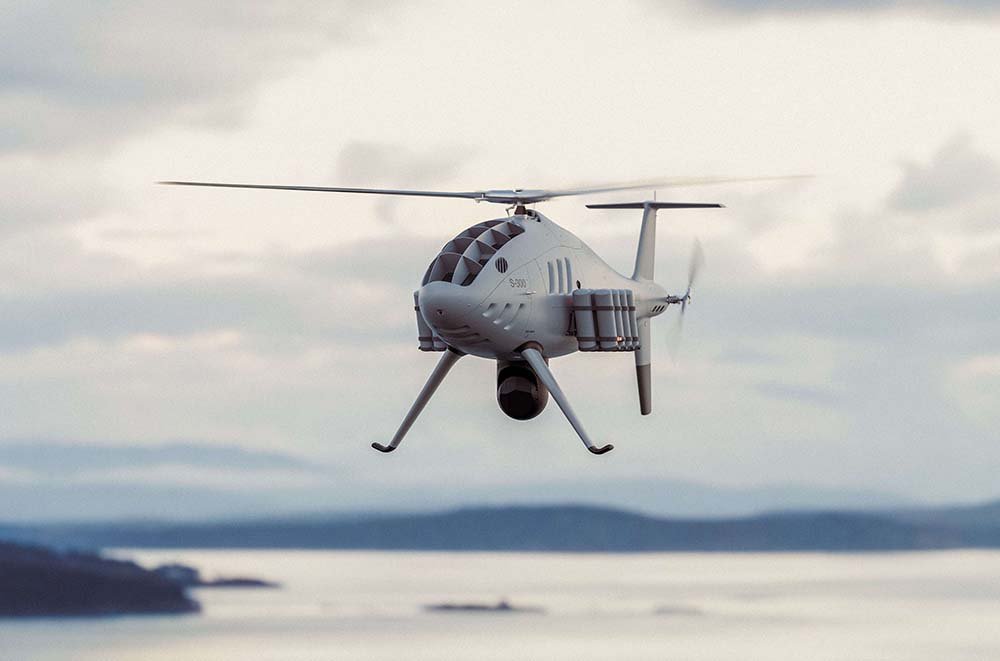
The CAMCOPTER® S-300 has been developed for precisely this environment. Building on the operational heritage of the S-100, it provides significantly greater payload capacity and endurance while retaining the advantages of a runway-independent VTOL system.
With a payload capacity of up to 350 kilograms including fuel, the S-300 can carry larger and more capable sensor suites. Depending on the mission configuration, it can remain airborne for more than 24 hours with a lighter surveillance payload, or fly for approximately six hours while carrying a 250-kilogram mission load.
Its 200-kilometre data-link range and compact operational footprint make it suitable for maritime and land-based deployments.
This combination opens a broader spectrum of missions. The S-300 can support extended-range Intelligence, Surveillance and Reconnaissance, search and rescue, cargo delivery and the remote deployment of advanced sensors.
Its payload and endurance also make it particularly relevant for anti-submarine warfare, where persistent coverage and the ability to carry multiple specialised payloads can transform how navies monitor large areas.
For India, a platform of this class could complement existing naval aviation assets and provide persistent coverage across strategically important maritime zones. It could support naval task groups, coastal commands and island territories, while also contributing to humanitarian assistance and disaster relief operations.
The wider significance is even greater. The progression from the S-100 to the S-300 reflects the direction in which uncrewed aviation is moving: from individual remotely operated aircraft toward networked, multi-mission systems that work alongside ships, aircraft, satellites and other autonomous platforms.
In the coming decade, the decisive advantage will belong not to the country with the largest number of individual systems, but to the country that can connect them, share information securely and turn data into timely decisions.
India has rightly placed growing emphasis on indigenous manufacturing, local maintenance, skills development and collaboration with domestic industry. The objective is not simply to acquire equipment, but to build knowledge and create lasting national capacity
Technology as an Instrument of Diplomacy
India’s growing maritime capability also has a diplomatic dimension. As a trusted security partner, India is increasingly called upon to contribute to regional stability, humanitarian missions, search and rescue and the protection of shared maritime interests.
Persistent uncrewed surveillance can support these responsibilities without being inherently escalatory. It can help detect distress at sea, monitor environmental incidents, strengthen maritime domain awareness and support coordinated responses with partner nations.
This is an important expression of global power. It is not defined only by the ability to project force, but also by the capacity to provide security, respond to crises and offer reliable partnership.
India’s approach has long resisted simple alignment with competing blocs. Its model is based on strategic autonomy and practical cooperation. Defence technology partnerships that respect this principle, support domestic capability and allow India to retain freedom of action can strengthen both national resilience and international relationships.
The Next Meaning of Independence
India’s first decades of independence were devoted to building the institutions of a sovereign nation. The decades that followed established the foundations of economic and technological growth. The next decade will be about converting that scale, talent and ambition into sustained global influence.
India’s first decades of independence were devoted to building the institutions of a sovereign nation. The decades that followed established the foundations of economic and technological growth. The next decade will be about converting that scale, talent and ambition into sustained global influence
Uncrewed systems are only one part of this larger story, but they reveal its central themes. They combine advanced engineering with operational necessity. They create opportunities for industrial cooperation and skilled employment. They strengthen the ability to protect trade, territory and citizens. And they allow India to contribute more effectively to regional and global security.
The S-100 in service with the Indian Navy demonstrates that this transition is already under way. The S-300 points towards what may come next: longer reach, greater persistence, heavier payloads and a wider range of missions.
As India marks its 80th Independence Day, the country can look toward the coming decade with confidence. The task ahead is not merely to adopt the technologies shaping the future, but to master, integrate and help define them.
That is the deeper meaning of strategic autonomy. And it is how an emerging power becomes a real global power.

The writer is a Chief Executive Officer, Schiebel Systems India Pvt Ltd. The views expressed are of the writer and do not necessarily reflect that of Raksha Anirveda





