


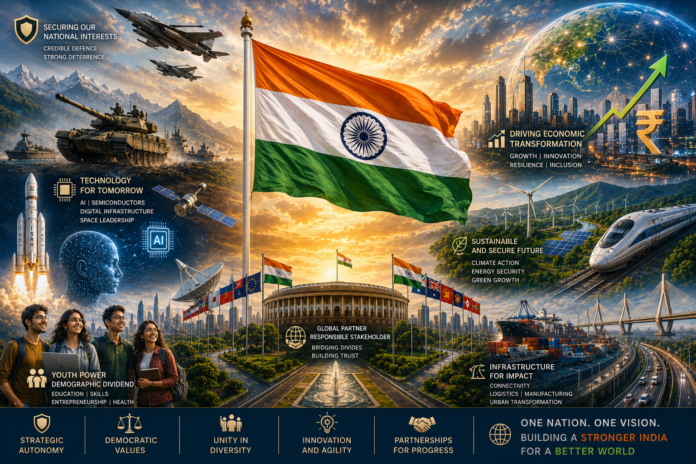
Between roughly 2015 and 2025, India moved from being described as a promising ‘emerging power’ to something more substantive: a state with the industrial base, economic heft, and diplomatic reach to shape outcomes rather than merely respond to them. India chaired the G20 in 2023, landed a spacecraft near the Moon’s south pole, built the world’s most-used real-time payments network, and became the fastest-growing large economy on the planet. Its diplomats now speak the language of multi-alignment rather than dependence, and its planners talk openly about a $30 trillion economy by 2047. This does not mean India has arrived — the country’s per capita income ($2,813 vs China’s $14,874) remains modest, its defence-industrial base still imports critical sub-systems, and its GDP ranking has proven more volatile than headline announcements suggest. But the trajectory is real, and it is best understood as the product of three reinforcing pillars: technological self-reliance, economic scale, and an increasingly confident, multi-aligned diplomacy. Whether ambition survives contact with execution is the defining question of India’s next decade.
An Economy Tested by Shocks, Rebuilt by Reform
India’s recent economic story is one of resilience under repeated stress. The pandemic contracted the economy by nearly 6% in FY 2020-21, one of the sharpest downturns among major economies. The recovery that followed has been just as sharp: by 2023-24, growth was running at 6-7%, and by 2026 the IMF was projecting real growth of roughly 6.5%, again the fastest pace among the world’s large economies, with the World Bank’s April 2026 South Asia Economic Update putting 2025-26 growth even higher, near 7.6%, on the back of private consumption, GST rationalisation and export resilience.

The headline ranking, though, has recently told a more complicated story. India’s nominal GDP for 2026 stands at roughly $4.15 trillion — still the world’s sixth-largest economy — but that figure actually represents a slip from a widely reported milestone in April 2025, when India briefly overtook Japan to claim fourth place. The reversal wasn’t about slower growth; it reflected a weaker rupee (which depreciated from about 84.6 to nearly 88.5 per dollar through 2025, with further pressure since) and a technical rebasing of India’s GDP series from a 2011-12 base year to 2022-23, which trimmed the officially reported size of the economy by 3-4%. In PPP terms, where currency effects wash out, India remains the world’s third-largest economy at close to $19 trillion. The episode is a useful reminder that India’s ‘great power’ numbers are sensitive to measurement choices even as the underlying growth story stays intact — the IMF itself has flagged concerns about how well India’s statistics capture its vast informal economy.
Structural reforms of the past decade have mattered. The Goods and Services Tax unified a famously fragmented internal market; the Insolvency and Bankruptcy Code improved the ease of doing business; and production-linked incentive schemes have pulled investment into electronics, pharmaceuticals and renewables manufacturing
The modest per-capita income underscores that scale, not affluence, is India’s current claim to weight. Domestic consumption still drives roughly 70% of GDP, making India the world’s third-largest consumer market, with services contributing more than half of output and manufacturing pushing — unevenly — towards a larger share of global value chains.
Structural reforms of the past decade have mattered. The Goods and Services Tax unified a famously fragmented internal market; the Insolvency and Bankruptcy Code improved the ease of doing business; and production-linked incentive schemes have pulled investment into electronics, pharmaceuticals and renewables manufacturing. India now supplies roughly a fifth of the world’s generic medicines and the majority of vaccines by volume, a status often described as the ‘pharmacy of the world’. Exports have climbed towards $860 billion, with foreign exchange reserves providing a buffer of around $700 billion even through a year of rupee pressure and global oil-price shocks.
The digital economy is where India’s reforms have compounded most visibly. The Unified Payments Interface (UPI) now processes billions of transactions a month and has become a model other countries study directly. The Open Network for Digital Commerce is attempting to do for e-commerce what UPI did for payments, and the broader ‘India Stack’ — Aadhaar digital identity, direct benefit transfers and related public digital infrastructure — has funnelled trillions of rupees in welfare payments directly to citizens, sharply reducing the leakage that once defined Indian subsidy programmes.

None of this erases India’s structural weak points. Unemployment sits near 5% nationally, higher among youth; more than 85% of employment remains informal, capping productivity gains; and while India’s Gini coefficient has improved to a relatively low 25.5 (placing it among the most equal societies), that national number sits atop sharp regional divides between the wealthier west and south and lagging northern and eastern states. Public debt near 80% of GDP leaves less room for error as capital spending on infrastructure accelerates.
Building the Technological Base of Power
If economics is India’s foundation, technology is increasingly its calling card. India has the world’s third-largest startup ecosystem and a services sector whose global capability centre — clustered in Bengaluru, Hyderabad and Pune — now does far more than back-office IT work for multinational firms.

The India Semiconductor Mission is the most consequential long-term bet: a push towards domestic chip fabrication and design capacity, with investment commitments from firms including Micron and Tata Electronics. India remains well behind Taiwan or South Korea in this race, and electronics imports remain high, but the strategic intent — reducing dependence on a handful of foreign fabs for a technology now central to both economic and military power — is clear.
Defence indigenisation under the ‘Aatmanirbhar Bharat’ banner has moved India from being almost purely an arms importer towards becoming a more credible, if still modest, exporter — BRAHMOS missile exports are the most visible examples, alongside expanding drone programmes and naval shipbuilding involving private conglomerates such as Tata, L&T and Adani
Space policy tells a similar story of asymmetric ambition paying off. ISRO’s low-cost missions, capped by Chandrayaan-3’s 2023 landing near the lunar south pole, have been paired with growing private-sector participation from firms like Skyroot Aerospace and Agnikul Cosmos, and preparations continue for the Gaganyaan crewed spaceflight programme. Artificial intelligence is the newer frontier: the IndiaAI Mission is building out compute capacity, public datasets and talent pipelines, betting that a young, English-speaking population and a billion-plus citizens’ worth of data give India a distinctive angle on applied AI in healthcare, agriculture and public administration.
Defence indigenisation under the ‘Aatmanirbhar Bharat’ banner has moved India from being almost purely an arms importer towards becoming a more credible, if still modest, exporter — BRAHMOS missile exports are the most visible examples, alongside expanding drone programmes and naval shipbuilding involving private conglomerates such as Tata, L&T and Adani.
A Foreign Policy of Multi-Alignment
India’s diplomacy has shifted from the Cold War-era doctrine of non-alignment to something analysts now call multi-alignment: deepening ties with Washington, Tokyo and Canberra through the Quad on maritime security and technology, while preserving a substantial trade and energy relationship with Moscow that has helped stabilise India’s domestic fuel prices through the Ukraine war and its aftermath. Defence cooperation with the United States has expanded through initiatives like the US-India Initiative on Critical and Emerging Technology, alongside a deep and influential diaspora relationship.
The 2023 G20 presidency remains India’s signature diplomatic achievement of the decade, delivering the African Union’s permanent inclusion in the G20 and building consensus around debt relief and climate finance for the Global South — a constituency India has increasingly positioned itself to lead. Trade diplomacy has also advanced: India and the European Union announced agreement in principle in January 2026 on a long-negotiated free trade deal — dubbed by some observers the “mother of all deals” after two decades of talks — that would cut tariffs on over 90% of goods traded between the two blocs, though final signing awaits resolution of remaining legal details, with both sides hoping for effectiveness in early 2027.
Border tensions with China persist and continue to shape Indian defence posture, with continued infrastructure investment along the Line of Actual Control. Relations with immediate neighbours are mixed — improving with Sri Lanka, more strained with Bangladesh and Nepal, and chronically difficult with Pakistan. On climate, India has positioned itself as an advocate for “common but differentiated responsibilities,” pairing that stance with one of the world’s largest solar power buildouts and initiatives like the International Solar Alliance.
The 2023 G20 presidency remains India’s signature diplomatic achievement of the decade, delivering the African Union’s permanent inclusion in the G20 and building consensus around debt relief and climate finance for the Global South — a constituency India has increasingly positioned itself to lead
Where Ambition Meets Friction
The gap between India’s stated 2047 ambitions and its present capacity is where the real story of the coming decade will be written. Logistics costs remain stubbornly high, around 13-14% of GDP, well above competitor economies, even as India has visibly upgraded highways, airports and rail (including new high-speed Vande Bharat services and dedicated freight corridors). Power-sector reform remains incomplete, and water stress and climate vulnerability increasingly threaten both agricultural output and urban liveability.
Human capital is arguably the tightest constraint. School enrolment has risen sharply, but learning outcomes lag behind enrolment gains, according to independent assessments such as the Annual Status of Education Report. India’s median age of roughly 28 is often cited as a demographic dividend, but that dividend becomes a liability without a workforce equipped with employable skills — and female labour force participation remains persistently low relative to India’s income level, a pattern the World Bank has repeatedly flagged as a drag on growth potential.
Governance friction compounds these gaps: bureaucratic inertia, uneven regulatory predictability across India’s states, and centre-state coordination problems slow down large projects, as do land acquisition disputes and environmental clearance processes. India’s high ranking on corruption indices, alongside chronic judicial backlogs, continues to weigh on investor confidence even as macro fundamentals improve.
Convergence, and the Test of the Coming Decade
What makes India’s case for “consequential power” credible is not any single achievement but the way its economic, technological and diplomatic gains reinforce one another. Electronics manufacturing incentivised under PLI schemes creates both export revenue and diplomatic leverage; digital public infrastructure built for domestic welfare delivery is now offered as a model to the Global South; strategic autonomy in foreign policy buys India room to pursue chip investment from the United States and energy security from Russia simultaneously.
The Viksit Bharat 2047 vision — a developed India with a $30-trillion-plus economy, high human development and technological leadership — will require sustaining growth in the 7-8% range for two decades, roughly doubling manufacturing’s share of GDP, and a level of human capital investment India has not yet demonstrated it can consistently deliver
The Viksit Bharat 2047 vision — a developed India with a $30-trillion-plus economy, high human development and technological leadership — will require sustaining growth in the 7-8% range for two decades, roughly doubling manufacturing’s share of GDP, and a level of human capital investment India has not yet demonstrated it can consistently deliver. Research and development spending as a share of GDP remains low by the standards of aspiring technology powers, and reform of labour and land markets — politically the hardest kind — still lies mostly ahead rather than behind.
India’s strengths for this test are real: a still-open demographic window, a globally networked entrepreneurial class, a resilient (if noisy) democratic system, and a form of civilisational soft power that gives its diplomacy reach well beyond its current economic weight. Its proven ability to deliver public goods at scale — vaccines during the pandemic, digital payments and identity systems more broadly — offers a genuine model that other developing economies are studying.
Whether all of this adds up to consequential power in the fullest sense depends less on any single metric — GDP rank, satellite launches, trade deals — than on India’s ability to close the execution gap that has shadowed its ambitions for a generation. The foundation, built through a genuinely convergent decade of economic reform, technological investment and diplomatic repositioning, is now in place. What happens next is a question of delivery, not vision.

The writer is a defence journalist specialising in military affairs, security policy and defence technology. He reports extensively on operation strategies, defence manufacturing initiatives and geopolitical developments across the Indo-Pacific region. The views expressed are personal and do not necessarily carry the views of Raksha Anirveda





