


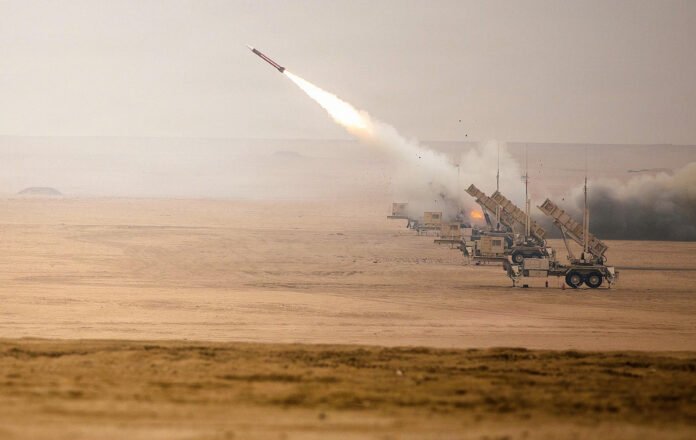
Kyiv: The race for a new anti-ballistic system has begun. After decades of relying on the US-made Patriot interceptor system and its hit-to-kill PAC-3 munition as the most proven air defence against ballistic missiles, three new tracks are now leveraging international cooperation and a dire global need to develop and manufacture cheaper interceptor platforms.
Some officials, meanwhile, are hoping the sense of urgency leads to the fielding of the first new prototypes by the end of 2026 — years faster than today’s Patriots can be made.

The missile defence world has long described the mechanics behind anti-ballistic defence as akin to hitting a bullet out of the sky with another bullet, multiplied in difficulty by the number of simultaneous air threats coming in — a stark reminder of the mass air raids seen today in Iran and Ukraine that stretch air defences to the breaking point.
Today’s anti-ballistic momentum began with US President Donald Trump’s seemingly off-the-cuff comment at the NATO summit in Ankara earlier this month, when he pledged to grant Ukraine permission to produce Patriot missiles for the first time.
“We’re going to give a license to you to make Patriots. That’s pretty cool. This way, you can’t complain that we’re not giving ‘em enough,” Trump said, adding that the companies that make the system’s components, primarily Lockheed Martin, had not yet been consulted on the plan.
Five days later, Ukraine and nine European countries launched a coalition in Paris to field Freyja, an entirely new anti-ballistic system centred on a Ukrainian interceptor priced at roughly one-fifth of a Patriot round.

A week after that, Lockheed Martin unveiled a cheaper, faster-to-produce Patriot missile of its own. The company announced the Pentagon had awarded it another $53.86 billion for PAC-3 production, bringing its multiyear deal up to $58.62 billion and aiming to triple production capacity by the end of 2030.
The new anti-ballistics arms race has manifested largely as a result of the munitions shortage created by the US-Israeli war with Iran, during which American forces have fired at least 1,060 to 1,430 Patriots at roughly $3.9 million apiece, draining an estimated two-thirds of America’s pre-war Patriot inventory, according to a new analysis by the Centre for Strategic and International Studies.







