


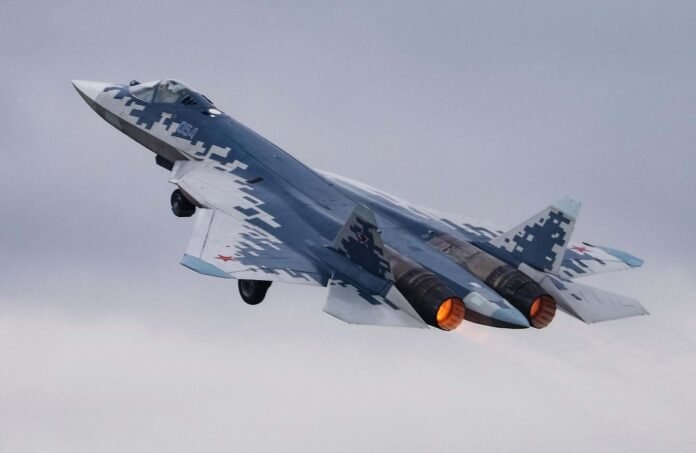
India has closed the door on a deal Moscow spent more than a decade trying to close. The Defence Ministry has confirmed that the country is not pursuing new Sukhoi variants — a statement that, without ever naming the aircraft, ruled out the Su-57. Instead, the Indian Air Force will modernise 260 of its existing Su-30MKI fighters to a ‘Super Sukhoi’ standard, expand its Rafale fleet, and place its long-term bets into a fighter it intends to build itself: the Advanced Medium Combat Aircraft (AMCA).
It is a decision with a backstory, real strategic logic, and no shortage of risk.

A Partnership That Never Quite Worked
India’s relationship with the Su-57 goes back to 2010, when Hindustan Aeronautics Limited and Russia’s Rosoboronexport signed a design contract worth around $295 million to jointly develop what was then called the Fifth-Generation Fighter Aircraft (FGFA) — a derivative of Russia’s PAK FA programme. On paper, it looked like exactly the kind of partnership India wanted: co-development, shared costs, and a route to fifth-generation airpower without starting from zero.
In practice, it frayed.
Instead of spending billions in importing a foreign fifth-generation jet — with all the dependency on foreign spare parts, software updates, and political goodwill that comes with it — India is directing that capital towards the AMCA, a stealth fighter it will design, build, and own outright, with full control over future upgrades and export rights
By 2018, India had walked away, citing dissatisfaction with the jet’s stealth characteristics, its engines, its radar and sensor suite, and — most corrosively — how much of the underlying technology Russia was actually willing to hand over. Costs had climbed and timelines had slipped, but the deeper problem was trust. India wanted to be a genuine co-developer with access to source code, design data, and manufacturing know-how. Russia, according to Indian officials at the time, was willing to sell an airplane but reluctant to share the aircraft. For a country trying to build a domestic aerospace industry, that distinction mattered more than the price tag.
Russia never fully let go of the idea of India as a customer. In the years since, Moscow returned with an unusually generous package: licence production in India and access to the Su-57’s source code, which would have let the IAF integrate its own weapons and mission systems onto the jet — a level of openness Russia has rarely extended to any export customer. India still said no.

Whatever trust had eroded in the 2010s did not come back with a better offer; by the time the offer improved, India’s own programme had matured enough that it no longer needed to say yes.
Aatmanirbharta is the Key
The logic behind India’s decision rests on a single word New Delhi uses constantly in defence policy: Aatmanirbharta, or self-reliance. Rather than spending billions in importing a foreign fifth-generation jet — with all the dependency on foreign spare parts, software updates, and political goodwill that comes with it — India is directing that capital towards the AMCA, a stealth fighter it will design, build, and own outright, with full control over future upgrades and export rights.

The near-term plan fills the gap in the meantime. The Super Sukhoi upgrade will bring around 260 Su-30MKIs up to a 4.5-generation standard with indigenous AESA radar and extended-range precision weapons, including BRAHMOS integration that was validated operationally during Operation Sindoor in May 2025.
Russia’s defence industry remains under sweeping Western sanctions, which constrain production throughput and complicate financing and spare-parts logistics for any customer. Reducing reliance on Russian hardware lowers India’s exposure to a supply chain under geopolitical strain
In parallel, India is pushing forward the long-running MRFA deal for up to 114 additional Rafales. The message is consistent: buy proven, licence-built, or friendly-partnered hardware for the near term, and build the true leap-ahead capability domestically rather than renting it.
The Case for Going Solo
Full control over technology and upgrades. The No.1 advantage is sovereignty. A domestically owned design means India isn’t at the mercy of a foreign supplier’s whims to release source code, integrate new weapons, or approve upgrades — the exact friction that killed the FGFA partnership.
Export potential. A fighter India owns outright is a fighter India can sell. Russia’s export struggles with the Su-57 — which has only landed one confirmed buyer, Algeria — are a live demonstration of how hard it is to sell someone else’s jet on the world stage when export approval runs through a foreign capital.
Industrial base building. The AMCA programme is intentionally structured to grow India’s aerospace ecosystem — private-sector participation, domestic radar and avionics development, and now a genuine indigenous engine effort — rather than simply assembling foreign-designed kits.
Avoiding sanctions exposure. Russia’s defence industry remains under sweeping Western sanctions, which constrain production throughput and complicate financing and spare-parts logistics for any customer. Reducing reliance on Russian hardware lowers India’s exposure to a supply chain under geopolitical strain.
The Pitfalls
Timeline risk. This is the sharpest edge of the bet. AMCA prototypes are reportedly targeted for flight testing around 2028, with operational induction likely deferred well into the 2030s. That creates a real capability gap: regional rivals are already fielding or advancing fifth-generation fighters, and India’s stealth window will not open for years. The Super Sukhoi upgrade is meant to bridge that gap, but a heavily upgraded fourth-generation airframe is not a substitute for genuine low-observable capability.
Cost and schedule overrun risk. Indigenous programmes, including India’s own Tejas, have a track record of delays and budget growth. A ‘clean sheet’ fifth-generation fighter is an order of magnitude harder than anything HAL or DRDO have built before, and there is no guarantee the AMCA avoids the same fate.
The engine problem. This is the historical Achilles’ heel of Indian fighter programmes. India’s indigenous Kaveri engine effort, dating back decades, never produced a powerplant capable of powering a frontline fighter — a major reason the Tejas and other programmes have relied on imported engines. AMCA Mk1 prototypes will fly on GE F414-INS6 engines from the United States, an interim solution while India works towards propulsion independence.
Does India Have the Engineering Capability?
This is the open question, and the honest answer is: partially, and increasingly so, but not yet completely on its own.
GE’s F414-INS6 engine will power the initial AMCA Mk1 prototypes and early squadrons, under a deal that includes a substantial technology transfer to HAL, though the exact scope has reportedly been a sticking point in negotiations
India has real strengths — DRDO’s Aeronautical Development Agency and HAL have decades of airframe design experience from the Tejas programme, a functioning (if still developing) radar and avionics industry, and a metallurgical research base that has made genuine progress on single-crystal turbine blade technology, a critical bottleneck for high-thrust engines. The AMCA’s structural design, stealth shaping, and systems integration work is being led domestically, with expanded private-sector participation intended to speed development beyond HAL’s traditional pace.
But the hardest parts of a fifth-generation fighter — a high-thrust, stealth-compatible engine capable of super cruise, advanced sensor fusion, and low-observable materials science — are areas where India has historically needed outside help, and continues to.
For those not in the loop, advanced sensor fusion combines data from dozens of temperature, pressure, speed, and vibration sensors. This blended data creates a precise, real-time picture of engine health and performance, allowing the computer to adjust fuel flow and safely optimise thrust.
Help from France and the US
Rather than leaning on Russia, India has split its foreign partnerships strategically between France and the United States, largely around the engine — the single hardest technical problem in the programme.
The United States (GE Aerospace): GE’s F414-INS6 engine will power the initial AMCA Mk1 prototypes and early squadrons, under a deal that includes a substantial technology transfer to HAL, though the exact scope has reportedly been a sticking point in negotiations.
France (Safran): For the long term, India has struck a roughly $7 billion co-development agreement with Safran to jointly design a new 120-140 kN-class turbofan engine for the definitive AMCA Mk2, under India’s DRDO/GTRE. Unlike the GE arrangement, this is structured as a genuine clean-sheet co-development with a reported 100% technology transfer, including access to the hot engine core and single-crystal blade manufacturing — the exact category of know-how Russia was reluctant to share over the Su-57. India would retain the intellectual property, giving it control over future upgrades and exports.
India has struck a $7 billion co-development agreement with Safran to jointly design a new 120-140 kN-class turbofan engine for the definitive AMCA Mk2, under India’s DRDO/GTRE. Unlike the GE arrangement, this is structured as a genuine clean-sheet co-development with a reported 100% technology transfer
In effect, India appears to have learned the lesson of the failed Su-57 partnership and applied it in reverse: rather than one partner offering an aircraft with limited technology sharing, India is now running parallel partnerships — an off-the-shelf US engine for speed, and a deeper French co-development for sovereignty — while keeping design authority over the airframe itself.
The Bottom Line
India’s rejection of the Su-57 isn’t really a story about one aircraft. It’s a story about a country that tried genuine co-development with Russia, didn’t get the technology access it wanted, and has since decided that owning a slower, harder, riskier path is preferable to renting someone else’s stealth fighter — however good the final offer got.
Whether that bet pays off depends less on the July 2026 announcement than on whether the AMCA, its French-partnered engine, and India’s broader aerospace industry can deliver on a timeline that doesn’t leave the IAF exposed in the meantime. For Russia, the loss is close to final: with Algeria its only confirmed Su-57 customer, India’s decision leaves the jet with almost no path to a major export success.

The writer is a defence journalist specialising in military affairs, security policy and defence technology. He reports extensively on operation strategies, defence manufacturing initiatives and geopolitical developments across the Indo-Pacific region. The views expressed are personal and do not necessarily carry the views of Raksha Anirveda





