


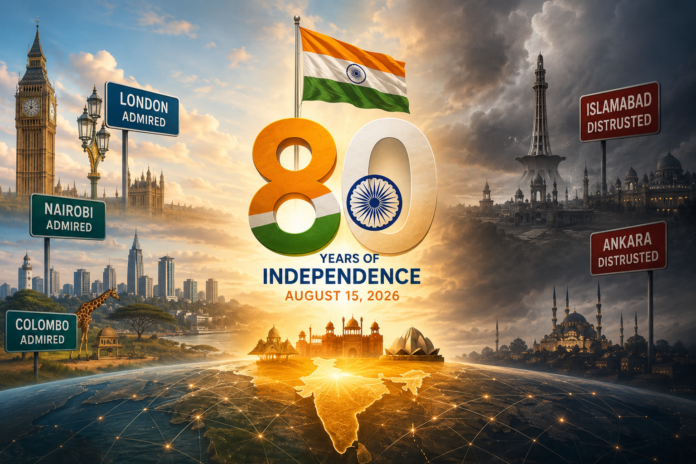
Eighty years ago, on August 15, 1947, India woke up to a freedom it had to build almost from scratch – a fractured economy, a freshly drawn and bloody border, and a place in the world order that barely existed. On the eve of its 80th Independence Day this year, a new Pew Research Center survey offers an unusually candid mirror of where that nation stands today: not universally admired, not universally distrusted, but caught in one of the more fascinating global-image splits of any major power currently measured.
The headline numbers tell the story of a country whose reputation has become more contested, not less. A median of 45% across 36 countries hold a favourable view of India, against 41% unfavourable – a gap of just four points, considerably tighter than the comfortable double-digit cushion India enjoyed in Pew’s 2023 survey of 23 countries. India, in other words, has not fallen out of favor globally so much as it has become more polarising – a country people increasingly feel strongly about, in both directions.

On the eve of its 80th Independence Day, India finds its global image as divided as ever: a median of 45% of people across 36 countries view it favourably, against 41% unfavourably – a gap that has narrowed sharply since 2023
A Neighbourhood of Extremes
Nowhere is that split starker than among India’s own neighbours, exactly the audience whose opinion should, in theory, matter most on an anniversary defined by the birth of a nation-state and its borders. Sri Lankan favourability toward India has surged to 79%, up 14 points since 2024 and the highest rating recorded anywhere in the 36-country study. Nearly two-thirds of Sri Lankans (63%) name India their most important ally, and 70% express confidence in Prime Minister Narendra Modi’s handling of world affairs.
Barely a thousand kilometres away, the picture inverts completely. Only 7% of Pakistanis view India favourably, with a crushing 91% holding an unfavourable opinion – among the most lopsided readings anywhere in the survey. Pakistanis and Bangladeshis alike name India as their country’s single greatest threat, not merely a rival; Indians return the sentiment in kind, most often naming Pakistan as their own top security concern, with favourable Indian views of Pakistan sinking to among the lowest levels Pew has ever recorded.
Sri Lanka’s favourability toward India has hit 79%, the highest ever recorded, while just 7% of Pakistanis feel the same – the starkest neighbour-to-neighbour divide Pew has measured
Bangladesh supplies the survey’s sharpest swing of all. Favourability toward India there fell 15 points since 2024, down to 42%, coinciding with turbulent domestic politics in Dhaka and a broader regional recalibration – Bangladeshi warmth toward Pakistan simultaneously jumped from 40% to 54% over the same period, suggesting a genuine reshuffling of regional loyalties rather than India-specific disillusionment alone.
Washington’s Cooling, Europe’s Warming
Farther from South Asia, opinion follows a different, more partisan logic. The US favourability toward India has slipped to 45%, with 50% now unfavourable – the weakest showing since Pew began tracking the relationship in 2008, extending a decline that began after a 2023 high of 51%. The erosion runs along generational and party lines: just 42% of Americans aged 18-29 view India favourably compared with 50% of those 65 and older, while Democrats (50% favourable) run notably warmer than Republicans (42%).

Europe, by contrast, has been warming. The United Kingdom (71% favourable), Germany (63%) and Israel (60%) all rate India strongly, with British and German favourability climbing 11 and 6 points respectively just since 2025. Germany’s shift is part of a longer arc – from 47% favourable in 2023 to 63% today – a reminder that goodwill, once lost, can also be rebuilt.
American opinion has flipped, with 50% of US adults now viewing India unfavourably versus 45% favourably – the weakest reading since Pew began tracking the relationship in 2008
Eighty Years of Hard Power
What the Pew numbers don’t fully capture is the quieter, harder story running alongside India’s soft-power fluctuations: its transformation, over eight decades, from a newly partitioned, militarily improvised state into one of the world’s most consequential defence powers. India entered independence in 1947 with barely any indigenous arms industry and a military built largely on colonial-era inheritance. It now sits among the top four militaries in the world by most rankings, and the Lowy Institute’s Asia Power Index rates it the third-largest defence power on the continent, trailing only the United States and China.

That rise has been deliberate rather than accidental. India tested its first nuclear device in 1974 and has since built a credible nuclear triad, with an estimated arsenal now approaching 190 warheads and a naval leg – anchored by nuclear-powered ballistic missile submarines such as INS Aridhaman, commissioned in 2026 – that guarantees second-strike capability. On the conventional side, the “Aatmanirbhar Bharat” and “Make in India” defence pushes have driven a structural shift from being one of the world’s largest arms importers toward becoming a genuine manufacturer and exporter.
Defence exports have climbed toward ₹30,000 crore annually, reaching over 100 countries, while capital expenditure on military modernisation has more than doubled in a decade, and industrial licences in the sector have more than tripled since 2015. Operation Sindoor, showcasing indigenous weapons and anti-drone systems, became a recent proof point of that self-reliance for a domestic and international audience alike.
Yet, global perception hasn’t caught up uniformly with hard power – a reminder that strategic muscle and soft-power appeal don’t always move in the same direction
Strategically, India has also worked to diversify its alignments rather than lock into a single bloc – holding membership in the Quad alongside the US, Japan and Australia, while simultaneously participating in the Shanghai Cooperation Organisation (SCO) and BRICS alongside China and Russia. That balancing act, itself a reflection of India’s post-1947 doctrine of strategic autonomy, helps explain why global favourability doesn’t track cleanly with military or economic weight: a country hedging between blocs will inevitably draw mixed reviews from partisans of each.
Power Without a Settled Image
Eighty years on, that is perhaps the truest takeaway of this year’s survey: India has become powerful enough, and consequential enough, to be judged intensely rather than mildly – loved where it is seen as a security guarantor, resented where it is seen as a threat, and increasingly filtered through the domestic political lens of countries as distant as the United States.
Ten countries recorded statistically significant shifts in their view of India this year alone, and seven moved downward – proof that even eight decades of accumulating military, economic and diplomatic weight has not bought India a fixed place in the world’s imagination. It has bought it, instead, the more complicated privilege of mattering enough to be argued about.
Source: Pew Research Center, Spring 2026 Global Attitudes Survey, conducted Feb. 9-May 13, 2026, among 42,092 respondents across 36 countries, alongside Pew’s companion South Asia regional survey; additional defence and strategic data from SIPRI Yearbook 2026 and the Lowy Institute Asia Power Index.

-The writer is a New Delhi-based senior commentator on international and strategic affairs, environmental issues, an interfaith practitioner, and a media consultant. The views expressed are personal and do not necessarily carry the views of Raksha Anirveda





