


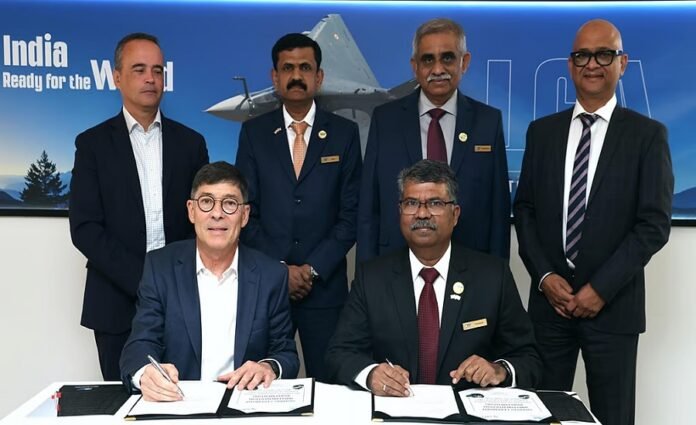
On July 25, 2026, Hindustan Aeronautics Limited and Safran signed a deal to manufacture components for the LEAP engine on Indian soil. The move, which happened without much fanfare, represents something the Security and Defence Partnership’s grand January unveiling did not: real cooperation with Europe tends to happen bilaterally, not through a single Brussels-issued cheque.
When India and the European Union signed their first-ever Security and Defence Partnership (SDP) on January 27, 2026, the rhetoric being emitted from Brussels suggested a stronger political commitment than in previous years. Structuring cooperation across maritime security, cyber, space and defence-industrial ties, the agreement was billed as a new chapter in the relationship, arriving in the wake of a free-trade deal so ambitious it was nicknamed the ‘mother of all deals’.

For a country that has long promoted the diversification of its defence suppliers, the partnership also laid the groundwork, subject to mutual interests and the applicable legal frameworks, for participation
Subsequent reporting has tended to conflate two distinct issues: political dialogue, and access to a line of credit. In reality, they should be considered separately.
SAFE and the SDP: A Framework, Not a Fund
The SDP is, by design, an architecture for an annual Security and Defence Dialogue, negotiations on a Security of Information Agreement, and a framework for ‘industry-to-industry engagement’ that both sides will merely ‘explore’. SAFE (Security Action for Europe), by contrast, was conceived as an internal EU rearmament instrument, and analysts have already remarked that it can help provide political backing for dialogue on supply-chain resilience “without necessarily granting direct access to EU-level funding instruments that remain reserved for member states and closely associated partners.” That is a carefully worded assessment, and for good reason.
The EU-India partnership ‘risks drifting without purpose’ unless both sides replace symbolism with concrete priorities. The enthusiasm surrounding the partnership may therefore reflect not only a strategic reassessment of India’s role, but also Europe’s increasingly urgent industrial requirements
The January signature does change something, though, just not what many of the headlines implied. Under the SAFE Regulation (EU 2025/1106), a Security and Defence Partnership is the prerequisite for a third country to participate in the EU’s common procurement framework; India is now on that list. What the partnership does not do unlock funding.

The distinction is significant. Ukraine and the EEA-EFTA states are treated essentially as Member States for the proposes of SAFE. SDP partners occupy a lower tier: their companies become eligible beneficiaries only if a separate implementing agreement is subsequently concluded. This is not a theoretical distinction. In December 2025, the Member States
Even the narrower opening frequently cited in India’s case is more limited than it first appears. Article 16(10) caps non-European content at 35% of the estimated cost of an end product’s components. And where a non-European subcontractor holds between 15% and 35% of a contract, Article 16(4) tolerates it only as an exception, where the relationship predates the regulation, or the prime contractor commits to studying its replacement by a European supplier within two years. These are guardrails, not an opening of the programme.

None of this makes the SDP insignificant. A think tank close to New Delhi’s strategic establishment has described it as giving India access to the EU’s SAFE initiative. But ‘access’ in this context means a door has been left opened, not that funding is available on the other side. The distinction matters because the two concepts are often presented, in Brussels and in parts of the Indian commentariat alike, as though they were interchangeable. Over time, political dialogue may evolve into financial cooperation. On day one, however, the two are not the same.
A Convenient Rebalancing
It is also worth asking who stands to benefit most from portraying India as a newly courted defence partner. European defence manufacturers are
The export control hurdle: One analysis of strategic autonomy argues that any meaningful partnership will require European export-control practices to be reconciled with India’s own export ambitions, rather than expecting New Delhi simply to adapt
India, with its growing industrial base and increasingly ambitious defence export strategy, especially in missiles and drones, is an obvious partner. A EUISS brief has been equally candid, warning that despite polished summits and ambitious rhetoric, the EU-India partnership ‘risks drifting without purpose’ unless both sides replace symbolism with concrete priorities. The enthusiasm surrounding the partnership may therefore reflect not only a strategic reassessment of India’s role, but also Europe’s increasingly urgent industrial requirements.
That industrial logic is precisely why announcements
The Fine Print Brussels Skips
Three obstacles lie beneath the surface of the January announcement. The first is export control. Any transfer of EU defence technology is accompanied by restrictions on re-export, an uncomfortable fit with India’s ambition to market indigenous systems, from the Akash, and Kusha air-
The second is the unresolved Russian question. Several European capitals remain privately cautious about India’s continued reliance on Russian equipment, a concern that reportedly contributes to reluctance over sharing the most sensitive technologies, particularly in areas such as missile defence, advanced air systems and naval capabilities. The SDP’s language about shared interests does little to resolve that underlying hesitation. It is rarely expressed as a formal prohibition, but it nevertheless shapes the scope of negotiations.
Several European capitals remain privately cautious about India’s continued reliance on Russian equipment, a concern that reportedly contributes to reluctance over sharing the most sensitive technologies, particularly in areas such as missile defence, advanced air systems and naval capabilities
The third is conceptual. ‘Strategic autonomy’ means different things in New Delhi and Brussels. For India, it reflects a historical resistance to bloc discipline and a preference for strategic flexibility. For the EU, it has increasingly become a response to an over-reliance on Washington. A EUISS assessment captures this divergence well: India’s Viksit Bharat 2047 development ambition anchors autonomy as a broader national development logic, whereas Europe’s
The Bilateral Yardstick: A Standard Already Set in Paris
In this context, it is instructive to compare
Germany can make a similar case at sea. TKMS is the inheritor of the HDW yard that helped build India’s first submarines at Mazagon Dock in the early 1990s under technology transfer, and it is now pursuing Project 75(I), an approximately €8–9 billion programme for six boats to be built in Mumbai. Its bid rests on a fuel-cell propulsion system and an industrial offer, competitors have struggled to match. In both cases, European capitals are offering defined capabilities through bilateral contracts
The sensible position is neither to dismiss the SDP nor to overstate its immediate significance. It is a door worth opening carefully, with the negotiating leverage that comes from already having dependable partners, whose commitments have been tested contract by contract
When India and France elevated their ties to a Special Global Strategic Partnership in February 2026, the agenda reportedly extended to the possible co-development of a sixth-generation fighter and preliminary discussions on nuclear-powered submarines. Such ambitions go well beyond anything SAFE currently offers a non-member state. One assessment of the visit observed that the real test would lie in implementation. The same standard should be applied to the EU-level partnership rather than judging it by the warmth of the January press conference.
This is not an argument against engaging with Brussels. It is an argument for treating the SDP as what it is: a political scaffold that may gradually acquire genuine industrial substance, but which currently provides far less certainty than India’s most mature bilateral defence
The sensible position, therefore, is neither to dismiss the SDP nor to overstate its immediate significance. It is a door worth opening carefully, with the negotiating leverage that comes from already having dependable partners, whose commitments have been tested contract by contract.

–The writer is a defence and security industry consultant with varied experience of working with medium and large companies majorly in European market. The views expressed are of the writer and do not necessarily reflect the views of Raksha Anirveda





