


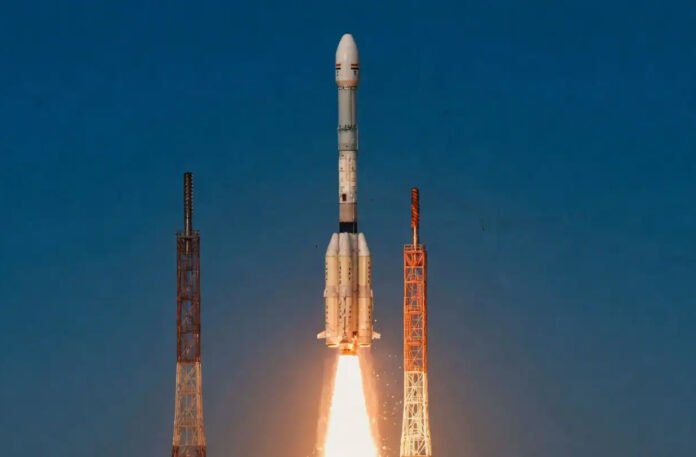
New Delhi: Two strategically important satellites, NVS-03 and GISAT-1A, have been waiting at India’s spaceport in Sriharikota for weeks, with their launches stalled due to the absence of government approval, media reports said. Alongside them, a GSLV MK-2 rocket stands in readiness, its propellant filling halted midway after clearance failed to materialise.
This situation has raised concerns within the Indian Space Research Organisation (ISRO), which has already endured a difficult period following consecutive failures of its PSLV missions. The delay comes against the backdrop of unresolved questions surrounding the failures of PSLV-C61 in May 2025 and PSLV-C62 in January 2026. Both missions suffered anomalies in the third stage, with ISRO attributing one to a “pressure drop” and the other to a disruption during stage operation.

Yet, beyond these brief explanations, neither the Department of Space nor the government has released detailed reports, leaving the scientific community unsettled.
NVS-03, the next satellite in India’s second-generation NavIC navigation constellation, has completed pre-launch preparations and is ready for flight. Its deployment is critical, as the NavIC system has been rendered ineffective with only three functional satellites.
Even the government recently admitted that the programme has failed to deliver navigation services due to the lack of operational spacecraft. The launch of NVS-03 is therefore seen as a vital step in reviving India’s indigenous navigation capability.
GISAT-1A, designated EOS-05, is equally significant. It is the replacement for GISAT-1, India’s first geostationary Earth observation satellite, which was lost in August 2021 when the cryogenic upper stage of GSLV-F10 failed to ignite.

The new spacecraft is designed to provide near real-time imaging of the Indian subcontinent, supporting disaster management, agriculture, forestry, environmental monitoring, and national security. Its repeated delays have already hindered India’s ability to maintain a robust Earth observation programme.
The government’s caution has extended beyond PSLV missions, affecting GSLV and LVM-3 launches as well. This has puzzled insiders, who argue that the issues identified so far are specific to PSLV’s third stage and do not directly impact other launch vehicles. One official likened the situation to being told not to drive a car because a motorbike had malfunctioned, pointing out that GSLV and LVM-3 share no components with PSLV’s problematic stage.

The broader context includes ISRO’s investigation into the NVS-02 anomaly in January 2025. Partial findings revealed that the spacecraft failed to reach its intended orbit because a drive signal never reached the pyro valve in the oxidiser line during orbit-raising manoeuvres. Corrective measures were subsequently implemented and validated during the CMS-03 mission aboard LVM-3 in November 2025. Despite these assurances, the government has maintained a cautious stance, keeping all launches on hold.
The delay has compounded morale issues within the Department of Space. Officials have expressed frustration at the lack of clarity, noting that hardware, satellites, and rockets are ready but remain grounded. The absence of launch activity has slowed India’s space programme across vehicle families, undermining confidence in ISRO’s operational tempo.
The strategic importance of both NVS-03 and GISAT-1A makes the delay particularly consequential. NavIC’s revival is essential for India’s navigation independence, while GISAT-1A’s imaging capabilities are critical for national security and disaster response. With the satellites and launch vehicles prepared, the bottleneck lies solely in government authorisation, leaving India’s next missions in limbo.






