


The war in Iran is now in its sixth month and there are no signs of it ending soon. The past 175 days have brought about unprecedented crises in the region and its effects are being felt across the globe.
Despite overwhelming military superiority of the US and Israel, Iran has not been defeated yet, and is instead calling the shots on how this war can end. The US and President Trump are looking at an early exit from the war without looking defeated or compromised but Iran is not relenting.

A war which started based on the threat posed by Iran’s nuclear programme and ballistic missiles inventory, has finally boiled down to one simple deciding factor, the opening of Strait of Hormuz.
Caught in the cross-fire is the entire Gulf region which has borne the wrath of Iran’s missile and drone barrage and have found that the American security umbrella, for which they had invested billions of dollars over the past three decades has proven grossly insufficient.
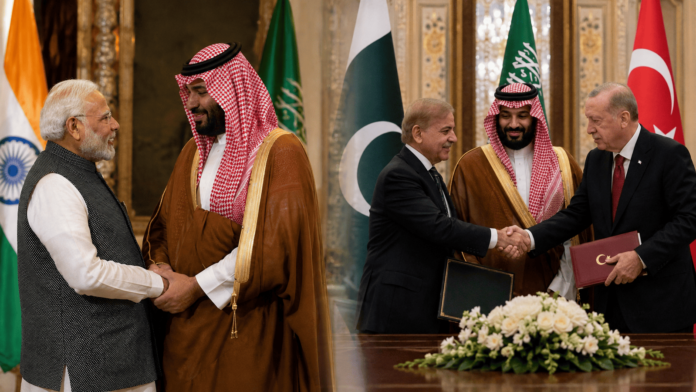
As the war has progressed, talk on forging alternate security arrangements have gathered pace within and outside the region. One such arrangement, the ‘Mecca Pact’ was announced in the holy city of Mecca on August 7th with Saudi Arabia, Pakistan and Turkey signing a joint defence pact.
As per the signing statement, the pact aims to strengthen collective security and collective deterrence against any act of external aggression. Interestingly, it also stipulates that any armed attack against anyone of the three states will be regarded as an attack against all, a typical NATO, Article 5 type of provision.

Egypt, which had been part of the discussion with the three countries on the pact, over the past few months for a possible security arrangement, was surprisingly missing from the pact.
The announcement of the pact has led to a flurry of commentaries and analyses with many even coining it an ‘Islamic NATO’. Going beyond the text, the pact poses many interesting questions. Why now? Why is there a NATO Article 5 type of provision in it? Who is it targeted against? And most importantly from an Indian perspective, how does it impact us?

Interestingly, India’s National Security Adviser, Ajit Doval had recently visited Saudi Arabia on July 20th and held talks with the Saudi leadership on regional security. Did the Saudis inform Doval of the possibility of the Mecca Pact being finalised or was India kept in the dark, too is a question to ponder.
Rising from the ashes of the stalling Iran conflict, the Mecca Pact signals a pivotal shift as Gulf powers actively abandon sole reliance on US security guarantees to seek regional deterrence
Why Now
The pact has been announced at a very critical inflection point in the Iran war. While the direct conflict between the US and Iran is at a stalemate, the geography of the conflict is expanding steadily.
With the Houthis joining the war, two things have happened. The free flow of trade and traffic across the Red Sea and Bab-al Mandeb has been disrupted, especially of ships carrying goods from Saudi Arabia.
This is not only a big blow to Saudi Arabia’s strategy of diversifying supply of petroleum products beyond the Strait of Hormuz but can, in the longer run, be disruptive to global energy security too.
Secondly, the targeted strikes on Saudi pipelines and energy infrastructure has meant that Saudi Arabia finds itself in the thick of the war and is forced to respond and strategise.
Plus, the stagnating war in Iran and the continuing blockade of Strait of Hormuz means that kinetic options remain on the table, both for the US as well as Iran.
Featuring a NATO-style Article 5 mutual defence provision, the alliance legally binds its members to treat an attack on one state as an attack on all – substantially elevating regional escalation risks
Announcement of this pact has therefore clearly sent signals that the region is looking beyond the US. It has also shifted the entire narrative from the war to this new security arrangement, something that the US would welcome. Therefore, it is very likely that the timing, the choice of three partners and the content of the pact may well have had a backhand US support.
The ‘All for One’ Approach
The insertion of the ‘all for one’ clause is interesting although it is not unique. Just last year when Saudi Arabia and Pakistan signed a Mutual Defence Agreement with Pakistan on September 17th, aspects like “joint deterrence against any aggression” and “any aggression against either country shall be considered an aggression against both” were included.
Did it however lead to Pakistan coming to the rescue of Saudi Arabia directly during the current war in Iran? Will the clause in the current pact lead to either of the partner nations getting involved directly in fighting a war alongside others? How does it work when the pact does not have a defined adversary or an enemy? There are no definitive assurances or answers to either of them.
Also, the comparisons with NATO merely based on one clause look premature and out of place.
Firstly, for a NATO type of military alliance, many more countries will require to join in. They will have to define a primary adversary or enemy against whom it is based.
In the execution of the alliance, a formal HQ, a commitment of troops, a possibility of a Rapid Deployment Force and common military bases will be needed to be identified along with cross-posting of officers and troops.
The pact fuses Saudi Arabia’s massive financial power with Turkey’s advanced defence industry and Pakistan’s nuclear-backed manpower, creating a potent military trilateral
All these may still come about as the pact evolves and matures, and perhaps then there may be justifiable comparisons with NATO. This possibility therefore brings the India question into the discussion.
The India Factor
The Mecca Pact is not something new or revolutionary nor is it the first one involving Pakistan. Just a few months after being defeated by India during Operation Sindoor in May 2025, Pakistan had entered into a bilateral defence pact with Saudi Arabia.
At that point of time too, Saudi Arabia had allayed concerns in India that there will be no consequences of it on India’s security. This time too, the Mecca Pact countries have stated that it is not directed against any nation in particular.
But the levels of cooperation and military interoperability may evolve over time, based on how the strategic landscape changes in the region after the war in Iran. However, what is clear is that it is a military alliance which includes India’s key adversary and neighbour, Pakistan, and therefore, in effect, the military alliance is knocking at the doorsteps of India.
What is also of concern is the fact that among the three nations in the pact, what Saudi Arabia brings to the table is its huge financial resources along with Turkey’s expertise in defence technology and a well-oiled defence industry. Pakistan brings its huge military resources and nuclear weapons (as the X factor).
For Pakistan, which has often faced humiliation at the hands of India in military conflicts, this pact offers opportunities like never before. With Turkey’s defence industry churning out modern weapon platforms like drones, fifth generation fighter aircrafts etc and Saudi Arabia pumping in money, Pakistan will have the opportunity to rapidly build capabilities both in numbers and modern technology.
Despite Saudi assurances, Pakistan is poised to leverage Turkish tech and Gulf capital to rapidly modernise its military, creating inadvertent yet grave security consequences for New Delhi
The fact that all three nations are predominantly equipped by NATO weapon platforms, makes interoperability and cross-utilisation across borders easy.
This brings the factor of intended and unintended consequences of the pact to the forefront. Turkey has demonstrated during Operation Sindoor that it will be willing to support Pakistan in any conflict against India.
With Saudi Arabia however, it could be a case of unintended consequences. Even though Saudi Arabia looks towards India as a key strategic partner in the region and has clearly stated that the pact does not have an ‘anti-India’ look, how much it will be able to control how its money is spent by Pakistan in developing its military capabilities and how these are brought to bear upon India in a future conflict, is something that Saudi Arabia will be in no position to control when a conflict breaks out.
Coupled with it is the fact how closely the interests of the US and Pakistan have got aligned in Trump 2.0, especially Trump’s personal relationship with Pakistan’s Field Marshal Munir.
China’s military assistance to Pakistan both in terms of hard equipment as well as intelligence and satellites is well known too. Cumulatively, it therefore develops into a scenario which Pakistan can easily exploit.
Overall, the Mecca Pact may have had its origins in the insecurity generated due to the US security guarantees failing in the Gulf region, but its geographical reach has brought the war to India’s borders.
To safeguard its borders, India must move beyond passive monitoring by accelerating defence self-reliance, maintaining absolute counter-terror deterrence and establishing a strategic footprint in the region
With two of the three countries in the pact willing to undertake military risks against India, the pact may well result in many direct and indirect security consequences for India.
India can no longer say that it is ‘monitoring the situation’ but it will have to take proactive steps to safeguard its security interests with key nations in the region with whom it has invested immense diplomatic capital over the past two decades and built strategic partnerships.
Simultaneously, India also needs to proactively strengthen its military preparedness, promote self-reliance in defence production and rope-in private industry for more technological innovation, all aimed to build multi-layered defensive and offensive capabilities.
Its policy of ‘zero tolerance to terror’ needs to be pursued proactively too. There cannot be another Pahalgam type terror attack leading to another Operation Sindoor.
Instead, any potential terror threat has to be taken out before it manifests into the Indian territory. Also, India should explore the feasibility of a physical presence of some of its military assets in some form in the region. It should be an option on the table for India, even if it is as a confidence building measure, rather than as an instrument of power projection.

The writer is a Senior Research Consultant at CRF, Delhi and author of “Between Tehran and Tel Aviv-Gaza's Story of Unending War”. The views expressed are personal and do not necessarily carry the views of Raksha Anirveda





