


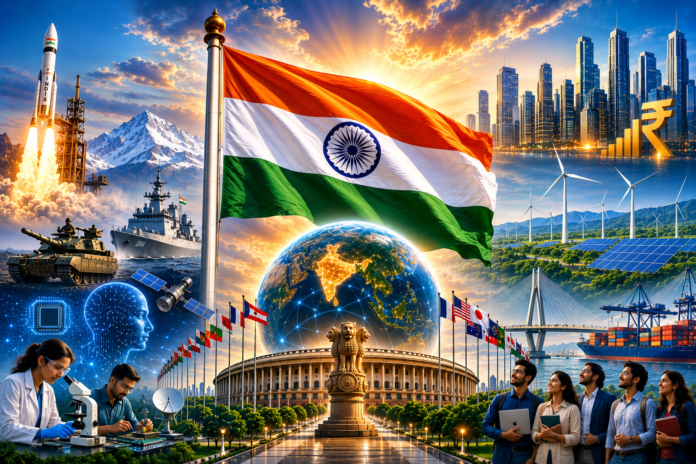
There is a particular kind of confidence that comes only from being tested. India in 2026 carries that confidence. For decades, the world described India in the future tense: an emerging market, a rising power, a country to watch. That language is now outdated. The last decade is the hinge on which that shift turned: a decade of infrastructure laid, institutions built, and hard choices made across the domains that determine whether a nation merely grows or actually leads.
The Economic Foundation
Every serious power in history has first had to answer a basic question: can it feed, house, and employ its own people while still building for the future? India spent this decade answering that question in the affirmative, becoming the fastest-growing major economy in the world through a pandemic, a global energy shock, and a war in Europe that disrupted supply chains worldwide.

What changed was not just the growth rate but the architecture beneath it. The Goods and Services Tax gave India one internal market instead of twenty-nine fragmented ones. The Insolvency and Bankruptcy Code taught Indian capitalism that failure has consequences, which is what allows success to be rewarded. Digital public infrastructure, built on Aadhaar and UPI, brought hundreds of millions of citizens who had never touched a bank into the formal financial system, instantly and almost for free. UPI alone now processes more transactions each month than several G7 economies combined process in a year.
Manufacturing, long India’s weak flank, began to change. Production-linked incentive schemes drew global electronics and semiconductor assembly into Indian factories, making India the second-largest mobile phone manufacturer on earth. Highways, ports, and an ambitious railway upgrade cut logistics costs that had quietly burdened business for generations. At the same time, investment diversified into renewable energy and clean mobility, sectors where India is building depth rather than simply assembling what others design.
None of this means the job is done. Unemployment among educated youth remains a concern, agriculture needs deeper reform, and India must continue climbing the value chain rather than settling for assembly work alone. But the direction is set. India is no longer a market that global business merely visits. It is a market that global business needs.
Every serious power in history has first had to answer a basic question: can it feed, house, and employ its own people while still building for the future? India spent this decade answering that question in the affirmative, becoming the fastest-growing major economy in the world through a pandemic, a global energy shock, and a war in Europe that disrupted supply chains worldwide
The Technology Leap
If economics is a nation’s body, technology has become its nervous system. Rather than importing digital transformation, India built its own model and exported it. The India Stack, with its identity, payments, and data layers, is now studied and adapted across Africa, Southeast Asia, and Latin America. This is a new kind of soft power: not films or cuisine, but code.

The decade also saw India place a serious bet on frontier science. The Chandrayaan Moon landing near the lunar south pole in 2023 made India the fourth nation to land softly on the Moon and the first to do so near that pole, at a fraction of what other space programmes would spend. Alongside this, India has pushed hard into semiconductor fabrication, committing to build the chip plants its economy will need rather than remaining dependent on others for the components that run modern life.
Artificial intelligence has become the next arena, and India’s approach has been distinct. Instead of chasing headline models alone, the national AI mission has focused on compute access, language models for Indian languages, and applications in agriculture, health, and governance that touch ordinary lives. A farmer receiving weather advisories in his own dialect is less of a headline than a chatbot breakthrough, but it may matter more for long-term productivity. In India’s telling, technology is a tool for inclusion at scale, which is why it has scaled.

If economics is a nation’s body, technology has become its nervous system. Rather than importing digital transformation, India built its own model and exported it. The India Stack, with its identity, payments, and data layers, is now studied and adapted across Africa, Southeast Asia, and Latin America. This is a new kind of soft power: not films or cuisine, but code
A country that controls its own digital rails and builds its own chips cannot be quietly switched off by a foreign supplier. In an era when technology and national security are almost indistinguishable, that self-reliance is basic prudence, not a nationalist flourish.
The Diplomatic Repositioning
Perhaps the most quietly radical shift has been in how India carries itself abroad. For much of its post-independence history, Indian foreign policy was defined by careful non-alignment, a reasonable stance for a young and vulnerable state. That caution has given way to multi-alignment. India today can host a Quad summit with the United States, Japan, and Australia, continue buying discounted energy from Russia, deepen trade with the European Union, and lead the Global South’s demand for a fairer voice in the international system, none of which is seen as contradictory.
India’s Presidency of the G20 in 2023 made this posture clear. It used the platform to propose the African Union as a permanent member and to push global debt relief and climate finance onto the agenda, using language the developing world recognised as its own. That was diplomacy as advocacy, not just protocol.
India has also stopped apologising for defending its interests, whether on trade terms, data sovereignty, or its right to an independent energy policy. Its expanding naval presence across the Indian Ocean and its role in disaster relief for smaller nations reinforce one message: India intends to be a provider of regional stability, not merely a consumer of it.
This is what real power looks like. It is not about being loved by every capital. It is about being necessary to enough of them that your voice cannot be worked around.
The most quietly radical shift probably has been in how India carries itself abroad. The careful non-alignment policy has given way to multi-alignment. India today can host a Quad summit with the US, Japan, and Australia, simultaneously continue buying discounted energy from Russia, deepen trade with the EU, and lead the Global South’s demand for a fairer voice in the international system
The Deterrence Edge: Defence as a Guarantee of Peace
Military strength has undergone a quiet revolution of its own. India has moved from being one of the world’s largest arms importers to a credible exporter, with defence exports at record levels and indigenous platforms such as the Tejas fighter and the INS Vikrant carrier proving the country can build what it once could only buy. A functioning nuclear triad, integrated theatre commands, and rising investment in space and cyber warfare point to one doctrine: deterrence credible enough to be rarely tested. A nation builds this kind of capability not to seek conflict, but so that conflict never has to be sought against it. Operation Sindoor demonstrated India’s 21st-century military prowess. Yet Operation Sindoor was only a stand-off, four-day skirmish. India’s defence capabilities for the future require greater budgetary support and reorientation to emerging threats.
Strength at the national level means little without resilience at the citizen level. A truly Surakshit Bharat, a secure India, needs citizens who make disaster preparedness, cyber hygiene, and civic vigilance everyday habits, not after-the-fact reactions. Deterrence abroad and a security-conscious citizenry at home are two halves of the same shield. India needs a National Citizens Security Culture.
The Fourth Pillar: Youth as Nation Builders
No account of this decade is complete without reckoning with who carries it forward. India’s median age is close to twenty-nine, making it the youngest large workforce among major economies at a time when much of the developed world is ageing out of its productive years. That dividend is not automatic. It becomes national strength only when matched with usable skills, real employment, and a seat at the table rather than a place in the audience.
None of this adds up to a finished story, and no honest strategist would claim otherwise. India’s per capita income remains modest, its institutions still creak in places, unemployment among educated youth remains a concern, agriculture needs deeper reform, and the gap between ambition and administrative capacity has not fully closed. Yet the direction of travel is unmistakable and consistent
The encouraging sign is that today’s young Indians are not waiting to be handed a future. They are building one, starting companies before they finish college, entering space and semiconductor ventures once reserved for state laboratories, and using digital platforms to reach markets a previous generation could only dream of. Skilling missions, apprenticeship pipelines, and easier access to credit are slowly replacing the old assumption that a single degree determines a career. What this generation wants is opportunity that matches its ambition and a nation that treats it as a builder rather than a bystander.
The Decade Ahead
None of this adds up to a finished story, and no honest strategist would claim otherwise. India’s per capita income remains modest, its institutions still creak in places, and the gap between ambition and administrative capacity has not fully closed. Yet the direction of travel is unmistakable and consistent. A country that once needed the world’s permission to matter now shapes conversations the world cannot avoid.
As India marks another Independence Day, the honest way to view this moment is not as a celebration of arrival but as an acknowledgement of momentum. The last decade did not make India a great power by declaration. It made India a great power by construction, brick by brick, chip by chip, and treaty by treaty. The next decade’s task increasingly belongs to those still in school when this transformation began. Keep building, hand them the tools, and let the results, as they have for the past ten years, speak for themselves.

The writer, a PVSM, AVSM, VSM has had an illustrious career spanning nearly four decades. A distinguished Armoured Corps officer, he has served in various prestigious staff and command appointments including Commander Independent Armoured Brigade, ADG PP, GOC Armoured Division and GOC Strike 1. The officer retired as DG Mechanised Forces in December 2017 during which he was the architect to initiate process for reintroduction of Light Tank and Chairman on the study on C5ISR for Indian Army. Subsequently he was Consultant MoD/OFB from 2018 to 2020. He is also a reputed defence analyst, a motivational speaker and prolific writer on matters of military, defence technology and national security. The views expressed are personal and do not necessarily carry the views of Raksha Anirveda





